
Reviewed · GOLF CART TOURS
Krakow: City Sightseeing Tour Eco Electric Buggy Golf Cart
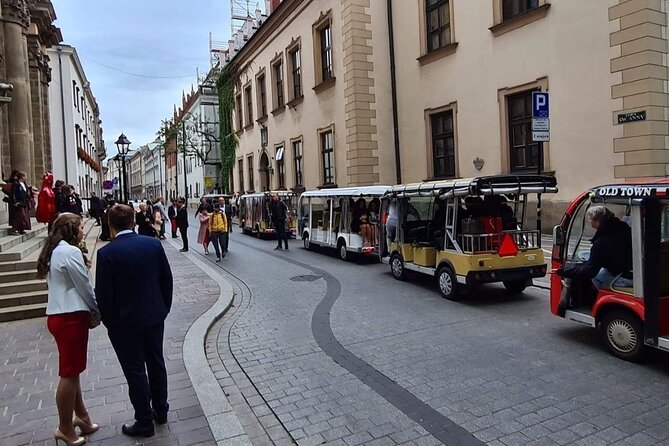
Krakow’s past comes into sharp focus on this compact electric golf cart ride, especially once you leave the postcard center for Kazimierz and Podgórze. In 90 minutes, you pass synagogues, Jewish memorials, the former ghetto, Schindler sites, and narrow streets that are easy to miss on foot. I like the warm vehicle in winter and the way guides such as Natalie, Olivia, Roch, and Radek add context beyond the recorded commentary.
I also like the tour’s practical reach. You cover more ground than you would walking, and the $13 price makes it an easy first-day orientation. The main consideration is its focus: this is strongly centered on Jewish Krakow and the ghetto, not a full tour of Wawel Castle or every major Old Town sight. Some stops are viewed from the cart, with only a few chances to get out.
Key points at a glance
- Kazimierz takes center stage: See all the major synagogues, old Jewish shops, Ciemna Street, and Wolnica Square.
- The former ghetto is treated seriously: Visit Ghetto Heroes Square, the ghetto wall, the Pharmacy Under the Eagle, and sites linked to Oskar Schindler.
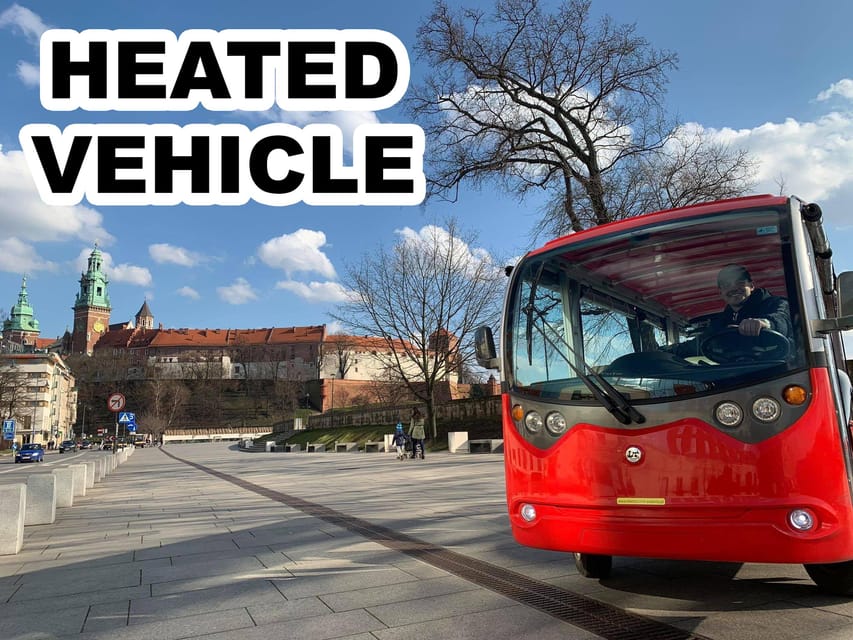
- Winter comfort is a real advantage: The cart is heated, and blankets or weather covers help in cold conditions, though some chill can enter from the open sides.
- You cover 24 listed sights in 90 minutes: This gives you a useful overview, but many places are pass-by views rather than long visits.
- Live guides improve the experience: Guides including Natalie, Olivia, Roch, and Radek have been praised for clear explanations, humor, and thoughtful answers.
- The $13 fare is easy to justify: It is inexpensive for a guided city orientation, especially if walking is difficult or your time is short.
Why this electric cart tour works as a first look at Krakow
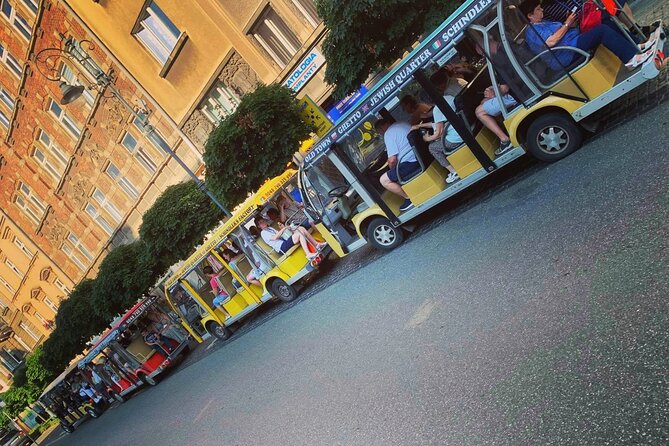
Krakow is compact in the center, but its important neighborhoods are spread across streets where a casual walk can become tiring. This tour links Planty Park, the medieval center, Kazimierz, and Podgórze without asking you to spend the whole afternoon on foot.
The cart is not a sightseeing bus with a tall view over rooftops. It is smaller and better suited to narrow streets, particularly in the Jewish Quarter. You get close to buildings, signs, courtyards, memorials, and ordinary streets that can be passed without notice if you stay on the main tourist routes.
I would book it early in your stay. The tour gives you a useful sense of direction and leaves you with a list of places to revisit properly. Several guides also give practical suggestions about what to see later, which makes the ride more useful than a simple loop with a recorded voice.
The format suits families, older visitors, and anyone who prefers to limit stairs and long walks. It also works well on a final day, when you want a short activity rather than another major museum or day trip. The 90-minute length is enough to feel substantial without taking over your schedule.
More Golf Cart Tours in Krakow
- Krakow: City Sightseeing Tour by Electric Golf Cart
★ 4.5 · 3,264 reviews - Krakow: Extended City Sightseeing Tour – Eco Buggy Golf Cart
★ 4.7 · 794 reviews - Krakow: Jewish Quarter and Ghetto Electric Golf Cart Tour
★ 4.6 · 348 reviews
Planty Park and the medieval city
The route begins with Planty Park, the green belt that circles much of Krakow’s Old Town where the medieval walls once enclosed the city. The guide uses this section to explain Krakow’s development and to place the later neighborhoods in context.
You will not receive an extended walking tour of the Main Market Square or Wawel Castle on this route. That is an important distinction. The tour presents Krakow as a connected city, but its main attention moves toward Kazimierz and Podgórze.
The cart lets you see how quickly the city changes from the central medieval area to streets shaped by Jewish life, wartime displacement, and postwar renewal. If you are unfamiliar with Krakow, this broad view is useful. If your main goal is royal Krakow, choose a Wawel-focused walking tour instead.
Kazimierz: synagogues, squares, and narrow streets
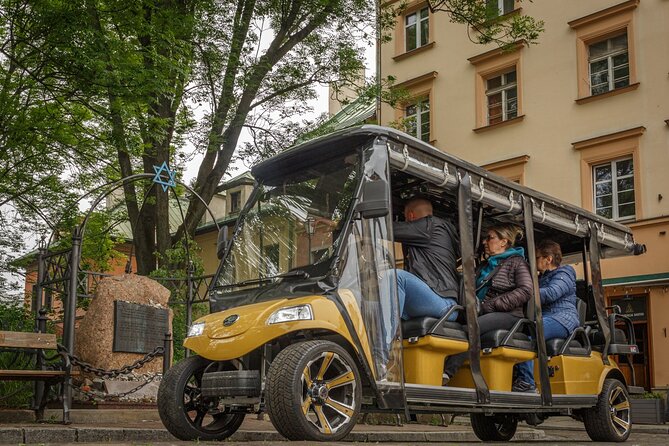
Kazimierz is the heart of the route. Once a separate town beside Krakow, it became a major center of Jewish life before the Second World War. The tour introduces that story through buildings and street layouts rather than through a single museum visit.
At Wolnica Square, you see the former Jewish City Hall and get a sense of Kazimierz as an organized community, not simply a district with attractive cafes and restored facades. The route continues to the Church of St. Catherine and Skałka Church, showing that the quarter’s identity includes both Jewish and Christian landmarks.
The synagogue sequence is the strongest part of the itinerary. You pass Tempel, Kupa, Isaac, the Old Synagogue, Popper, and Remuh. Seeing them together helps you understand the size and variety of the former Jewish community. Each building has a different setting and character, even if the short format means you will not receive a full architectural talk at every stop.
Ciemna Street and the old Jewish shops add a more intimate scale. These details matter because the story is not only about grand religious buildings. It is also about daily life, commerce, families, and the streets where people lived and worked.
You also pass the family home of Helena Rubinstein, the cosmetics entrepreneur who was born in Krakow. It is a small but memorable link between the neighborhood and a figure known around the world.
What to expect at the synagogues and churches
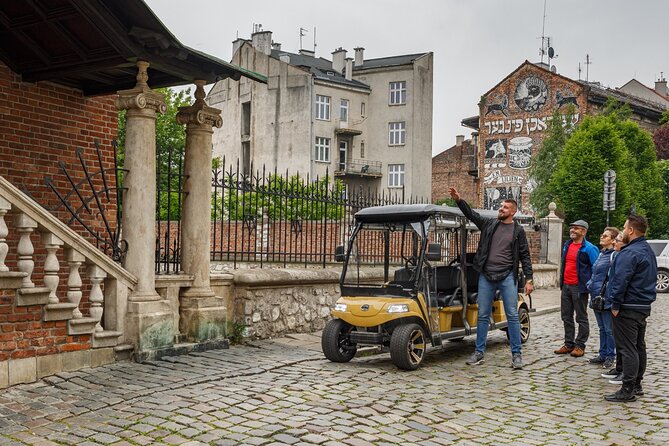
The itinerary lists all synagogues, but do not assume that you will enter each one. The cart tour is designed to show the locations and explain their importance from the street. A few tours include short opportunities to step inside selected churches, with Corpus Christi Church receiving particular praise for its interior.
That distinction affects how you plan the day. If you want detailed interiors, worship spaces, or museum displays, use this ride to mark your targets, then return on foot when opening hours allow. One useful tip is to schedule the tour earlier in the day if you hope to go inside churches afterward.
The live guide can also make a difference here. Olivia, Natalie, Roch, and other guides have been singled out for clear English, humor, and the ability to answer questions. The audio system supplies a wider choice of languages, including Spanish, Italian, German, French, Portuguese, Japanese, Korean, Arabic, Hebrew, and several others. English and Polish are available as live guide languages.
Audio equipment can have occasional technical trouble. One guide solved a problem during a tour, but you should treat the live commentary as the part worth listening to most closely. A good driver-guide can explain a detail that a standard recording skips.
Same country, a completely different kind of day:
- From Krakow: Auschwitz-Birkenau Guided Tour & Hotel Pickup
★ 4.5 · 33,358 reviews - From Krakow: Auschwitz-Birkenau Guided Tour & Hotel Pickup
★ 4.5 · 29,340 reviews - Krakow: Auschwitz Guided Tour with Optional Hotel Pickup
★ 4.5 · 15,280 reviews - Krakow–Zakopane: Cable Car, Chocholow Baths, Cheese & Vodka
★ 5.0 · 10,720 reviews
Podgórze and the former Krakow ghetto
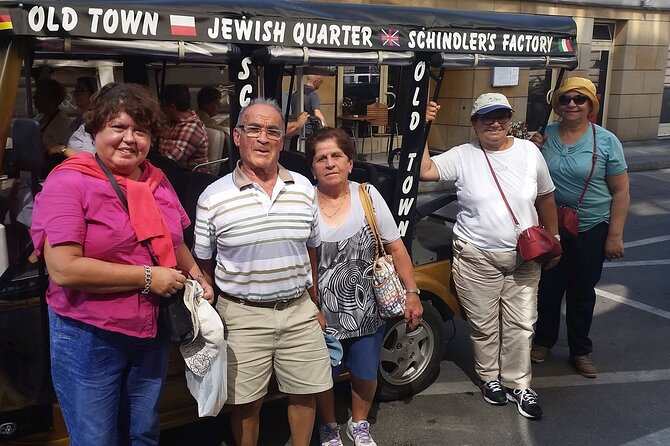
The tour becomes more solemn as it reaches Podgórze, the district where the Krakow ghetto was established during the German occupation. This section is not decorative sightseeing. It asks you to look at streets, walls, squares, and memorials through the experience of people who were forced from their homes.
At Ghetto Heroes Square, the empty chair sculptures commemorate those who were deported. The chairs are simple, but their placement across the square makes the absence impossible to ignore. The guide explains the site and the wider story of life in the ghetto.
You also see the Pharmacy Under the Eagle, associated with Tadeusz Pankiewicz. The pharmacy served as a place of aid and witness during the ghetto period, and it now helps explain the choices and risks faced by people inside the sealed district.
The route includes a remaining section of the ghetto wall and a memorial stone connected with the Nissenbaum Family Foundation. These stops can feel brief from a vehicle, but they give you fixed points to revisit. I recommend writing down the names, since the subject deserves more time than a single pass-by.
The Oskar Schindler section adds another layer. You learn about Schindler’s actions and the ghetto’s history, but this ride does not replace a visit to Schindler’s Factory Museum. If that museum is high on your list, reserve time separately. The cart tour provides orientation, not a complete museum experience.
A warm ride in cold Krakow
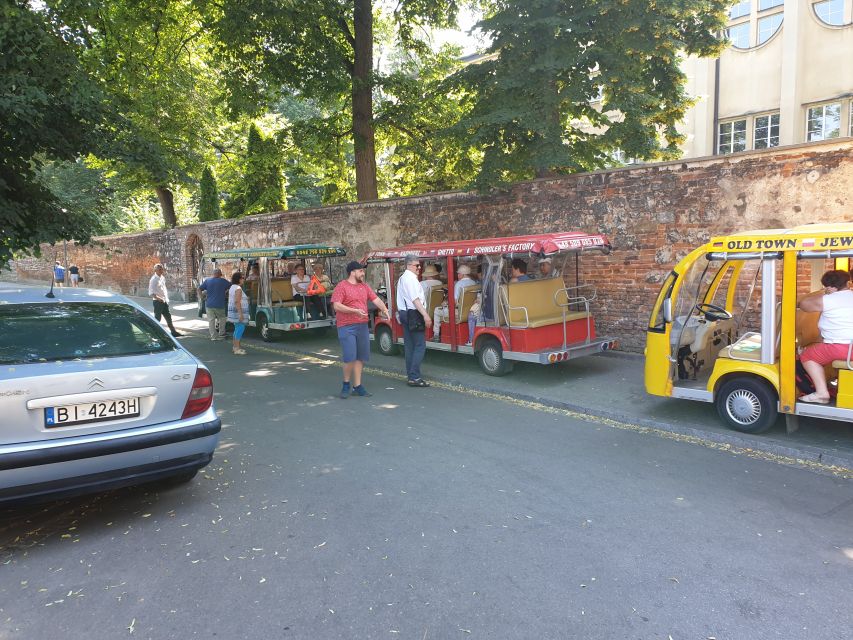
The heated cart is one of the tour’s clearest practical strengths. In winter, the vehicle has heating, weather protection, and blankets. People have taken the ride in snow and temperatures as low as minus 12 Celsius and still found it comfortable.
Comfort depends on conditions and on where you sit. The cart is not a sealed coach, so some cold may enter from the sides, especially when the vehicle is moving. Wear a proper coat, even if the heating is running. The blankets help, but they are not a substitute for winter clothing.
On a mild day, the open design is an advantage. You get a better feel for the streets and can hear the city around you. On a bitter day, you will appreciate the protection more than the view.
The driver’s handling also matters because the cart shares city roads with regular traffic. The available feedback describes careful driving and a reassuring experience, but conditions can still affect timing. Allow a little flexibility if you have a flight, train, or another timed booking immediately afterward.
How much history fits into 90 minutes
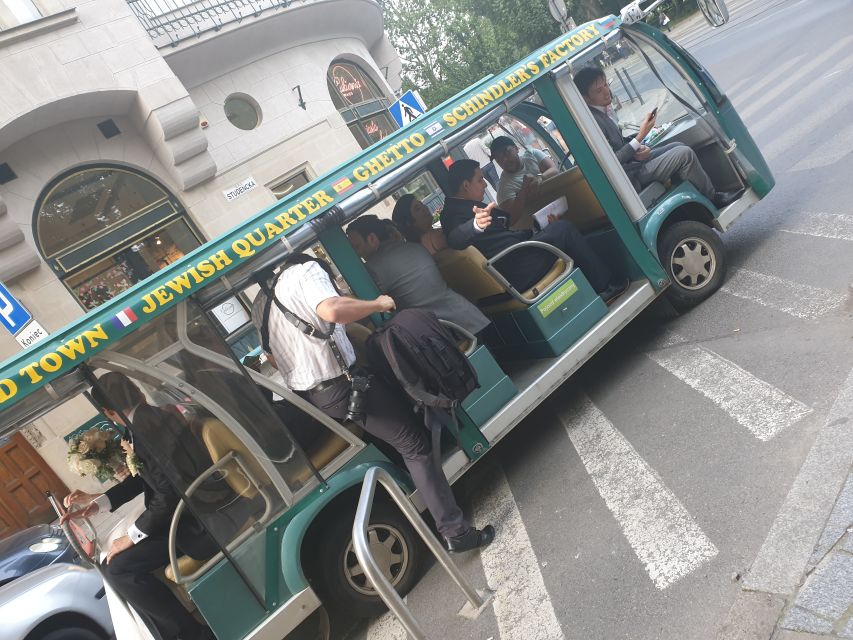
The advertised route covers more than 24 places. That sounds like a lot because it is a lot. The trade-off is pace.
You will receive short explanations while moving, then pause at selected points. The format is best for connections: this synagogue belongs to this neighborhood, this square relates to the ghetto, this wall marks a forced boundary, and this museum connects with Schindler’s story.
It is less suited to anyone seeking a slow architectural study or a detailed account of every individual building. You may leave with questions, and that is not a flaw if you use the tour as a map for further exploring.
I especially value the balance between recorded information and live explanation. The audio guide gives structure in your chosen language, while the driver can add local detail, clarify a question, or point out something not covered in the recording. The strongest guides, including Natalie, Olivia, and Roch, appear to make the ride feel personal rather than mechanical.
Price, group size, and practical planning
At $13 per person, this is one of the easier Krakow activities to fit into a budget. You are paying for 90 minutes of transport, a driver, and guided or recorded information. Compared with booking a private walking guide, it is inexpensive. Compared with simply walking through Kazimierz, it costs more, but it saves time and reduces physical effort.
Private and small-group options are available. A small group can make it easier to hear the guide and ask questions. If cancellations leave you alone in the cart, the ride may continue as a private experience, which allows you to ask more questions and adjust the pace within the fixed route.
The meeting point can vary by booking option, so check your confirmation carefully. Hotel pickup and drop-off are not included by default, though optional pickup may be arranged if you provide your accommodation address.
Do not bring luggage or large bags. This is a small vehicle, and storage is limited. A small day bag is the sensible choice.
Free cancellation is available up to 24 hours before departure, and you can reserve now and pay later. Those terms are useful if your Krakow schedule depends on a salt mine visit, Auschwitz, airport delays, or changing weather.
Who should choose this tour
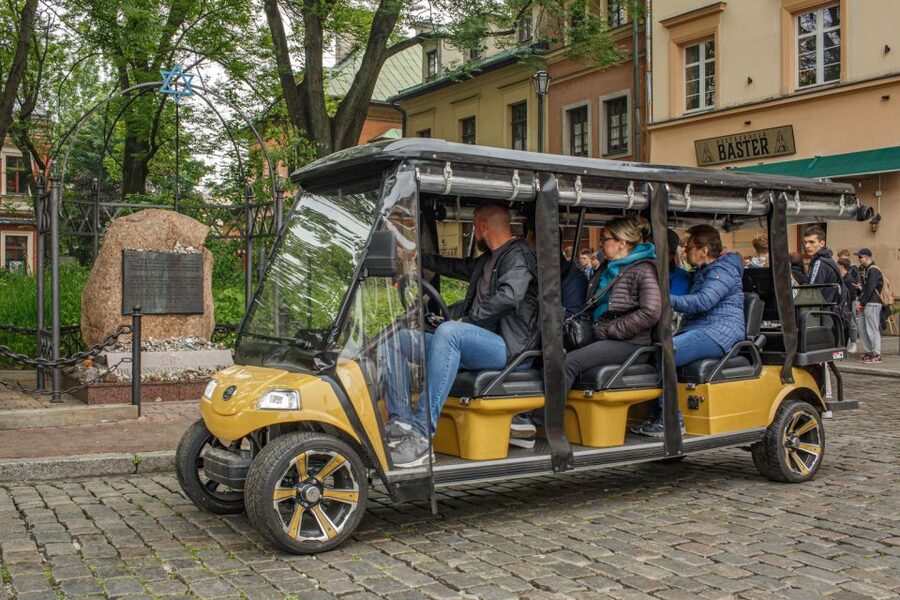
I would choose this ride if you have limited time, dislike long walks, are visiting in winter, or want a clear introduction before exploring alone. Families may find the vehicle easier than a long walking route, and teenagers can appreciate the change of pace.
It is also a good match for anyone specifically interested in Jewish Krakow, the former ghetto, or the story of Schindler. The route gives those subjects more attention than a general city loop would.
I would not choose it as your only Krakow sightseeing activity if you want Wawel Castle, the Main Market Square, or museum interiors in depth. The ride touches the medieval city, but its real subject is Kazimierz and Podgórze.
Plan a return visit to the places that catch your attention. The Old Synagogue, Remuh area, Ghetto Heroes Square, Pharmacy Under the Eagle, and Schindler’s Factory all deserve more time than the cart can provide.
Should you book the Krakow electric golf cart tour?
Book it if you want a warm, low-effort way to cover Krakow’s Jewish Quarter and former ghetto in 90 minutes. The combination of a modest price, heated winter transport, multilingual audio, and strong live guides makes it a sensible orientation tour.
Go in with the right expectations. You are not getting a long stop at every synagogue or a complete Old Town tour. You are getting a well-packed introduction to important streets, memorials, churches, and difficult chapters of Krakow’s past.
For a first activity, I think the tour makes good sense. It helps you choose where to return, and it lets you see parts of the city you might otherwise miss. For a final-day activity, it is equally practical, especially when your legs are tired and you still want one last look around.
FAQ
How long is the Krakow electric golf cart tour?
The tour lasts 90 minutes.
How much does the tour cost?
The listed price is $13 per person.
What areas of Krakow does the tour visit?
It visits the medieval city area, Kazimierz, the Jewish Quarter, and Podgórze, including the former Krakow ghetto.
How many sights are included?
The route includes more than 24 listed places, including synagogues, churches, squares, memorials, old shops, the ghetto wall, and sites linked to Oskar Schindler.
Is the electric cart heated in winter?
Yes. The vehicles are heated in winter. Blankets and weather protection may also be provided, though some cold can enter through the open sides.
Which languages are available?
Live guides are available in English and Polish. The audio guide is available in many languages, including Spanish, Italian, German, French, Chinese, Japanese, Korean, Arabic, Hebrew, and others.
Is hotel pickup included?
Hotel pickup and drop-off are not included by default. Optional pickup may be available if you provide your hotel or apartment address.
Can I book a private or small-group tour?
Yes. Private and small-group options are available.
Can I bring luggage?
No. Luggage and large bags are not allowed.
What is the cancellation policy?
You can cancel up to 24 hours in advance for a full refund. A reserve-now, pay-later option is also available.
Just added around Krakow
- Tour to Wadowice: Hometown of Pope Saint John Paul II★ 4.6 · 12 reviews
- The Jewish Quarter – Walking Tour★ 5.0 · 4 reviews
- From Kraków; to Białka Thermal Baths private tour★ 5.0 · 5 reviews
- St. Mary’s Basilica and more – a short walk with a guide★ 4.7 · 56 reviews
- Krakow: Auschwitz-Birkenau and Wieliczka Salt Mine Day Trip★ 4.7 · 84 reviews
- Krakow: Skip-the-Line Wawel Castle & Old Town Guided Tour★ 4.9 · 23 reviews
- Krakow: Schindler’s Factory Guided Tour★ 4.2 · 12 reviews
- Shooting Range Experience!★ 4.8 · 66 reviews
Golf Cart Tours, compared.
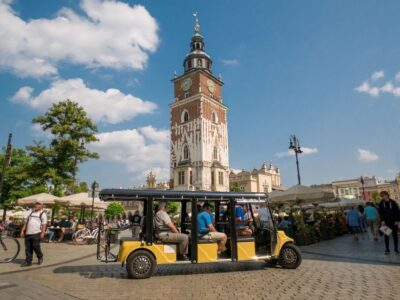
Extended City Sightseeing Tour – Eco Buggy Golf Cart
Read our review →
Jewish Quarter and Ghetto Electric Golf Cart Tour
Read our review →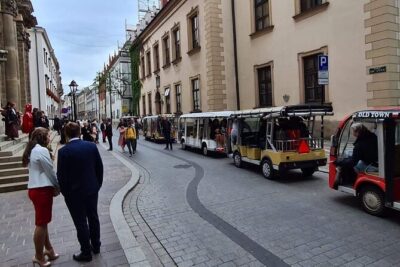
City Sightseeing Tour Eco Electric Buggy Golf Cart
Read our review →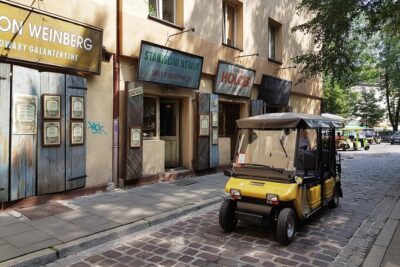
Krakow Grand City Tour by golf cart – All 3 districts
Read our review →
Shared or Private City Tour Sightseeing By Golf Cart
Read our review →
City Sightseeing Tour by Buggy/Golf Cart LIVE GUIDED 1H
Read our review →Browse the lists this tour appears in