

Reviewed · GOLF CART TOURS
Krakow: City Sightseeing Tour by Golf Cart
Krakow packs three very different chapters of its past into this 90-minute golf cart ride: the medieval center, Jewish Kazimierz, and Podgórze, the former ghetto district. You pass more than 29 sites without wearing out your feet, then finish at Krakus Mound for a wide city view.
I like the small vehicle, which carries no more than 13 people, and the broad choice of audio languages. I also like the route itself: you get Old Town churches, Jewish synagogues, ghetto memorials, and Schindler’s Factory area in one sitting. The trade-off is simple: the recorded commentary does most of the explaining, so the quality of the live driver’s extra remarks can vary.
Key points to know
- Three major districts in 90 minutes: Old Town, Kazimierz, and Podgórze are covered in one continuous route.
- More than 29 historic places: The itinerary includes Wawel Castle, synagogues, ghetto sites, and Krakus Mound.
- Electric vehicle for up to 13 people: You avoid a long walking circuit and get a small-group feel.
- Audio guide in many languages: English, Spanish, French, German, Italian, Polish-related regional options, and many others are available.
- Krakus Mound adds a real viewpoint: The final panorama gives the ride a pleasant visual finish.
- Dress for the weather: The tour runs in all conditions, and large bags or luggage are not allowed.
Three Krakow districts, one moving history lesson
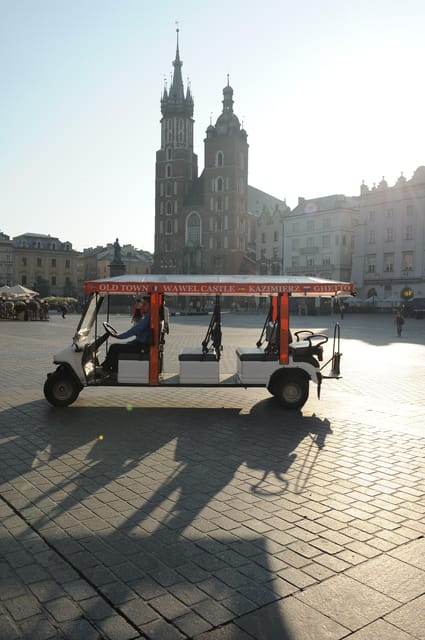
The clever part of this tour is its shape. Instead of spending 90 minutes circling only the famous center, you cross into Kazimierz and Podgórze, giving you a quick sense of how Krakow’s story changes from one neighborhood to the next.
The Old Town is polished and grand. Kazimierz feels more layered, with Jewish religious sites, old streets, and reminders of a community that was almost destroyed during the Second World War. Podgórze brings the hardest material, including the former ghetto and its memorials.
I would not treat this as a replacement for walking Krakow. It is better as an introduction, especially early in your stay. You get a city map in your head, note the places that catch your interest, and return later on foot.
More Golf Cart Tours in Krakow
- Krakow: City Sightseeing Tour by Electric Golf Cart
★ 4.5 · 3,264 reviews - Krakow: City Sightseeing Tour Eco Electric Buggy Golf Cart
★ 4.7 · 3,143 reviews - Krakow: Extended City Sightseeing Tour – Eco Buggy Golf Cart
★ 4.7 · 794 reviews
Old Town begins at the Barbakan and Planty Park
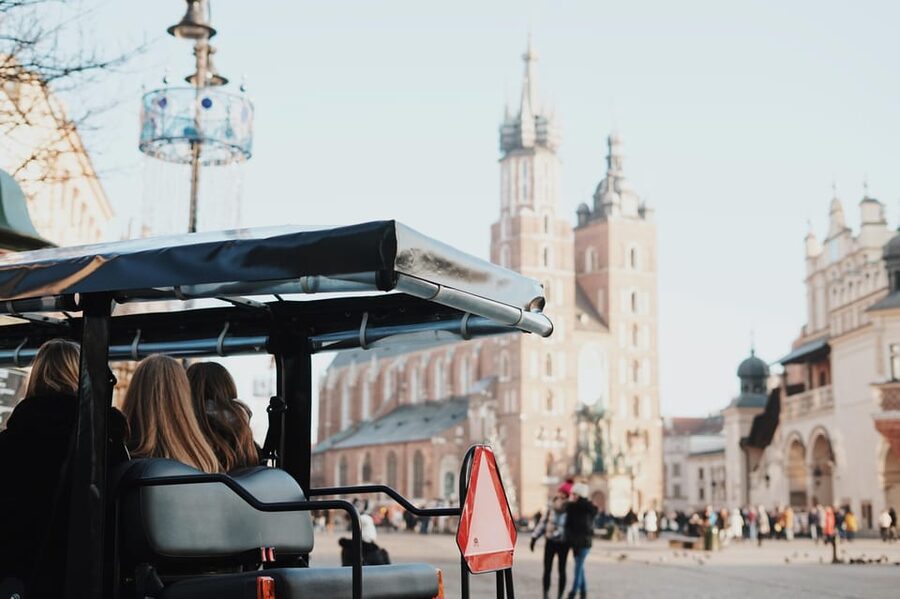
The route takes in the Barbakan, one of Krakow’s most recognizable medieval defensive structures. Its round brick form and heavy walls make the city’s former fortifications easy to picture, even if you only see it from the vehicle.
Nearby Matejko Square and St. Florian’s Church add a change of scale. The square carries the name of Jan Matejko, Poland’s best-known historical painter, while the church marks the northern approach to the Old Town.
You also pass through Planty Park, the green belt that follows the line of the old city walls. Planty is useful for understanding Krakow’s layout: the historic core sits inside this ring, and the park now replaces much of the former defensive boundary.
From the cart, you get orientation more than close inspection. That is useful on a first look, but you will not have much time to study architectural details or step inside each church.
Wawel Castle gives the route its royal center
Wawel Castle is one of the key stops in any Krakow sightseeing plan. It represents Poland’s royal past and sits above the Vistula, giving the city a strong historical focal point.
The tour includes Wawel as part of its Old Town route, but this is a passing overview rather than a castle visit. You should not expect entry to the royal chambers, cathedral interiors, or exhibitions. If Wawel is high on your list, set aside separate time to explore it properly.
Still, seeing the castle in the flow of the city helps you understand its position. The route does not reduce Krakow to one attractive market square. It connects the royal district with the neighborhoods that follow.
Kazimierz changes the mood at Skałka and Wolnica Square
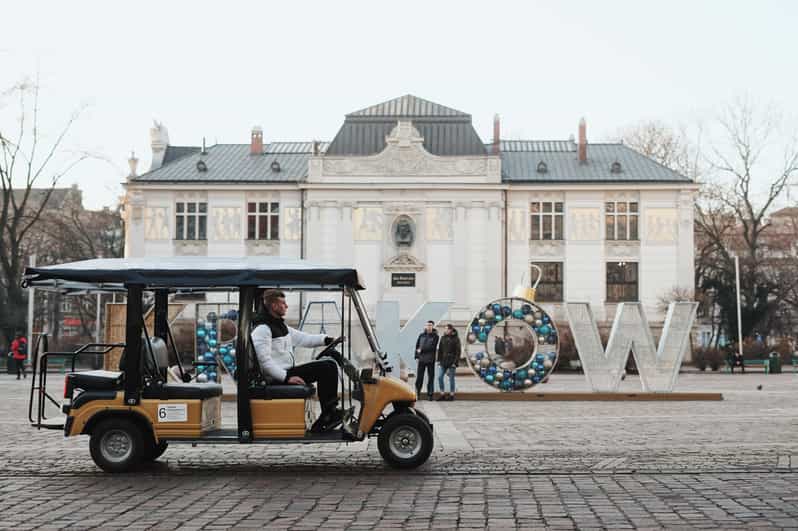
Kazimierz is where the tour becomes more textured. The route includes Skałka Church, Church of St. Catherine, and Wolnica Square, places that help show the district’s Christian and civic past alongside its Jewish heritage.
The former Jewish City Hall on Wolnica Square is especially useful for understanding that Kazimierz was once a separate town. It was not simply a side street of Krakow. Its own institutions and public spaces shaped local life.
You then reach the Church of Corpus Christi, one of Kazimierz’s major landmarks. The vehicle gives you a quick look at how churches, squares, synagogues, and narrow streets sit close together.
This section rewards a second visit on foot. The cart can show you the sequence, but Kazimierz’s details are found at street level. If you have time after the tour, return to the sites that interest you most rather than trying to absorb every name at once.
Same country, a completely different kind of day:
- From Krakow: Auschwitz-Birkenau Guided Tour & Hotel Pickup
★ 4.5 · 33,358 reviews - From Krakow: Auschwitz-Birkenau Guided Tour & Hotel Pickup
★ 4.5 · 29,340 reviews - Krakow: Auschwitz Guided Tour with Optional Hotel Pickup
★ 4.5 · 15,280 reviews - Krakow–Zakopane: Cable Car, Chocholow Baths, Cheese & Vodka
★ 5.0 · 10,720 reviews
The synagogues explain Kazimierz’s Jewish past
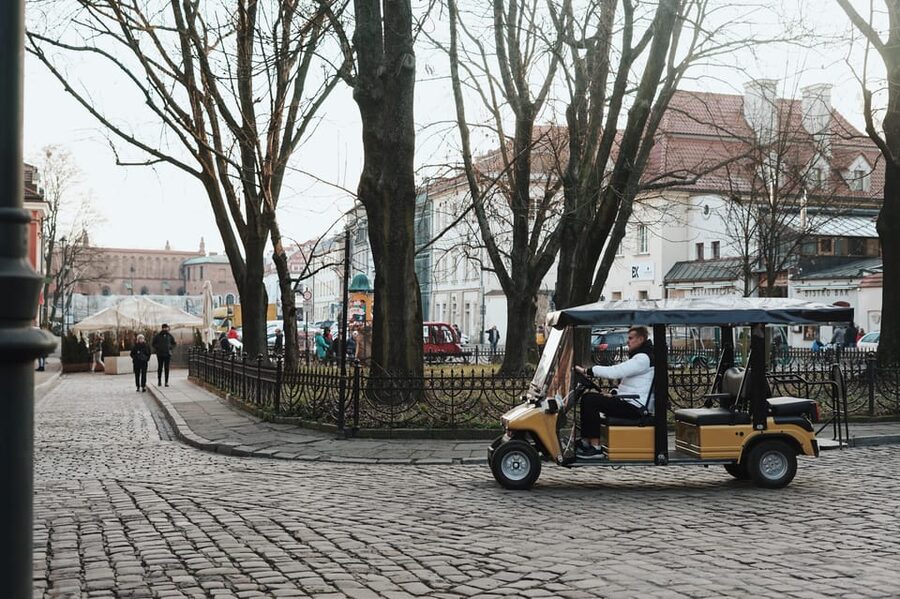
The route includes Tempel, Kupa, Isaac, Old, Popper, and Remuh synagogues, along with the old cemetery beside Remuh Synagogue. That is a lot of Jewish heritage in a short period, and the audio guide is important here because the names and dates can otherwise blur together.
Ciemna Street and the old Jewish shops add a more intimate sense of the district. The Family House of Helena Rubinstein provides another personal connection to Kazimierz, linking the neighborhood to a figure whose name became known around the world through cosmetics.
The Memorial Stone of the Nissembaum Family Foundation is another quiet reminder of the people and families connected to this area. These details matter because the district is more than attractive old buildings. It points to a community, its institutions, its daily businesses, and the violence that broke that life apart.
The cart’s advantage is time. You can cover several sites in one route, including places that would take longer to connect on foot. The limitation is emotional and visual compression. Synagogues and memorials deserve unhurried attention, so use this ride to decide where you want to return.
Podgórze brings the most serious part of the route
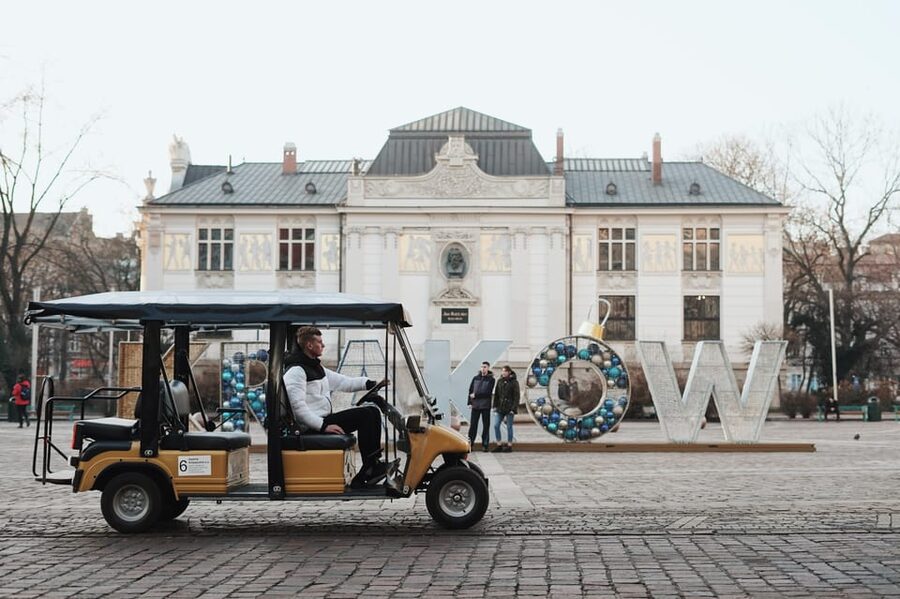
The former ghetto section in Podgórze is the most sobering part of the tour. You visit Ghetto Heroes Square, the Pharmacy under the Eagle connected with Tadeusz Pankiewicz, the ghetto wall, and the Church of St. Joseph.
Ghetto Heroes Square is now known for its memorial chairs. The site recalls the people forced from their homes and the belongings left behind. It is a place where the history of the Krakow ghetto becomes physical rather than abstract.
The Pharmacy under the Eagle was operated by Tadeusz Pankiewicz, who helped people in the ghetto. The site carries a strong personal connection to the period, and the audio commentary gives you context for why it matters.
The remaining section of ghetto wall is another useful stop. A wall fragment can look modest, but it helps you grasp the confinement imposed on the Jewish population. You are not just hearing a date and moving on. You are seeing part of the boundary itself.
The route also explains life in the ghetto and the historical importance of Oskar Schindler’s Factory. The factory is not presented as a simple film location. Its meaning comes from the people who worked there, the wartime setting, and the wider story of Krakow under Nazi occupation.
You should plan a separate visit to Schindler’s Factory if you want the museum exhibitions. This golf cart experience provides historical context and an exterior view, not a full museum tour.
Krakus Mound supplies the best visual finish
The final stop at Krakus Mound changes the pace again. After the dense streets and difficult wartime history, you get an open panorama over Krakow.
A viewpoint is especially welcome on a vehicle tour because much of the route happens at street level. From the mound, the city’s districts make more sense as a whole. You can look back toward the built-up center and see how the older neighborhoods fit into the wider city.
The stop is also practical. If you are still learning Krakow’s geography, the panorama helps connect the places you have just passed. Bring a camera, but keep your expectations sensible. The tour information promises a city view, not a long hiking visit or a sunset excursion.
What the electric golf cart adds
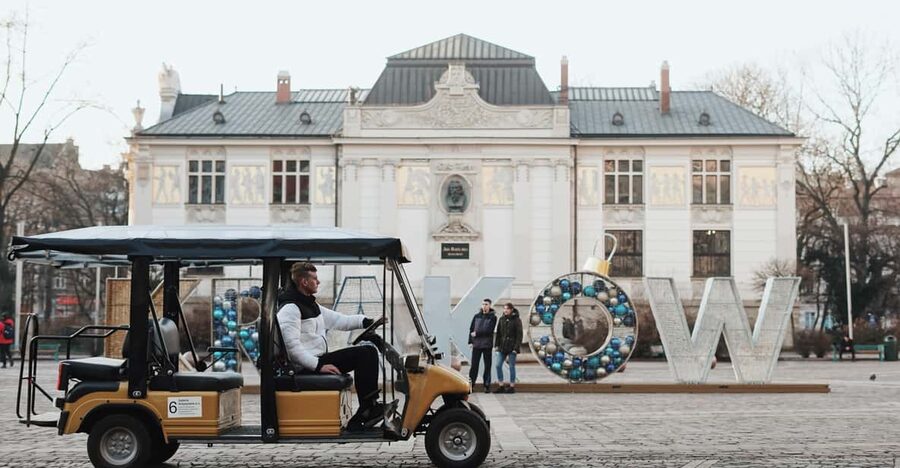
Krakow is walkable, but the distances between Old Town, Kazimierz, and Podgórze can add up. A golf cart lets you cover those districts without turning your first day into a marching exercise.
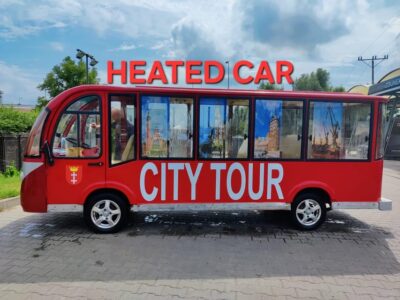
The electric vehicle is quieter and smaller than a standard sightseeing bus. With no more than 13 people, it should feel less anonymous than a large coach. The vehicle also fits the narrow urban setting better than a full-size bus.
This format works well for families, older visitors, people with limited stamina, and anyone arriving with only a short window in the city. It also helps during poor weather, though you still need suitable clothing because the tour operates in all conditions.
The ride is not a private walking guide. Even though the activity is described as a private group experience, the vehicle size is capped at 13 people, and the main historical narration comes through headphones or the vehicle’s audio system. Clarify the exact group arrangement when booking if privacy is important to you.
Audio commentary is useful, but set the right expectation
The audio guide is offered in a long list of languages, including English, Spanish, Italian, French, German, Dutch, Portuguese, Russian, Ukrainian, Arabic, Hebrew, Japanese, Korean, Chinese, and several Central and Northern European languages.
That range is a real benefit for mixed-language families and international groups. You can follow the history in the language you understand best instead of relying on a driver to explain every detail.
The recorded material covers the sites in more depth than a quick drive-by narration normally would. Still, your driver’s personal contribution may be limited. One recorded assessment found the commentary good but felt the driver added little enthusiasm, likely because of language differences. Another account praised the driver’s safe handling and said the audio was supplemented with interesting anecdotes.
My advice is to treat the audio guide as the reliable core and the driver as a possible bonus. If you want a lively conversation with detailed questions answered on the spot, a dedicated walking guide may suit you better.
Is $44 fair for 90 minutes?
At $44 per person, this is not the cheapest way to see Krakow. The value depends on how much you would otherwise spend on taxis, planning, and walking time to connect three districts.
You are paying for a small electric vehicle, a fixed route, multilingual historical commentary, and transport between Old Town, Kazimierz, and Podgórze. The price makes more sense if you have limited time or want a quick first look before choosing which sites deserve paid admission.
It is less attractive if you already plan to walk everywhere and have several days in Krakow. Many of the public streets and squares can be visited freely, and this ride does not include meals, beverages, or entry to the interiors of the listed attractions.
The strongest value is the route. Few short city tours combine medieval defenses, royal Krakow, Jewish Kazimierz, former ghetto sites, Schindler’s Factory area, and a hilltop panorama in one compact outing.
Who should book this Krakow ride?
I would recommend it to first-time visitors who want orientation without a long walk. It is also a good fit for families with children, older people, and anyone who wants to see the city from a seated vehicle.
It suits you if you value historical context but do not yet know which museums and churches you want to enter. The route gives you a useful shortlist for later.
You may want a different experience if you prefer slow photography, long stops, or a guide who speaks constantly and responds to detailed questions. You should also avoid bringing large luggage, since bags and suitcases are not allowed.
Book it early in your Krakow stay if possible. Then use the rest of your visit to return to Wawel, Kazimierz’s synagogues, the Pharmacy under the Eagle, or Schindler’s Factory with more time.
Should you book it?
Book this tour if you want broad coverage in a short time, especially across districts that are too spread out for a relaxed first walk. The combination of Old Town, Kazimierz, Podgórze, and Krakus Mound gives you a clear introduction to Krakow’s major historical themes.
Skip it if your ideal sightseeing day means entering every landmark and lingering at each memorial. At $44, the ride is best viewed as a city orientation service with substantial historical narration, not as a collection of full attraction visits.
The 4.8 rating from 10 recorded ratings reflects a generally strong response, with praise for the route, careful driving, and useful audio. The one clear caution is the uneven level of live enthusiasm. If you are comfortable with the audio guide doing most of the work, this is a practical and worthwhile first look at Krakow.
FAQ
How long does the Krakow golf cart tour last?
The tour lasts 90 minutes, or one and a half hours.
Which parts of Krakow does the route visit?
The route covers the historic Old Town, Kazimierz, the former Jewish Quarter, and Podgórze, the former site of the Krakow ghetto. It also includes Krakus Mound.
How many historic sites are included?
The route covers more than 29 significant sites, including Barbakan, Wawel Castle, several synagogues, Ghetto Heroes Square, the ghetto wall, and the area connected with Schindler’s Factory.
Is an audio guide included?
Yes. A professional audio guide is included in the selected language. Available languages include English, Spanish, Italian, French, German, Chinese, Japanese, Korean, Arabic, Hebrew, Portuguese, Russian, Ukrainian, and others.
How many people fit in the golf cart?
The electric vehicle carries no more than 13 people. The activity is also described as a private group experience.
Can I bring luggage or a large bag?
No. Luggage and large bags are not allowed on the tour.
Does the tour operate in bad weather?
Yes. The tour runs in all weather conditions, so you should dress appropriately.
Just added around Krakow
- Tour to Wadowice: Hometown of Pope Saint John Paul II★ 4.6 · 12 reviews
- The Jewish Quarter – Walking Tour★ 5.0 · 4 reviews
- From Kraków; to Białka Thermal Baths private tour★ 5.0 · 5 reviews
- St. Mary’s Basilica and more – a short walk with a guide★ 4.7 · 56 reviews
- Krakow: Auschwitz-Birkenau and Wieliczka Salt Mine Day Trip★ 4.7 · 84 reviews
- Krakow: Skip-the-Line Wawel Castle & Old Town Guided Tour★ 4.9 · 23 reviews
- Krakow: Schindler’s Factory Guided Tour★ 4.2 · 12 reviews
- Shooting Range Experience!★ 4.8 · 66 reviews
Golf Cart Tours, compared.
City Sightseeing Tour Eco Electric Buggy Golf Cart
Read our review →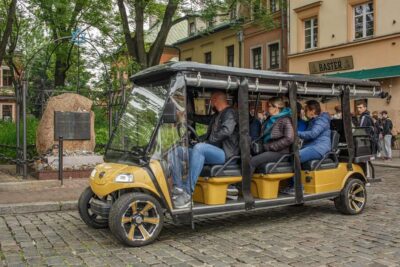
Extended City Sightseeing Tour – Eco Buggy Golf Cart
Read our review →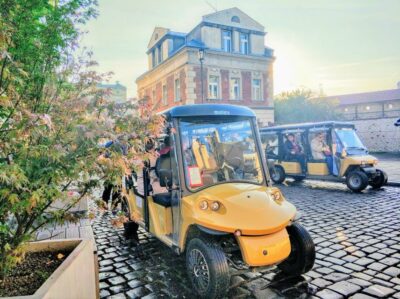
Jewish Quarter and Ghetto Electric Golf Cart Tour
Read our review →City Sightseeing Tour Eco Electric Buggy Golf Cart
Read our review →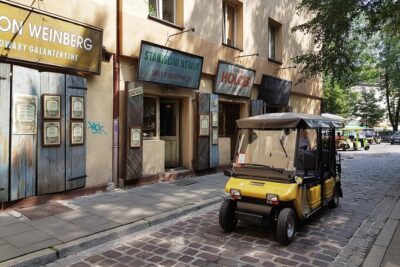
Krakow Grand City Tour by golf cart – All 3 districts
Read our review →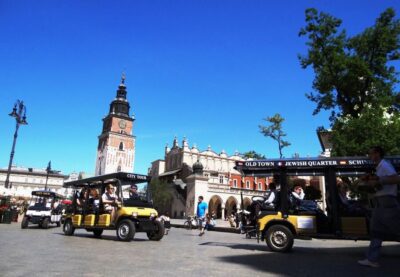
Shared or Private City Tour Sightseeing By Golf Cart
Read our review →Browse the lists this tour appears in