Reviewed · KRAKOW TOURS
The best view of Krakow from Golf Cars
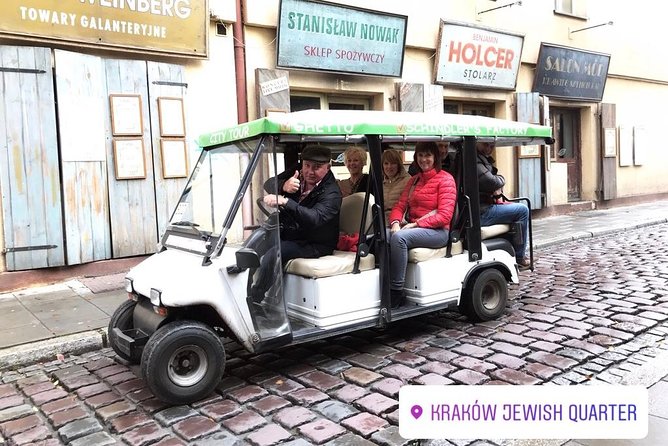
Krakow is especially easy to enjoy from a small electric golf cart. You can reach lanes and squares that large buses miss, while still covering the Old Town, Wawel Hill, Kazimierz, and Podgórze in about two hours. I like the small seven-person limit and the audio guide, available in 26 languages. I also like that the route includes places many quick city tours skip, such as the Father Bernatek Footbridge and the former Krakow Ghetto.
The main concern is reliability. Two separate bookings were reported as having no golf cart arrive, creating a serious problem for groups with limited time. I would confirm the pickup details before setting out, and I would book this only if the provider, Michal Urban, gives you clear meeting instructions.
Key points to know before booking
- A broad two-hour route: Cover Krakow’s Old Town, Wawel, Kazimierz, and Podgórze without arranging several separate walks.
- A compact electric vehicle: The golf cart can reach areas that full-size buses cannot.
- A useful language choice: Audio commentary is offered in 26 languages, while the driver speaks English.
- A strong history focus: The route links royal Krakow, Catholic churches, Jewish heritage, and Nazi-era sites.
- A group-friendly price: The $103.03 rate covers up to seven people, making the cost much better when the cart is full.
- A service warning: Past no-show problems make confirmation especially important.
Why a golf cart works well in Krakow
Krakow’s center is compact, but its sights are spread across several districts. A walking route through the Old Town will not naturally take you to Kazimierz, the former Jewish quarter, or Podgórze on the south side of the Vistula River.
This tour solves that distance problem without using a large coach. The electric cart is small enough for narrow streets and short lanes, so you can see more of the city while avoiding a long march between districts. It is also an easier choice for anyone who wants sightseeing without spending two hours on foot.
The vehicle has special covers, so the tour can operate in cold or rainy weather. Still, the cancellation terms say the experience requires good weather. If poor weather forces a cancellation, you should receive a choice of a new date or a full refund.
The group limit is seven people. That is small enough for the driver to answer questions and stop for photos, but the quality of the experience depends on the person driving. One named driver, Michal, received praise for friendly English commentary, safe driving, and helpful answers. Another driver was praised for adding useful facts beyond the recorded narration.
Other Krakow days people book alongside this one:
- From Krakow: Auschwitz-Birkenau Guided Tour & Hotel Pickup
★ 4.5 · 33,358 reviews - From Krakow: Auschwitz-Birkenau Guided Tour & Hotel Pickup
★ 4.5 · 29,340 reviews - Krakow: Auschwitz Guided Tour with Optional Hotel Pickup
★ 4.5 · 15,280 reviews
Starting at Jana Matejki Square
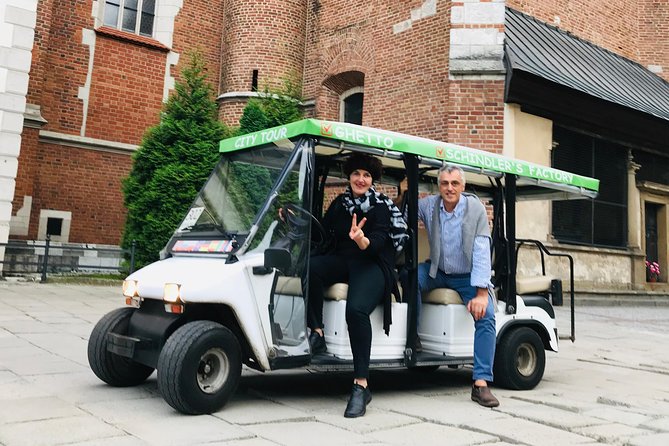
The meeting point is Plac Jana Matejki 2, near Krakow’s Old Town and public transportation. The route begins close to one of the city’s historic gateways, built around 1498 to lead into the medieval center.
This opening is a good reminder that Krakow was once protected by walls and gates. The city has changed considerably, but this part of the route quickly places you in the old royal capital rather than an ordinary modern center.
The golf cart format is useful here. A large bus would have difficulty getting close to many of the central sights, while the smaller vehicle can move through the historic core. You will not get a full walking visit inside every building, though. This is a moving overview with short stops, not a series of museum tours.
Grunwald Monument and Planty Park
The Grunwald Monument honors the Battle of Grunwald, a major medieval victory linked to Poland and Lithuania. It is also an important symbol of Polish national pride, making it a worthwhile early stop for visitors who want some political and military context.
From there, the route touches Planty Park, the broad green belt that circles the Old Town. The park follows the line of the former medieval walls, which were largely removed in the early 19th century.
I like this pairing because it gives you two different views of Krakow in a short time. The monument points to Poland’s medieval power, while Planty shows how the city reused its old defensive edge as public space. Your stop may be brief, so take a close look at the monument before the cart moves on.
Wawel Hill and the dragon by the river
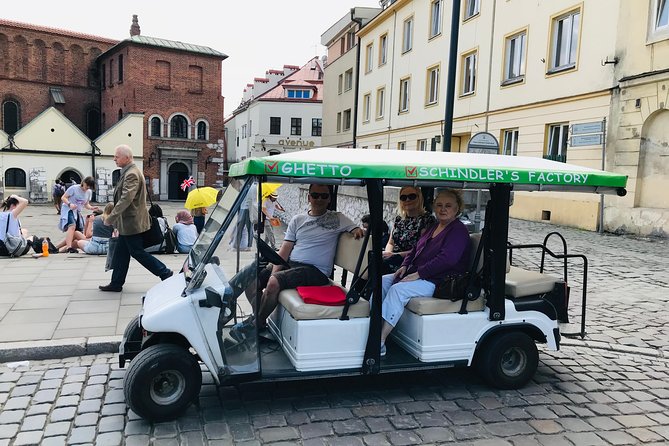
Wawel Castle is the grand centerpiece of the route. For centuries it was home to Poland’s kings and a symbol of Polish statehood. Today it houses one of Poland’s leading art museums, and the entire Historic Centre of Krakow received UNESCO World Heritage recognition in 1978.
A golf cart gives you a practical first look at Wawel without asking you to commit half a day to the castle complex. You can hear the major historical points, take photographs, and return later for an indoor visit if the castle interests you.
Near the foot of the hill, the tour stops at the Monument of the Wawel Dragon for about 10 minutes. The dragon is one of Krakow’s best-known folk characters, said to have lived in a cave beside the Vistula River. This is one of the lighter moments on the route, and it helps balance the heavier historical material that follows.
The nearby Bernardine Church sits directly below Wawel Hill. Its current building dates from the second half of the 17th century. You will also pass a Baroque church built between 1719 and 1728, adding more religious architecture to the royal quarter.
Same country, a completely different kind of day:
- Krakow–Zakopane: Cable Car, Chocholow Baths, Cheese & Vodka
★ 5.0 · 10,720 reviews - Krakow: Auschwitz-Birkenau Guided Tour with Pickup & Lunch
★ 4.5 · 9,800 reviews - From Krakow: Wieliczka Salt Mine Tour
★ 4.6 · 9,393 reviews - Krakow: Auschwitz-Birkenau Guided Tour Pickup/Lunch Options
★ 4.5 · 9,057 reviews
Churches along the Vistula
The Church on the Rock, or Kosciol na Skalce, receives a 10-minute stop. A church has occupied this site for centuries, and since 1472 it has been associated with the Pauline Fathers. The present interior gained its Baroque decoration between 1733 and 1751.
This sanctuary is one of Poland’s best-known religious sites. Even if you are not planning to enter, the setting at the edge of the old city gives the stop a strong sense of place.
Next comes Wolnica Square, part of the former market area of Kazimierz. The square helps explain that Kazimierz was not always viewed simply as a tourist district. It was a separate town and later became the center of Jewish life in Krakow.
The route then crosses the Father Bernatek Footbridge, which links Kazimierz with Podgórze over the Vistula. The stop lasts about five minutes, enough for a quick photograph and a look at the river connection between the two districts. You should not expect a long walk across the bridge, but the crossing neatly connects the route’s Jewish quarter with its later wartime history.
Corpus Christi and the heart of Kazimierz
Corpus Christi Church receives about 10 minutes. King Casimir III founded the Gothic church in 1335, and its interior combines Polish Gothic forms with impressive Baroque decoration.
This is one of the tour’s best examples of how Krakow’s religious buildings changed over time. The exterior and structure point to the medieval city, while the interior reflects later artistic tastes. The stop is short, so listen carefully to the audio commentary and use the time to notice the contrast between the building’s different periods.
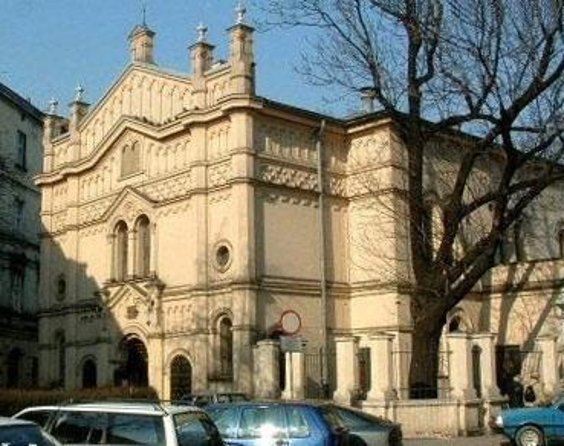
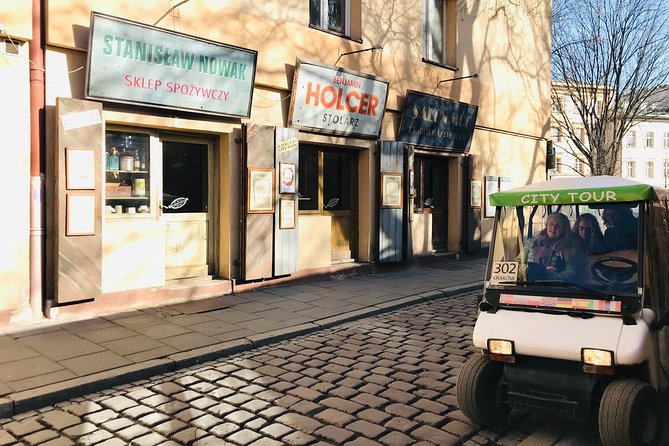
The route continues through Kazimierz, where the history becomes more focused and personal. You will pass the Tempel Synagogue, built in the 1860s as a Progressive synagogue. Entry is not included, but the building is an important reminder that Krakow’s Jewish community included several religious traditions.
You will also pass synagogues dating from the 16th and 17th centuries, including the High Synagogue. The exact time at each passing point may be limited, but together these buildings show how concentrated Jewish life once was in this part of Krakow.
Szeroka Street and the old Jewish quarter
Szeroka Street is described as the heart of Krakow’s Jewish district, and the tour gives you about 10 minutes there. This is a place where it is worth slowing down mentally, even if the vehicle cannot linger for long.
The route also reaches the square that served as part of the Jewish city from the late 16th century until the mid-19th century. Its most unusual feature is the Okrąglak, a covered market hall built around 1899 and 1900.
You will pass the building associated with Helena Rubinstein’s birthplace. The tour also includes a synagogue from the 1620s that now serves as part of a cultural center. During the Jewish Culture Festival, it is used for workshops and lectures.
These details give Kazimierz more depth than a simple list of pretty facades. The neighborhood was a working religious and commercial center, and the route points to that former daily life. The audio guide is particularly helpful here because many of the stories are not obvious from the street.
Stara Synagogue and Remuh Synagogue
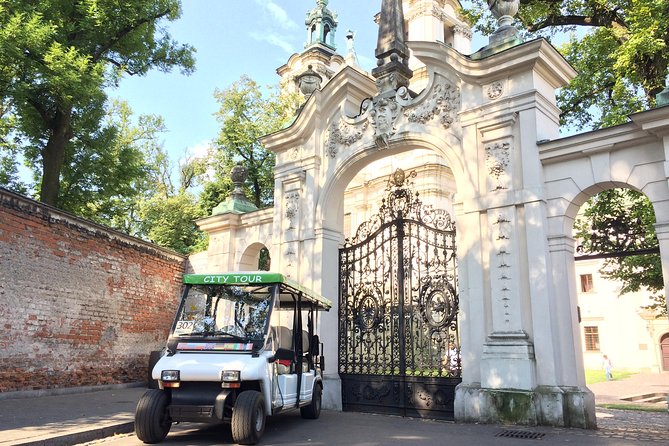
The Muzeum Krakowa, Stara Synagoga stop lasts about 10 minutes. The Old Synagogue is among the oldest in Krakow, with construction dated to either 1407 or 1492. Its museum holds a permanent display of Judaica.
Admission is not included, so treat this as a useful orientation stop rather than a museum visit. If you want to see the collection properly, you will need a separate visit and more time. The golf cart tour helps you decide if that extra stop belongs in your schedule.
Szeroka Street leads naturally toward Remuh Synagogue, another 10-minute stop. The synagogue and its related buildings form an important complex of Jewish architecture and religious art from the mid-16th century. It remains connected to religious life.
The Remuh stop is one of the strongest parts of the route for anyone interested in Krakow’s Jewish heritage. It also shows why a small vehicle is useful. You can cover several nearby sites without repeatedly searching for them on foot, while the audio system provides background in your chosen language.
Podgórze and the former Krakow Ghetto
The tour then moves to Plac Bohaterow Getta, or Ghetto Heroes Square, for about five minutes. Nazi Germany created the Krakow Ghetto as one of its major metropolitan Jewish ghettos during the occupation.
The square is not just another historic plaza. It marks the forced removal and confinement of Krakow’s Jewish population, so this section of the route has a far heavier tone than the castle or dragon stops.
You will pass the pharmacy that operated as the only pharmacy inside the Krakow Ghetto. It now contains a museum exhibition. You will also see a remaining fragment of the ghetto wall on Lwowska Street and the former entry area near the beginning of Limanowskiego Street, beside Podgórze Market Square.
The time here is short. I would not treat these stops as a full memorial visit. Instead, use the golf cart tour to locate the sites, learn the basic story, and return independently if you want time for the museum or a more careful walk through the district.
The route ends near St. Joseph’s Church on Podgórski Square. The church dates from the 20th century and provides a final landmark in Podgórze before the cart returns to the meeting point.
Audio commentary and the English-speaking driver
The tour includes an audio guide in 26 languages. That makes this a practical option for mixed-language groups, since you can listen in your preferred language while the driver handles the route.
The driver speaks English and may add information during the ride. That distinction matters. The recorded guide gives you consistent coverage at the monuments, while the driver can respond to questions, help with photographs, and provide extra local context.
Several strengths are clear here: safe driving, friendly service, and useful explanations were all praised in the strongest feedback. One driver also spoke enough English to share many facts directly, while the audio commentary was available in Dutch or Italian for passengers who needed it.
The experience will vary with traffic, weather, and the driver’s speaking style. If you prefer a long, structured lecture at every monument, a private walking guide may suit you better. If you want a clear overview with some room for questions, this format is more comfortable.
Is $103.03 good value for your group?
The price is $103.03 for up to seven people, not per person. At the full group size, that works out to about $14.72 each. For six people, it is about $17.17 each, and for four people, about $25.76 each.
That is fair value for a two-hour ride covering several districts, especially when you consider the vehicle, driver, multilingual audio system, and photo stops. The value drops sharply for a solo visitor or a pair. You are paying for the cart rather than buying seven individual seats.
Food and drinks are not included, and entry to the Old Synagogue, Remuh Synagogue, and Tempel Synagogue is not included. That is reasonable for a sightseeing circuit, but you should budget extra if you want to enter the museums or religious buildings.
The tour is best for a family, couple group, or set of friends who can fill most of the cart. For a group of eight, you would need two bookings, and that brings another practical issue: past no-show problems affected two carts booked for one group. I would not book duplicate vehicles without confirming both reservations directly.
Who should book this Krakow tour?
I would recommend it to you if you want a quick first look at Krakow, dislike long walks, or have only a short stay. It is also useful for families and older visitors who want to see Wawel, Kazimierz, and Podgórze without managing several public transport connections.
It suits visitors who like variety. In one ride, you move from medieval gates and royal power to churches, Jewish heritage, the Vistula, and the difficult history of the former ghetto.
I would be more cautious if you want extended time inside museums, detailed religious architecture tours, or a quiet memorial experience. Ten minutes at a site is enough to orient yourself, but not enough to study every room or inscription.
The rating information supplied for this experience is mixed, at 3.7 from 11 ratings. Five-star comments praise the friendly English-speaking drivers, safe driving, helpful facts, good photo assistance, and useful audio choices. The two one-star accounts involve carts that never arrived, which is a serious service concern rather than a minor complaint.
Final decision: book with one important check
Book this golf cart tour if your priority is broad coverage in a small vehicle. The route is unusually well-rounded, and the combination of Krakow’s royal center, Kazimierz, and Podgórze gives you a much better sense of the city than an Old Town-only ride.
Before paying, confirm the meeting point, pickup time, and vehicle directly. If the provider confirms clearly, the price is attractive for a group of four to seven. If you cannot get a firm confirmation, choose another way to see Krakow, since a no-show can cost you a valuable morning or afternoon.
Free cancellation is available until 24 hours before the start time. Changes or cancellations inside that window are not accepted for a refund, except when the operator cancels because of weather or because the minimum number of participants is not reached.
FAQ
How long does the Krakow golf cart tour last?
The tour lasts approximately two hours and returns to the starting point.
Where does the tour begin?
The meeting point is Plac Jana Matejki 2, 31-157 Kraków, Poland.
Where does the tour end?
The activity ends back at the meeting point.
How many people can join one golf cart?
One booking covers a group of one to seven people. The maximum group size is seven.
Is pickup available?
Pickup is offered, but the stated meeting point is Plac Jana Matejki 2. Confirm the exact pickup arrangement before the tour.
What languages are available for the audio guide?
The audio guide is available in 26 languages. The driver speaks English.
Are admission tickets included?
Admission tickets are not included for Tempel Synagogue, the Old Synagogue museum, or Remuh Synagogue. Several outdoor stops are free.
Can the tour operate in rain or cold weather?
The golf carts have special covers for cold and rainy days, but the experience still requires good weather. If the operator cancels because of poor weather, you can choose a different date or receive a full refund.
Just added around Krakow
- From Krakow: Zakopane and Dunajec River Rafting Tour★ 4.6 · 31 reviews
- From Krakow: Zakopane and Gubałówka Cable Car Private Tour★ 4.3 · 12 reviews
- From Krakow: Zakopane Full-Day Tour with Lunch Option★ 4.4 · 62 reviews
- From Krakow: Zalipie and Painted Village Guided Tour★ 4.0 · 4 reviews
- From Krakow: Zakopane Tatra Mountains & Hot Springs Tour★ 3.0 · 29 reviews
- From Krakow: Zakopane and the Tatra Mountains★ 4.7 · 36 reviews
- From Krakow: Hot Springs and Zakopane with Gubałówka★ 4.7 · 25 reviews
- Zakopane & Tatra Mountains Private Full-Day Tour from Krakow★ 4.5 · 33 reviews
Krakow Tours, compared.
Auschwitz-Birkenau Guided Tour & Hotel Pickup
Read our review →Auschwitz-Birkenau Guided Tour & Hotel Pickup
Read our review →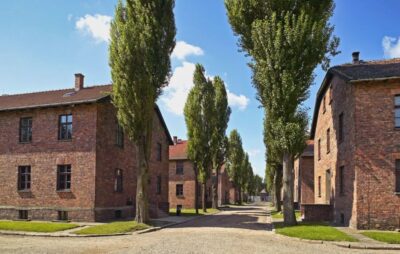
Auschwitz Guided Tour with Optional Hotel Pickup
Read our review →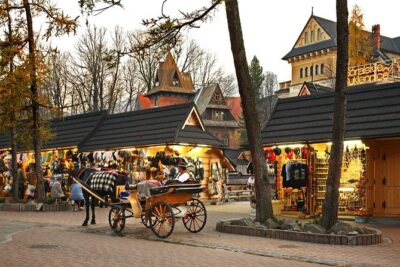
Zakopane: Cable Car, Chocholow Baths, Cheese & Vodka
Read our review →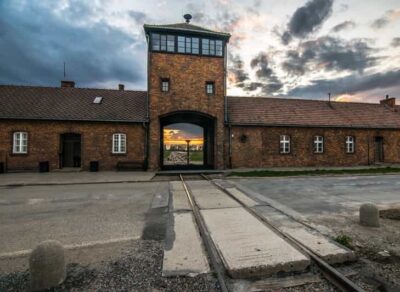
Auschwitz-Birkenau Guided Tour with Pickup & Lunch
Read our review →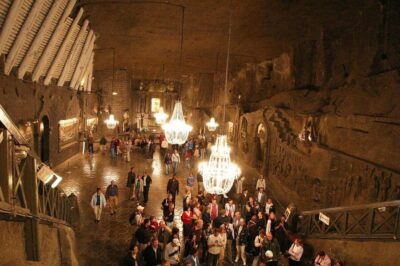
Auschwitz-Birkenau Guided Tour Pickup/Lunch Options
Read our review →