
Reviewed · KAZIMIERZ JEWISH QUARTER TOURS
Kraków old town and jewish quarter®
Kraków’s Old Town and Kazimierz are best understood together. One shows royal power, churches, universities, and medieval trade. The other reveals the long story of Jewish life in the city, its shared streets with Catholic neighbors, and the terrible break caused by the occupation. This three-hour Spanish-language walk links both areas with a historian’s eye rather than simply pointing out handsome buildings.
I like the way the route connects places that can otherwise feel unrelated, from the Barbican and Market Square to Wawel and the synagogues. I also like the guide’s teaching style: Luis has used photographs and drawings to make difficult subjects easier to follow, and his explanations keep a good pace. The main drawback is time. With so many major sights, three hours can feel short, especially if you want to enter buildings or linger at memorials.
Key points to know before booking
- A historian leads the walk: Your guide is a graduate in Geography and History, with Spanish as the tour language.
- Two major districts in one route: You cover Kraków’s historic center and Kazimierz, the former Jewish quarter.
- The route is packed with landmark stops: Expect the medieval walls, Market Square, Collegium Maius, the Franciscan Basilica, Wawel, synagogues, cemeteries, and memorials.
- History is connected, not isolated: The tour explains how events affecting Kraków and Poland shaped both Christian and Jewish communities.
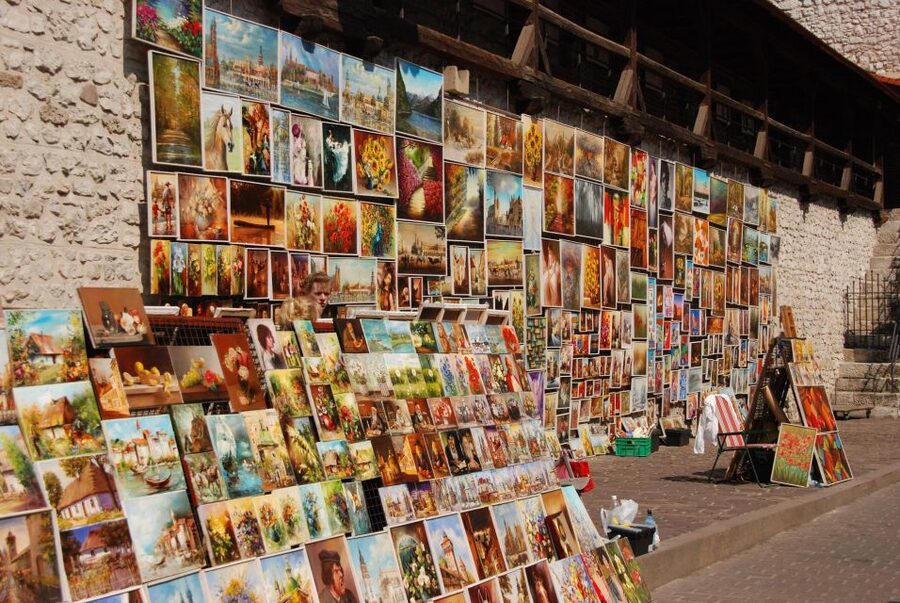
- Visual teaching aids add clarity: Photographs and drawings have been used during explanations, a useful touch for visitors who learn best by seeing.
- Good value at $16: Food and drinks are not included, but the price is low for a guided walk covering this much of central Kraków.
Start with Kraków’s medieval defenses
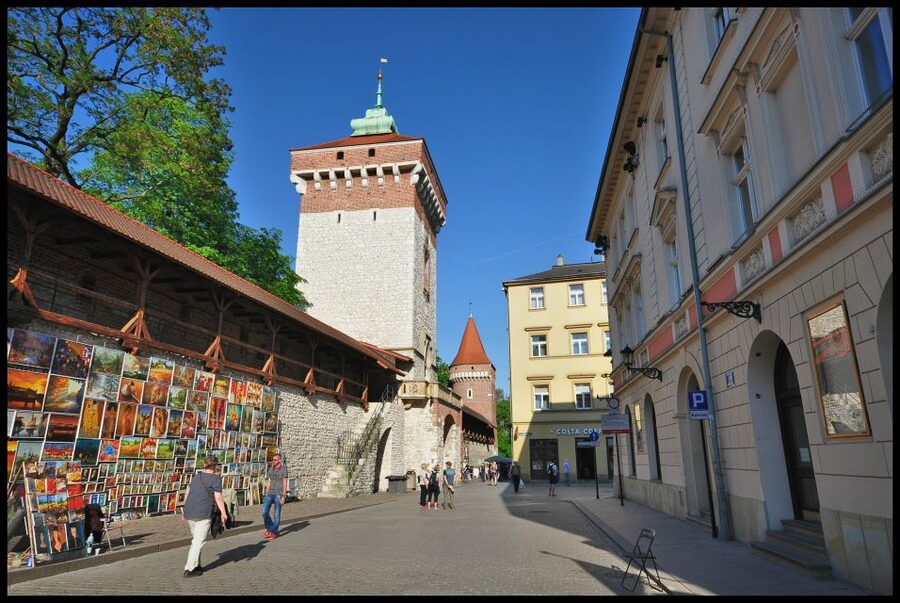
The walk begins in the downtown area, where Kraków’s old defenses and theatrical quarter introduce the city before the route reaches the main square. The Juliusz Słowacki Theater is an early highlight, followed by the medieval walls, the Barbican, and St. Florian’s Gate.
This opening gives you a useful sense of Kraków as a protected medieval city. The Barbican and gate are not just isolated photo stops. They help explain how people entered the city, how the center was defended, and why the old town still feels enclosed and distinct from the newer streets beyond it.
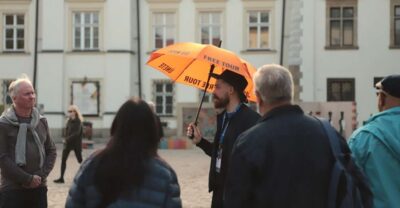
The route also gives you a chance to get your bearings. If this is your first morning in Kraków, the guide can help you understand how the main streets relate to the Market Square and Wawel Hill. The meeting point is identified by a gray umbrella, so keep an eye out for that simple marker.
You should expect to remain outdoors for much of the walk. That matters in Kraków, where winter cold and snow can slow the pace, and where summer sun can make three hours on stone streets tiring. Comfortable shoes and weather-appropriate clothing are practical choices, even though the walk itself is wheelchair accessible.
More Old Town Walking Tours in Krakow
- Old Town Krakow & Wawel Castle Walking Tour
★ 5.0 · 1,508 reviews - Krakow: Bike Tour of Old Town, Jewish Quarter and the Ghetto
★ 4.9 · 1,155 reviews - Krakow: The Old Town Walking Tour
★ 4.8 · 794 reviews
Market Square and Kraków’s monumental center
From the defensive quarter, the walk moves toward the Market Square, or Rynek Główny. This is the visual heart of the Old Town and one of the places where Kraków’s commercial, civic, and religious history meet.
The tour takes in the Basilica of Saint Mary, the Sukiennice, the old town hall tower, the Church of Saint Adalbert, the Adam Mickiewicz Monument, and the Eros Bendato sculpture. Each stop gives the guide a different way to explain how the square developed and why it carries such weight in the city.
The Basilica of Saint Mary anchors one side of the square with its distinctive towers. The Sukiennice recalls Kraków’s long role as a trading center, while the old town hall tower points to the civic authority that once operated here. Saint Adalbert’s Church adds an older religious layer, and the monuments show how later generations chose to remember culture and public life.
I appreciate that the walk does not treat the square as one large postcard. The point is to read its parts together. You can look at the architecture, but you also learn to ask what each building did, who used it, and how power was displayed.
The square can be crowded, particularly at popular times of day. That may make group movement slower and some explanations harder to hear. The guide’s reported use of pictures and drawings is especially useful here because it gives you something concrete to focus on when the surroundings are busy.
Collegium Maius and the university quarter
The route then heads into the university neighborhood, including Collegium Maius. This part of the walk shifts the focus from markets and royal authority to education and intellectual life.
Collegium Maius is linked with the Jagiellonian University, and the tour uses the neighborhood to discuss figures such as Nicolaus Copernicus and John Paul II, both associated with academic training in Kraków. That connection gives the university quarter a strong place in the city story.
You do not simply move from one attractive courtyard to another. The guide explains how Kraków’s academic institutions shaped the city and Poland more widely. Copernicus connects the city to European science, while John Paul II connects it to modern Polish religious and public life.
This is a good section for anyone who likes ideas as much as architecture. It also gives the walk a change of rhythm after the busy Market Square. The buildings are quieter, and the historical focus becomes more personal: who studied here, what did education mean, and how did Kraków produce figures with influence beyond the city?
Churches, the archbishop, and the road to Wawel
The archbishop’s palace and the Franciscan Basilica add another layer to Kraków’s religious story. These stops are especially useful because the tour does not present religion as a decorative extra. Churches, bishops, universities, and royal buildings all played a part in the city’s public life.
The Franciscan Basilica is one of the key places on the route. The archbishop’s palace provides a link to church leadership and to the modern history associated with Kraków’s Catholic identity. The guide connects these places to the broader story of Poland, rather than leaving you with a list of names and dates.
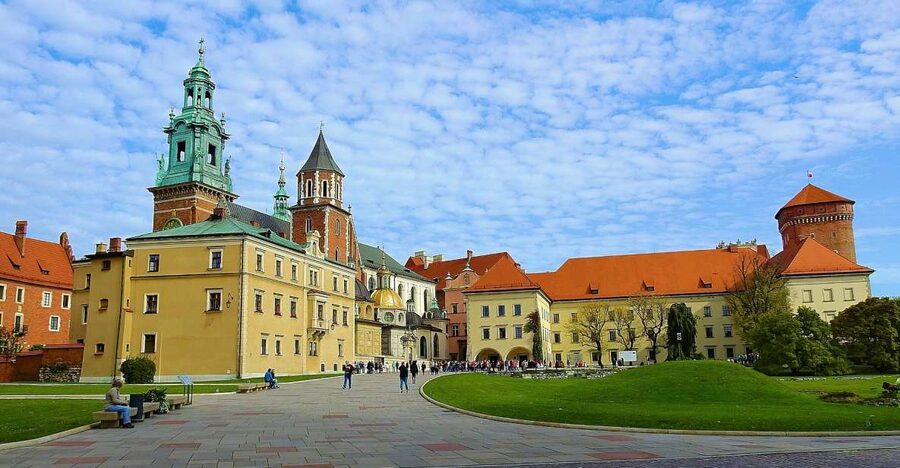
The walk continues to the Wawel complex, ascending the hill to examine the cathedral and the buildings around it. Wawel is the grandest section of the route, and it deserves the time given to it. The hill, cathedral, and surrounding structures show Kraków as a center of royal and religious authority.
You should understand the limits here. This is a walking tour, not a full interior visit to every Wawel building. The supplied information promises the Wawel complex and its cathedral as sights to analyze, but it does not state that entrance tickets or guided interior visits are included. If you want a detailed look inside the castle museums, plan a separate visit.
The Wawel section also gives you a strong sense of the city’s layout. From the hill, the guide can help you place the Old Town within the wider shape of Kraków, then prepare you for the very different character of Kazimierz.
More Kazimierz Jewish Quarter Tours in Krakow:
- Krakow: Jewish Quarter and Former Ghetto Tour
★ 4.9 · 1,441 reviews - Krakow: Kazimierz Jewish Quarter Walking Tour
★ 4.8 · 571 reviews - Krakow: Kazimierz, Schindler’s Factory & Ghetto Guided Tour
★ 4.8 · 460 reviews - Krakow: Bike Tour of the Old Town, Kazimierz, and the Ghetto
★ 4.9 · 350 reviews
Crossing into Kazimierz
Kazimierz is not just the second half of the itinerary. It changes the questions the tour asks.
Here, the focus turns to the Jewish communities that settled in Kraków, the reasons for those settlements, and the way Jewish and Catholic communities lived alongside one another. The route examines both cooperation and tension, rather than offering a polished version of coexistence.
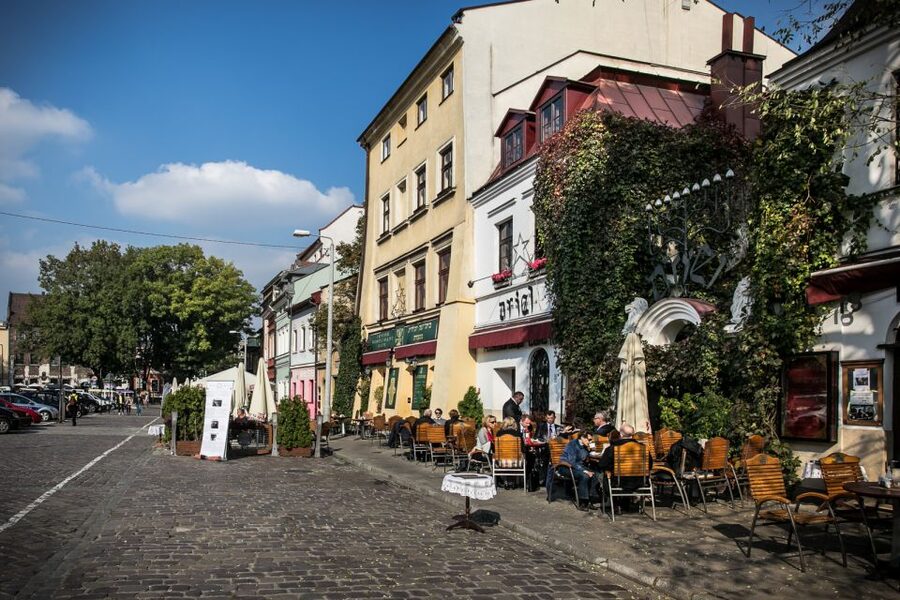
That balance matters. Kazimierz is now one of Kraków’s most visited areas, but its streets carry memories that are not always easy to see at first glance. A guide who explains the links between buildings, communities, and political events can help you move beyond the neighborhood’s restaurants and attractive facades.
The route includes the Tempel Synagogue and the Stara Synagogue, giving you two important points for understanding Jewish religious life in the district. It also includes the medieval square of the Jewish quarter, the walls of the Jewish quarter, and New Square.
These stops help you see Kazimierz as a community with its own institutions and public spaces. The synagogues are not simply architectural curiosities. They point to worship, education, local identity, and the place of Jewish life within Kraków.
The route’s description also makes clear that the guide addresses the more controversial parts of Jewish history in the city. You will hear about how the community became important, how relations between Jews and Catholics developed, and how those relations were later damaged by persecution and occupation.
Memorials and the difficult twentieth century
The final part of Kazimierz deals with memory and loss. The walk includes a monument to Holocaust victims, a monument to the Righteous Among the Nations, and a monument to Polish victims during the occupation.
These memorials require a slower pace than the Market Square. They are not background decoration, and you should allow yourself room to listen rather than rush toward the next stop. The guide’s use of photographs and drawings can help explain events that are difficult to understand from a monument alone.
The inclusion of both Holocaust remembrance and Polish wartime suffering is important. It acknowledges that the occupation affected different communities in different ways, while keeping the Jewish experience at the center of the Kazimierz section.
The route also reaches the old Jewish cemetery. This is one of the places where the story of Kazimierz becomes most direct. Tombstones and cemetery walls connect present-day streets with generations of Jewish residents who shaped the district before the destruction of the twentieth century.
The tour cannot cover every part of Kraków’s wartime story in three hours. What it can do is give you a framework. Afterward, you will be better prepared to decide which museums, synagogues, or memorial sites deserve a longer visit.
How the guide teaches
The guide is a graduate in Geography and History, and the experience is conducted in Spanish. Luis is the named guide associated with this walk, and his approach is described as clear, lively, and well paced.
That teaching style suits this itinerary. Kraków presents a large amount of information in a small area, and a guide who simply recites dates would quickly lose you. The use of photographs and drawings gives the explanations a visual anchor, especially at places where the original setting has changed.
The pace also matters. The walk shifts between open squares, narrow historic streets, churches, university buildings, royal sites, and memorials. You need enough movement to cover the ground, but enough explanation to understand why each stop matters.
The experience has earned a 4.5 rating from four reviews, with all of the listed comments giving five stars. The praise focuses on the guide’s historical knowledge, easy-to-follow explanations, visual aids, and good rhythm. One person wished the walk had continued longer, which points to the tour’s clearest limitation: the itinerary is ambitious for three hours.
Is $16 a fair price?
At $16 per person, this is a strong-value introduction to Kraków. The route covers two central districts, a long list of major landmarks, and a substantial amount of historical context. You are paying mainly for the guide’s interpretation, not for admission tickets, food, or drinks.
That distinction is important. The listed inclusions name a graduate guide in Geography and History, while food and drinks are not included. The information does not say that interior admission to the cathedral, synagogues, or other buildings is part of the price, so you should treat this as a guided exterior route unless the guide confirms otherwise.
For a first visit, the value comes from orientation. You see the main historic core, learn the basic sequence of Kraków’s past, and receive advice to help you use the rest of your time in the city. At this price, that is useful even if you later return to certain sites on your own.
Who will get the most from this walk?
I would choose this tour if you want a Spanish-speaking historical overview and prefer to understand a city through connected stories. It suits first-time visitors, couples, families with older children, and anyone who wants the Old Town and Kazimierz explained in one outing.
It is also a good match if you like your sightseeing active but not rushed. You will walk between many stops, listen to extended explanations, and spend time outdoors. The wheelchair-accessible designation makes it a practical option for many visitors, though the exact route conditions around historic streets and the climb toward Wawel should still be confirmed when booking.
You may want something else if you prefer a small number of interiors with long visits. This route covers a lot of ground, and the three-hour limit means each location receives a measured introduction rather than a full museum-style examination.
Free cancellation up to 24 hours before the activity and reserve-now, pay-later booking add flexibility. Those terms are useful if your Kraków plans are still changing.
Should you book Kraków Old Town and Kazimierz?
Book it if you want the city’s main historic areas placed into one clear story, especially in Spanish. The combination of the medieval defenses, Market Square, university quarter, Wawel, synagogues, cemetery, and occupation memorials gives you a strong first map of Kraków.
The best reason to choose it is the guide-led interpretation. Luis’s use of photographs and drawings, along with his steady pace, can make a dense route easier to follow. The main caution is simple: do not expect three hours to provide a full visit to every building named along the way.
At $16, I consider it a sensible first-day walk. Bring good shoes, dress for the weather, look for the gray umbrella, and save time afterward if one part of the route calls for a closer visit.
FAQ
How long does the Kraków Old Town and Jewish Quarter tour last?
The tour lasts three hours.
What language is the tour conducted in?
The live tour guide conducts the experience in Spanish.
How much does the tour cost?
The listed price is $16 per person.
What areas of Kraków does the tour visit?
The route covers Kraków’s historic center and Kazimierz, the Jewish quarter.
Is food or drink included?
No. Food and drinks are not included.
Is the tour wheelchair accessible?
Yes, the activity is listed as wheelchair accessible.
Can I cancel the booking for a full refund?
Yes. You can cancel up to 24 hours in advance for a full refund. The activity also offers reserve-now, pay-later booking.
Just added around Krakow
- Tour to Wadowice: Hometown of Pope Saint John Paul II★ 4.6 · 12 reviews
- The Jewish Quarter – Walking Tour★ 5.0 · 4 reviews
- From Kraków; to Białka Thermal Baths private tour★ 5.0 · 5 reviews
- St. Mary’s Basilica and more – a short walk with a guide★ 4.7 · 56 reviews
- Krakow: Auschwitz-Birkenau and Wieliczka Salt Mine Day Trip★ 4.7 · 84 reviews
- Krakow: Skip-the-Line Wawel Castle & Old Town Guided Tour★ 4.9 · 23 reviews
- Krakow: Schindler’s Factory Guided Tour★ 4.2 · 12 reviews
- Shooting Range Experience!★ 4.8 · 66 reviews
Kazimierz Jewish Quarter Tours, compared.
Bike Tour of Old Town, Jewish Quarter and the Ghetto
Read our review →
Kazimierz, Schindler’s Factory & Ghetto Guided Tour
Read our review →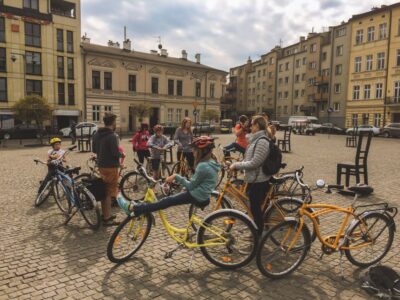
Bike Tour of the Old Town, Kazimierz, and the Ghetto
Read our review →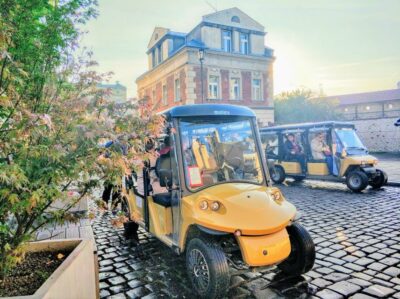
Jewish Quarter and Ghetto Electric Golf Cart Tour
Read our review →
Browse the lists this tour appears in