
Reviewed · CYCLING TOURS
3-Hour E-Bike Tour In Krakow
Krakow is compact, but its most important sights are spread across several distinct districts. This three-hour ride links the medieval Old Town, Wawel Hill, the Vistula riverfront, Kazimierz, and the former ghetto in one moving lesson about the city. You cover a lot without spending the day on foot.
I like the small maximum group of 15 and the frequent stops, which make it easier to hear the guide and take photos. I also like that local guides such as Michael, Chris, Mick, Krzysztof, Alex, and Tom bring practical advice about food and places to visit after the ride.
The main consideration is that the route is mostly a sightseeing circuit, not a museum visit. You do not enter Wawel Castle, Schindler’s Factory, the churches, or other buildings requiring admission, and busy streets can slow the group.
Key Points at a Glance
- One ride, several Krakow districts: Connect the Old Town, Wawel, the river, Kazimierz, the former ghetto, and the medieval city walls.
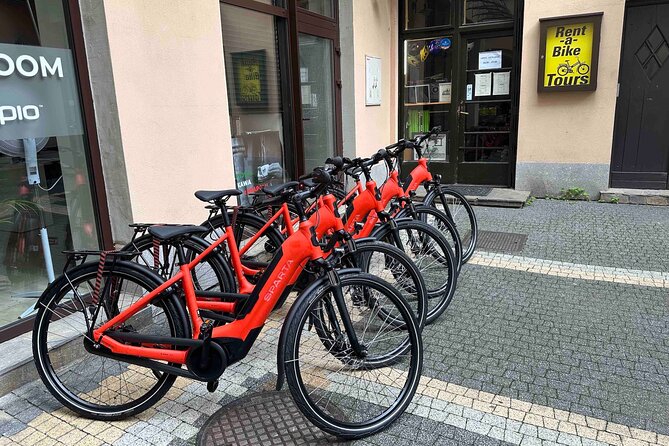
- Comfortable bikes for city streets: Sparta C-Grid e-bikes include front suspension, a useful feature on Krakow’s cobbled streets.
- A strong first-day activity: The route gives you a quick sense of direction, helping you decide where to return for a longer visit.
- History is explained at street level: Expect stories about kings, Jewish Krakow, World War II, Oskar Schindler, and the city’s legends.
- Mostly flat cycling: Several riders found the regular bicycle would have been enough, though the motor helps if you want an easier ride.
- Practical extras: Bike use, a local English-speaking guide, taxes, and a rain poncho if needed are included.
Why This Three-Hour Route Works
The appeal here is not speed. It is range. In a short morning or afternoon, you move through the parts of Krakow that most first-time visitors want to understand.
The ride begins at Sławkowska 11, near the Old Town, where the staff set you up with a bike and explain how it works. You can use the toilet before setting off. The staff can also provide instructions if you need help with the bicycle.
The route uses no or low-traffic streets where possible. That matters in a historic center where pedestrians, trams, cars, bicycles, and uneven paving all share limited space. You should still pay attention, especially when the city is crowded, but the ride is designed for sightseeing rather than athletic cycling.
The tour is offered in English, and the guide is an important part of its quality. The guide names associated with the experience include Michael, Chris, Mick, Krzysztof, Alex, Christopher, and Tom. The exact guide depends on the day, but the strongest pattern is clear: expect plenty of historical explanation, local stories, and suggestions for places to eat or visit later.
A few more Krakow trips to weigh up
- Complete Cracow Bike Tour (small group of maximum 15 people!)
★ 5.0 · 1,322 reviews - Krakow: Bike Tour of Old Town, Jewish Quarter and the Ghetto
★ 4.9 · 1,155 reviews - Highlights of Krakow Bike Tour – Small group
★ 5.0 · 662 reviews
Market Square and Collegium Maius
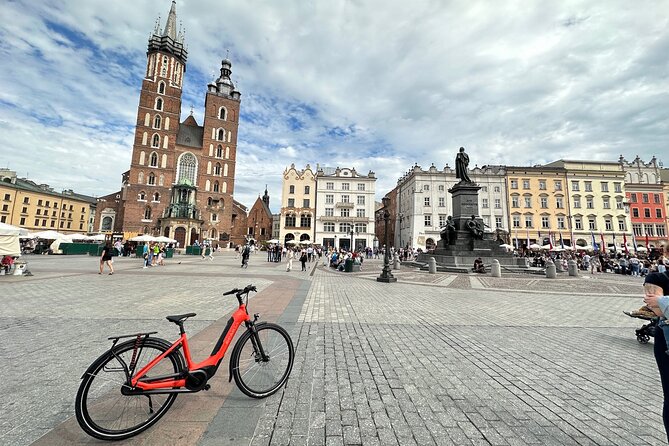
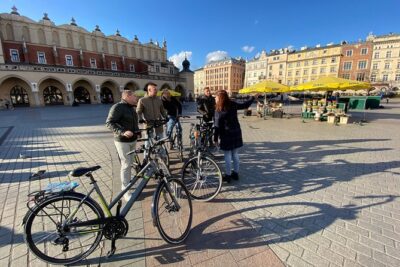
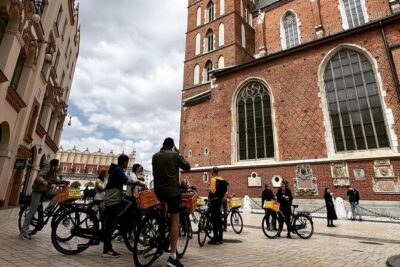
The first major stop is Stare Miasto, Krakow’s Old Town. You arrive at the enormous medieval Market Square, where the Cloth Hall occupies the center and St. Mary’s Church dominates one edge.
This is a good place to begin because Krakow’s old center is not just a pretty square. It was the commercial and civic heart of the medieval city. The Cloth Hall was a shopping center in the Middle Ages and remains one of the square’s defining buildings.
You also see the remains of the old Town Hall Tower. The stop lasts about 15 minutes, enough for an explanation and some photographs, but not enough for a careful look inside any building. If you want to hear St. Mary’s famous trumpet call, you will need to return on your own.
From there, the bicycle moves to Collegium Maius, the oldest building of Jagiellonian University. The guide connects the site with Nicolaus Copernicus, who studied at the university. This is a brief stop, but it gives useful context about Krakow as a center of learning as well as royal power.
I like this opening because it quickly establishes the city’s two sides: public medieval life in the square and serious academic life behind university walls.
Wawel Hill and the Fire-Breathing Dragon
The route continues toward the Vistula and Wawel Hill. At the Dragon Monument, you hear the old story of the monster defeated by a clever cobbler. The dragon still breathes fire, making this one of the tour’s easiest moments for children to enjoy.
The stop is short, around 10 minutes, so treat it as a quick photo opportunity and a bit of Krakow folklore. The story helps bring the city to life before the guide turns to more serious royal history.
Nearby, Wawel Royal Castle rises above the river. Your guide explains the importance of Wawel Hill as the former seat of Polish kings. You do not go inside the castle, so this part works best as an introduction. I would return later if you want the royal apartments, treasury, cathedral interiors, or longer views from the hill.
The route then follows the Vistula on one of Krakow’s pleasant cycle paths. This is one of the more relaxing sections. After the tight streets and historic buildings, the river gives you room to pedal and see the city from a different angle.
The e-bike is useful here if you want to keep moving without much effort, but the route itself is not a serious physical challenge. Several riders found the city largely flat and said a standard bicycle would have worked. The motor is still helpful for anyone who prefers gentle pedaling, is traveling with a mixed-ability group, or simply wants to conserve energy for sightseeing.
Kazimierz, Once a Separate City
The ride next reaches Kazmierz, more commonly spelled Kazimierz, the former Jewish district. This is one of the most valuable parts of the route because it gives you a sense of Krakow beyond the postcard center.
The district was once a separate city and an important center of Jewish life. The guide explains how it developed and how it later became part of Krakow. Today, you pass cafés, bars, and small galleries, but the tour does not reduce the area to nightlife. The better guides connect the current streets with the people and communities who shaped them.
At the former medieval market square of Kazimierz, you hear more about the district’s growth. The stop lasts about 10 minutes. It is enough to understand the layout, but not enough to explore the surrounding streets in detail.
Szeroka Street is another key stop. Despite its name, it feels more like a square. It was once the center of Jewish Kazimierz and later appeared as a ghetto square in Steven Spielberg’s story of Oskar Schindler. The guide helps separate film imagery from the actual history of the place.
You should expect a sober change in mood as the tour moves from medieval Krakow to the events of the Second World War. The route does not present a full museum lesson, but it gives you the basic map and context needed for a later visit to the Jewish cemeteries, synagogues, or museums.
Same country, a completely different kind of day:
- From Krakow: Auschwitz-Birkenau Guided Tour & Hotel Pickup
★ 4.5 · 33,358 reviews - From Krakow: Auschwitz-Birkenau Guided Tour & Hotel Pickup
★ 4.5 · 29,340 reviews - Krakow: Auschwitz Guided Tour with Optional Hotel Pickup
★ 4.5 · 15,280 reviews - Krakow–Zakopane: Cable Car, Chocholow Baths, Cheese & Vodka
★ 5.0 · 10,720 reviews
The Former Ghetto and Schindler’s Factory
At Plac Bohaterów Getta, the former Main Ghetto Square, you see the Empty Chairs memorial. The chairs represent the people forced from their homes and the possessions left behind during the wartime destruction of Krakow’s Jewish community.
This is a short stop, but it deserves your attention. The memorial is simple and difficult to misunderstand. Your guide can explain why the square matters, while the layout of the surrounding streets makes the history more immediate than a distant date in a textbook.
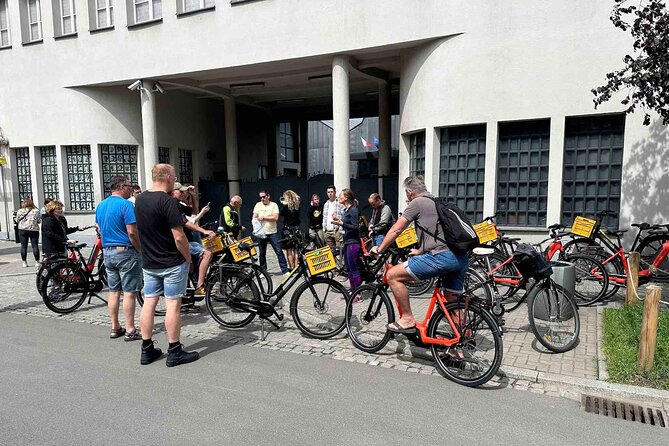
The route then pauses outside Oskar Schindler’s former enamel factory. You see the main building, but admission is not included and the group does not go inside.
That limitation is worth planning around. If you want to visit the museum, arrange a separate ticket and return with enough time to see it properly. The bike tour gives you orientation and background, but it cannot replace the museum’s exhibits.
I consider this section especially useful for first-time visitors who know Schindler’s name but want to place the story within Krakow itself. The guide can show how Kazimierz, the ghetto, and the factory relate geographically. That connection is one of the tour’s strongest benefits.
Green Streets Back to the Medieval Walls
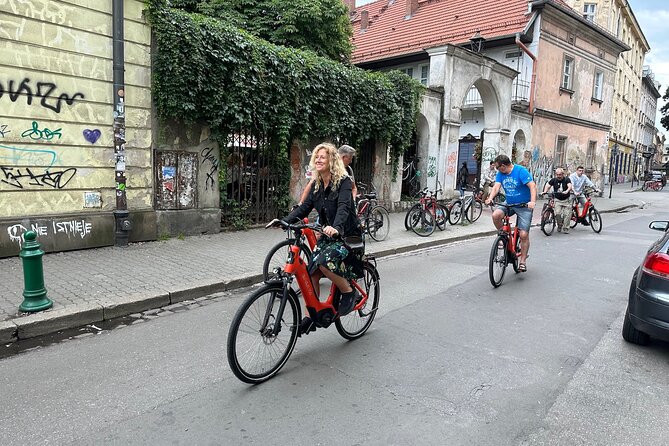
After the heavier history of the ghetto and Schindler’s factory, the route shifts to a quieter ride through a Krakow garden and picturesque alleys. This creates a useful pause before the final Old Town sights.
The exact character of this section depends on traffic, weather, and the group’s pace. It is not presented as a major sightseeing stop, but it gives your legs a rest and brings you back toward the medieval fortifications.
At the Barbican, you see one of the best remaining pieces of Krakow’s old defensive system. The circular brick structure once protected the city gate and helped guard the approach to the Old Town.
The final stop is St. Florian’s Gate, the medieval entrance to the city and the start of the Royal Way. Polish monarchs used this route when entering Krakow. The guide’s explanation helps tie together the castle, the old city, and the ceremonial road between them.
The final stops are short, around 10 minutes each. That is enough for photographs and orientation, but you should not book this ride expecting long visits at each monument.
What the E-Bike Adds
Krakow’s route is mostly flat. One rider noted that an e-bike was not really needed, while others appreciated the easy ride and the quality of the bikes.
The Sparta C-Grid e-bikes have front suspension, which is useful on cobblestones. That does not turn every street into smooth pavement, but it can make the ride more comfortable than a basic city bicycle.
I would choose the e-bike if you want to cover more ground with less effort, if your group has different fitness levels, or if you are visiting in cold weather and want to avoid arriving tired. I would choose a regular bike if you enjoy easy city cycling and want to keep the price down.
The e-bike also helps the guide maintain a steady pace. You are not racing, but you are moving between districts efficiently. That is why the tour works well on your first day in Krakow: you see the major areas, then return later to the ones that catch your interest.
Price, Group Size, and What You Get
The listed price is $66.37 per person for about three hours. That is not the cheapest way to see Krakow, especially because entrance fees are not included and the route passes outside the main museums.
Still, the value depends on how you use it. You are paying for the bicycle, the guide, local taxes, route planning, and a city orientation that would take much longer to piece together independently. The tour also links areas that are easy to treat as separate visits.
A maximum of 15 people keeps the group manageable. Some departures may be smaller, and a small group makes it easier to ask questions and stay close to the guide. Larger groups can feel slower in crowded parts of the Old Town, so the group limit is a real advantage.
The activity ends where it begins, at Sławkowska 11. Food and drinks are not included. A rain poncho is available if necessary, but the tour requires good weather and may be rescheduled or refunded if conditions are poor.
Book at least a day ahead if you need flexibility. Free cancellation is available up to 24 hours before the start time. The activity also requires a minimum number of participants, so a cancellation for that reason may result in a new date, another experience, or a full refund.
Who Should Book This Ride
I would recommend it most strongly to first-time visitors who want a quick map of Krakow. It is also a good fit for families with children, couples, and anyone who prefers seeing a city actively instead of spending three hours indoors.
The tour suits you if:
- You want the Old Town, Wawel, Kazimierz, and the former ghetto in one outing.
- You enjoy history explained through places rather than only through museum displays.
- You want advice about what to eat or see after the tour.
- You are comfortable cycling in a city and can follow safety instructions.
- You prefer a guided overview before choosing which sites deserve a longer visit.
It may not suit you if you want extended time inside museums or churches. It is also less appealing if you dislike cycling, though the route is considered manageable and largely flat.
Bring clothing suited to the weather. One rider specifically advised a hat, scarf, and gloves in autumn. The company supplies a poncho if needed, but you should not treat that as a substitute for planning ahead.
Should You Book the 3-Hour Krakow E-Bike Tour?
I would book this early in a Krakow visit, ideally on the first day. The ride gives you a useful mental map, introduces the city’s major stories, and shows where you may want to return for a closer look.
The strongest reasons to book are the route, the local guiding, the comfortable bikes, and the number of districts covered in only three hours. The main tradeoff is that nearly every stop is an exterior visit.
At $66.37, it makes sense if you value a friendly guide and efficient orientation more than saving every dollar. Choose the regular-bike version if available and you are comfortable cycling on mostly flat streets. Choose the e-bike when comfort, easy pedaling, or mixed fitness levels matter more.
With a 4.9 rating from 79 reviews and 99 percent of customers recommending it, this is a well-regarded introduction to Krakow. I would not use it as your only history experience, but I would gladly use it to get my bearings before exploring the city on foot.
FAQ
Where does the Krakow e-bike tour begin?
The tour begins at Sławkowska 11, 31-016 Kraków, Poland.
Where does the tour end?
The activity ends back at the meeting point on Sławkowska Street.
How long does the tour last?
The tour lasts approximately three hours.
Is the tour offered in English?
Yes. The tour is offered in English.
Are entrance fees included?
No. The tour does not enter museums or buildings requiring admission, and entrance fees are not included.
Is the route suitable for children?
Most people can participate, but children must be accompanied by an adult.
What happens if the weather is poor?
The experience requires good weather. If it is canceled because of poor weather, you will be offered a different date or a full refund.
More 3-Hour Experiences in Krakow
- Krakow: 3-Hour Small Group Tour on E-Bike
★ 4.8 · 135 reviews - 3-Hour Novice Ski Adventure & Relaxing Zakopane or Baths Combo
★ 5.0 · 93 reviews - Krakow 3-Hour Craft Beer Tour
★ 5.0 · 17 reviews - Zakopane: 3 hours Snowmobiles Guided Tour with bonfire and meal
★ 4.5 · 14 reviews
Just added around Krakow
- From Krakow: Zakopane and Dunajec River Rafting Tour★ 4.6 · 31 reviews
- From Krakow: Zakopane and Gubałówka Cable Car Private Tour★ 4.3 · 12 reviews
- From Krakow: Zakopane Full-Day Tour with Lunch Option★ 4.4 · 62 reviews
- From Krakow: Zalipie and Painted Village Guided Tour★ 4.0 · 4 reviews
- From Krakow: Zakopane Tatra Mountains & Hot Springs Tour★ 3.0 · 29 reviews
- From Krakow: Zakopane and the Tatra Mountains★ 4.7 · 36 reviews
- From Krakow: Hot Springs and Zakopane with Gubałówka★ 4.7 · 25 reviews
- Zakopane & Tatra Mountains Private Full-Day Tour from Krakow★ 4.5 · 33 reviews
Cycling Tours, compared.
Complete Cracow Bike Tour (small group of maximum 15 people!)
Read our review →
Bike Tour of Old Town, Jewish Quarter and the Ghetto
Read our review →
Full Bike Tour – the Old Town, Jewish Qtr & the Ghetto NEW BIKES
Read our review →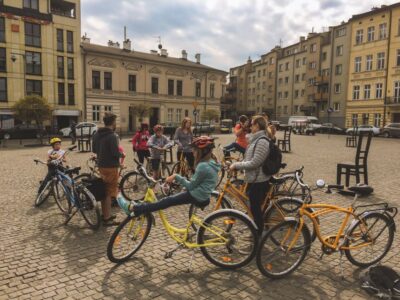
Bike Tour of the Old Town, Kazimierz, and the Ghetto
Read our review →
Half-Day Warsaw City Sightseeing Bike Tour for Small Group
Read our review →Browse the lists this tour appears in