Reviewed · GUIDED
Guided Tour of Plaszow Concentration Camp, Kraków
Plaszow is not a museum filled with barracks and display cases. It is an open, quiet place of memory, where the camp must be understood through memorials, fragments, cemeteries, and the shape of the ground. A guide helps you read what is easy to miss.
I like the careful pace and the way the tour links Plaszow to the Kraków Ghetto and Oskar Schindler’s wartime factory. I also like that the guide makes time for questions. One visitor had a private-feeling outing and praised the guide’s patient explanations, while another called the guide passionate and detailed.
The main consideration is emotional and practical: much of the visit takes place outdoors, with few surviving buildings. If you want a traditional museum experience, this may feel sparse. If you want a quiet place to face difficult history, the emptiness is part of the point.
Key points to know before you book
- Plaszow began on two Jewish cemeteries: The camp was created in October 1942 after the Kraków Ghetto was liquidated.
- The tour connects several layers of history: You learn about Jewish prisoners, Polish prisoners, Hungarian Jews sent onward to Auschwitz, and the camp’s changing role.
- The Grey House and ruined pre-burial hall help anchor the visit: These are among the few remaining physical traces.
- Schindler’s story is handled as part of Plaszow’s history: His enamelware business secured work permits and later helped move more than 1,000 people to safety.
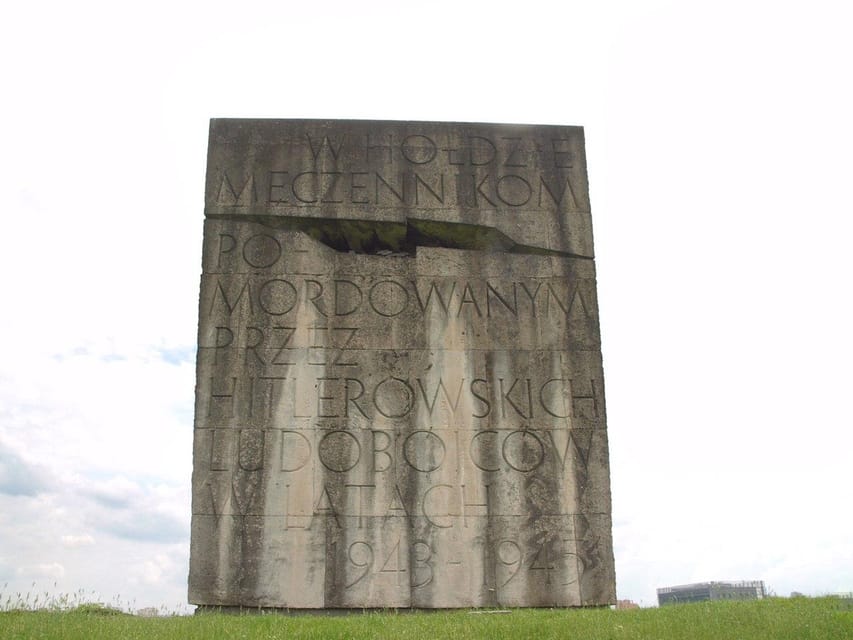
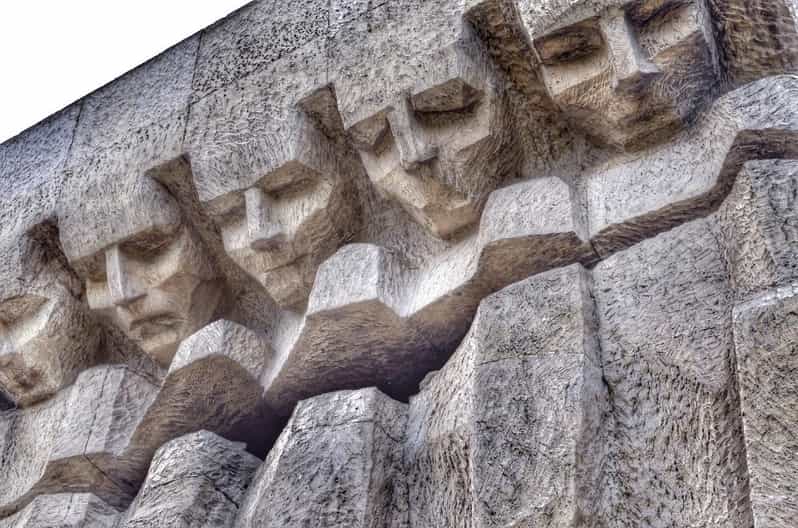
- The Monument of Torn-Out Hearts is a major pause point: Memorials and mass-grave sites give the walk its solemn focus.
- A tram ticket is included: Arrive 10 minutes early and look for the guide holding an excursions.city sign.
Why Plaszow requires a guided walk
Plaszow can be difficult to understand on your own because so little of the original camp survives. You may see open ground, a few ruins, memorials, cemetery traces, and paths, but without context the connections are not always clear.
That is where this two-hour tour earns its keep. Your guide explains how the camp was laid out, where its main sections were located, and how its purpose changed over time. You are not simply walking from one monument to the next. You are learning how a working camp, prison, execution site, and transit point occupied the same area.
I would not choose this tour for fast sightseeing. The route is paced for reflection rather than a checklist of stops. That means you have time to listen, ask questions, and absorb the meaning of each place.
The strongest part of the experience is the contrast between the quiet setting and the violence that took place here. Plaszow does not need dramatic staging. Its silence asks you to do more of the thinking yourself.
A few more Krakow trips to weigh up
- From Krakow: Auschwitz-Birkenau Guided Tour & Hotel Pickup
★ 4.5 · 33,358 reviews - From Krakow: Auschwitz-Birkenau Guided Tour & Hotel Pickup
★ 4.5 · 29,340 reviews - Krakow: Auschwitz Guided Tour with Optional Hotel Pickup
★ 4.5 · 15,280 reviews
From Jewish cemeteries to forced-labor camp
Nazi German occupiers established Plaszow in October 1942 on the grounds of two Jewish cemeteries in Kraków. It first served as a forced-labor camp for Jewish people from the liquidated Kraków Ghetto.
That origin matters. You are not looking at an isolated camp built without connection to the city. Plaszow grew out of the occupation’s destruction of Kraków’s Jewish community and the forced movement of people from the ghetto into imprisonment and labor.
From July 1943, the site also held Poles in a separate penal-labor section. In January 1944, the camp was redesignated as a concentration camp. Later, it functioned as a transit camp for Hungarian Jews being sent to Auschwitz.
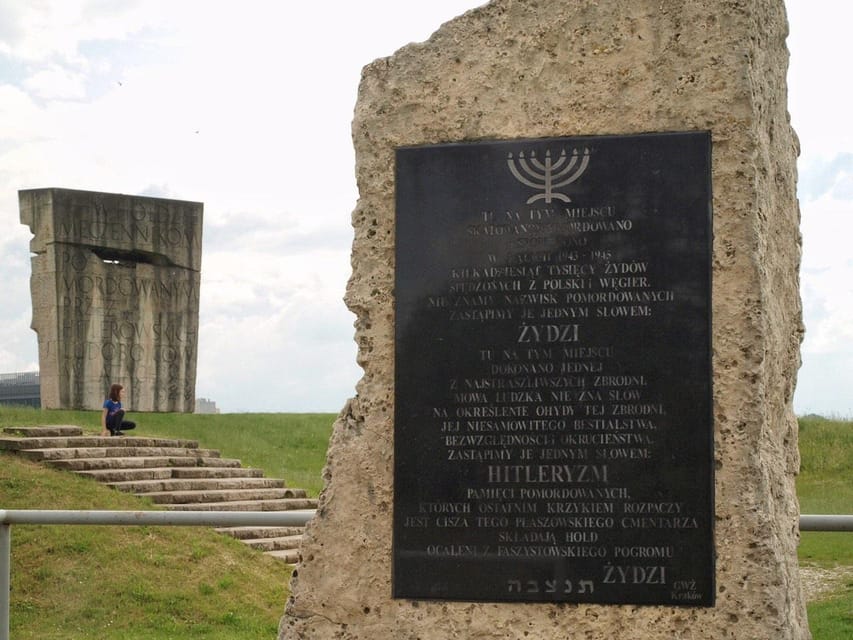
Your guide brings these changes into focus as you walk. More than 35,000 people were imprisoned at Plaszow during its existence, and around 6,000 were murdered. Executions took place at several locations within the camp, while mass graves and memorials now mark parts of the area.
This background gives the walking route its shape. Each surviving trace is tied to a larger system of imprisonment, labor, deportation, and murder.
The Grey House and the camp’s surviving traces
The Grey House is one of the key places on the route. Along with the ruins of the pre-burial hall, it helps you picture the camp as a functioning institution rather than an empty field.
You also see traces of the Jewish cemeteries. In places, paths were paved with fragments of gravestones. That detail is especially hard to forget because it shows how the camp authorities treated an existing place of Jewish memory.
The remains are limited, and your expectations should be realistic. This is not a preserved camp with rows of complete barracks or a large indoor exhibition. You will not move through a fully reconstructed compound.
Instead, the guide uses the pieces that remain to explain what once stood here. I find that approach more honest than a heavy reconstruction. It also means you need to pay attention. A ruin, path, or patch of ground may carry more meaning after an explanation than it did when you first saw it.
The guide also explains the camp’s living, hospital, administrative, and industrial sections. These details help you understand that Plaszow was not a single-purpose prison. Its different areas served different functions within the camp system.
Roll calls, executions, and memorial places
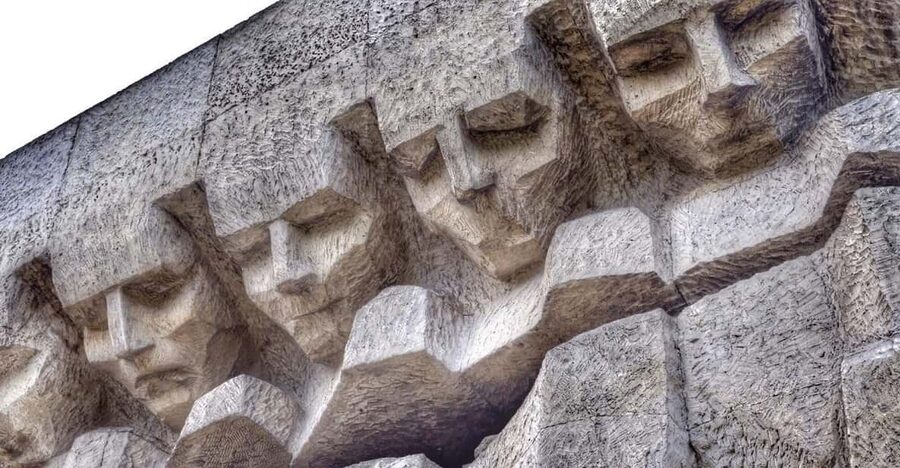
The roll-call square is another important stop. Roll calls were part of the daily control of prisoners, and the square helps you imagine the camp as a place of discipline and forced routine.
The route also addresses the execution sites. These are not presented as sensational stops. The value comes from understanding how several places within Plaszow were used for killings and how memorials now mark the dead.
The Monument of Torn-Out Hearts is the most prominent memorial named for the tour. It gives you a place to pause and consider the human cost behind the numbers.
I appreciate that the route does not rush from one point to another. The subject needs time. The guide’s job is not only to provide dates, but to help you connect the physical setting with the people who were imprisoned and killed here.
The memorials also make clear why Plaszow should be approached with respect. It remains a place of remembrance, not a backdrop for casual entertainment.
Same country, a completely different kind of day:
- Krakow–Zakopane: Cable Car, Chocholow Baths, Cheese & Vodka
★ 5.0 · 10,720 reviews - Krakow: Auschwitz-Birkenau Guided Tour with Pickup & Lunch
★ 4.5 · 9,800 reviews - From Krakow: Wieliczka Salt Mine Tour
★ 4.6 · 9,393 reviews - Krakow: Auschwitz-Birkenau Guided Tour Pickup/Lunch Options
★ 4.5 · 9,057 reviews
Oskar Schindler’s connection to Plaszow
Plaszow’s history is closely tied to Oskar Schindler, whose story became known around the world through the film Schindler’s List. The tour explains his role without separating it from the wider camp system.
Through his enamelware enterprise, Schindler obtained work permits for Jewish prisoners registered through Plaszow. Those permits helped shield them from further transports. Later, he organized their transfer to his wartime plant in Brünnlitz, saving more than 1,000 lives.
That story is important, but Plaszow gives it a necessary setting. Schindler’s actions took place within a system that imprisoned thousands of people and killed around 6,000. The guide can help you hold both facts together.
You also learn about filming locations connected with Schindler’s List. This will interest anyone who has seen the movie, but the film connection should not become the main reason to visit. The real subject is the history of Plaszow and the people who suffered there.
I like the way the film reference can serve as a doorway into the site. It gives you a familiar point of contact, then the tour moves beyond the movie to explain the actual camp.
What the two-hour route feels like
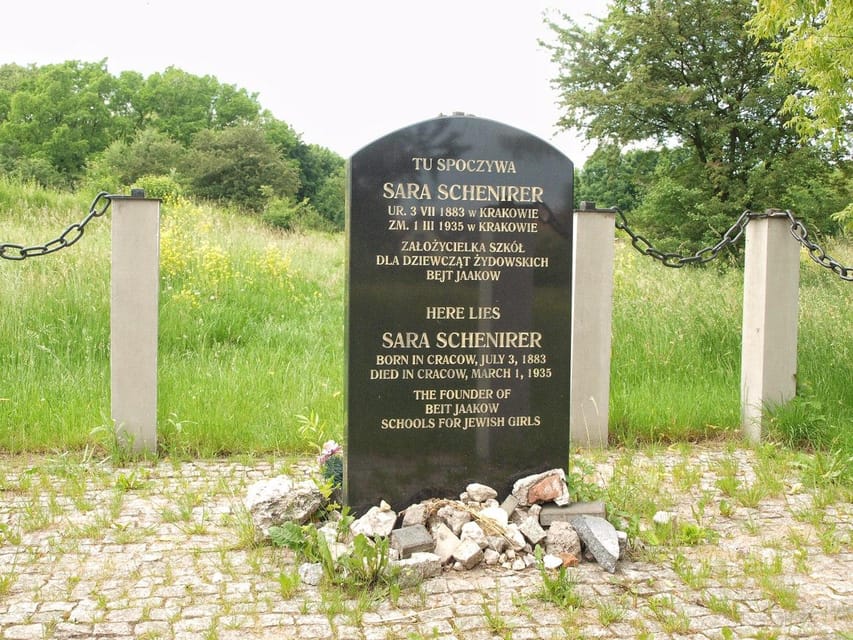
The length is well judged for a site this serious. Two hours gives the guide room to explain the history without turning the walk into an all-day commitment.
You should expect a route with several pauses at important remains and memorials. The supplied tram ticket covers a single tram journey connected with the activity, which is useful because you do not need to arrange every part of the visit separately.
Arrive at least 10 minutes before the start. Look for the guide holding an excursions.city sign. This is especially important because latecomers cannot join after the group has left, and the ticket cannot be refunded in that situation.
The tour is offered in English, and each group uses one language only. If you are booking for a mixed-language party, keep that rule in mind.
The pace is meant to leave room for reflection, not to get you through as many points as possible. That suits Plaszow. A hurried visit would give you facts but little time to consider them.
The guide makes the difference
At Plaszow, the guide is central to the experience. With so few original structures, the quality of the explanations shapes what you take away.
The strongest feedback points to patient, detailed guiding. One visitor described having plenty of time to ask questions, while another praised a passionate guide for explaining the camp in detail. Another account specifically described the guide as helpful and willing to answer every curiosity.
That matches what I would want here. You need someone who can explain the chronology clearly, identify what remains, and give you space when the subject calls for quiet.
The group size is not specified, so I would not book expecting a private tour. Still, the tour’s format allows questions, and the feedback suggests that a good guide will respond thoughtfully rather than simply recite a script.
No guide names are provided, so you cannot request a particular person when booking. The practical thing to look for is an English-speaking guide with the excursions.city sign at the meeting point.
Is $29 a fair price?
At $29 per person, the price is reasonable if you want historical context rather than only a walk around the memorials. The fee includes a licensed guide and a single tram ticket, so part of the basic transport is already covered.
The real value is the interpretation. Plaszow’s physical remains are limited, and you could visit the area without understanding how the cemeteries, camp sections, roll-call square, execution sites, and memorials fit together.
If you are comfortable reading a great deal before arriving and prefer to move at your own pace, a paid guide may feel less necessary. You would also avoid paying for a group experience if you want complete privacy.
For most visitors, though, the price makes sense because the guide provides the structure that the site itself cannot. I would especially consider it good value if Plaszow is your first visit and you want to understand its connection to the Kraków Ghetto, Auschwitz, and Schindler’s story.
Free cancellation up to 24 hours before the start and the option to reserve now and pay later add useful flexibility. They do not remove the need to arrive on time.
Who should take this tour
I would recommend it to you if you want to understand Kraków’s wartime history beyond the famous sights. It suits people who prefer a serious, place-based experience and who are willing to spend two hours outdoors with a guide.
It is also a good choice if you have seen Schindler’s List and want to separate the film’s locations from the full historical story. The movie connection is included, but the tour does not reduce Plaszow to a film set.
Families with older children may find the subject useful, though the material is grave. You should decide based on your child’s age and comfort with discussions of imprisonment and mass murder.
The tour is wheelchair accessible, which makes it more practical for many visitors. Still, the activity takes place across an open site, so anyone with mobility concerns may want to confirm the current route details before booking.
I would skip it if you want preserved interiors, a large collection of objects, or a light sightseeing stop between cafés. Plaszow offers none of those things. Its power comes from the sparse remains and the effort needed to imagine what is gone.
Practical details that matter
The tour lasts two hours and is conducted in English. Check the available starting times when booking, since the exact schedule is not fixed in the information provided.
Meet the guide by looking for the excursions.city sign. Arrive 10 minutes early. Once the group has departed, you cannot join it, and the ticket is not refundable for that missed start.
The tour includes one tram ticket, but no other inclusions are specified. The price is $29 per person.
You can cancel up to 24 hours in advance for a full refund. You can also reserve and pay later, which helps if your Kraków plans are still moving around.
The subject is serious, so give yourself a little breathing room after the tour if you can. The route is designed for reflection, and you may not want to rush straight into your next activity.
Should you book the Plaszow tour?
Book this tour if you want a guided reading of a difficult site that is easy to misunderstand alone. The excellent scores, repeated praise for patient and detailed guiding, and the chance to ask questions all support its value.
Choose it for the Grey House, cemetery traces, roll-call square, memorials, execution sites, and the fuller story behind Schindler. Do not choose it expecting a preserved camp or a standard museum visit.
At $29, with a licensed English-speaking guide and a tram ticket included, it is a fair buy for a serious two-hour experience. Arrive early, prepare for an outdoor walk, and give the site your full attention.
FAQ
How long does the Guided Tour of Plaszow Concentration Camp last?
The tour lasts two hours.
What language is the tour conducted in?
The tour is conducted in English. Group tours use only one language, so select English when booking.
How much does the tour cost?
The listed price is $29 per person.
What is included in the price?
The price includes a licensed guide and a single tram ticket.
Where do I meet the guide?
Look for the guide holding an excursions.city sign at the meeting point.
How early should I arrive?
Arrive 10 minutes before the tour begins. Latecomers cannot join after the group has departed, and tickets cannot be refunded in that case.
Is the tour wheelchair accessible?
Yes, the activity is listed as wheelchair accessible.
Can I cancel the booking?
Yes. You can cancel up to 24 hours in advance for a full refund.
Can I reserve now and pay later?
Yes. The reserve now and pay later option lets you book without paying at the time of reservation.
Just added around Krakow
- Tour to Wadowice: Hometown of Pope Saint John Paul II★ 4.6 · 12 reviews
- The Jewish Quarter – Walking Tour★ 5.0 · 4 reviews
- From Kraków; to Białka Thermal Baths private tour★ 5.0 · 5 reviews
- St. Mary’s Basilica and more – a short walk with a guide★ 4.7 · 56 reviews
- Krakow: Auschwitz-Birkenau and Wieliczka Salt Mine Day Trip★ 4.7 · 84 reviews
- Krakow: Skip-the-Line Wawel Castle & Old Town Guided Tour★ 4.9 · 23 reviews
- Krakow: Schindler’s Factory Guided Tour★ 4.2 · 12 reviews
- Shooting Range Experience!★ 4.8 · 66 reviews
Guided, compared.
Auschwitz-Birkenau Guided Tour & Hotel Pickup
Read our review →Auschwitz-Birkenau Guided Tour & Hotel Pickup
Read our review →
Auschwitz Guided Tour with Optional Hotel Pickup
Read our review →
Auschwitz-Birkenau Guided Tour with Pickup & Lunch
Read our review →
Auschwitz-Birkenau Guided Tour Pickup/Lunch Options
Read our review →
Krakow to Auschwitz Birkenau Guided Tour with Transfer and Ticket
Read our review →