
Reviewed · CITY TOURS
Private Tour: Warsaw City Sightseeing by Retro Fiat
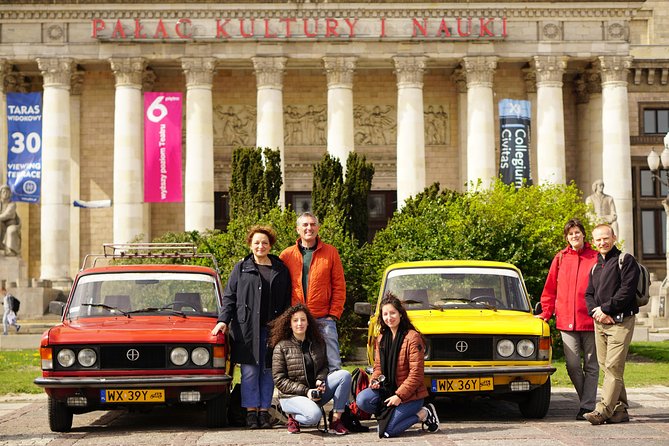
Warsaw’s past comes into focus from the front seat of a communist-era Fiat 125p, a boxy old Polish car that turns a standard city tour into a small piece of living history. Over about four hours, your private guide drives from the rebuilt Old Town to Soviet-era boulevards, royal gardens, and the eastern district of Praga.
I like the private, flexible format, since your guide can adjust the route for traffic, your interests, or a museum stop. I also like the local angle: guides such as Jacob, Karol, Maks, Martin, and Agata bring personal knowledge and plenty of stories about Polish life. The main drawback is comfort. The Fiat is small, and one review notes that it has no air conditioning, so a hot day may make the ride less charming.
Key points to know before booking
- A 1980s Fiat becomes part of the history lesson: Expect a small retro car that attracts attention as it moves through Warsaw.
- Hotel pickup and return are included: Your guide meets you in the lobby or outside your building within the pickup area.
- The route covers several eras: You move from medieval Warsaw and royal Poland to wartime destruction and communist rebuilding.
- Praga adds a different side of the city: If time allows, the tour crosses to the former rough-edged district now known for bars and cafes.
- Food is optional and paid separately: You can stop at a communist-era milk bar, while museum admission is also your expense.
- Four hours works well for a first look: You see many districts quickly, but some sights receive only a short stop.
Why the Fiat 125p makes this tour different
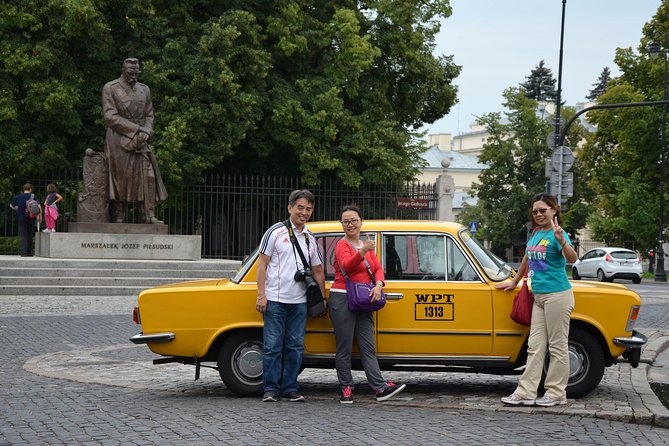
You can see Warsaw in a modern car, taxi, or sightseeing bus. The Fiat 125p gives the experience a more direct connection to the city’s recent past.
This was a common Polish car during the communist period, and its shape still carries a strong visual link to that era. Inside, space is limited, and the ride is not built for luxury. That is part of the charm, but also something to consider if you prefer a roomy vehicle.
The car makes the tour feel social. People notice it on the street, and it gives your guide an easy way to explain daily life during the years of communist rule. As you pass housing blocks, Constitution Square, and the MDM neighborhood, the vehicle feels like an appropriate traveling prop rather than a random novelty.
The private setup matters more than the car alone. Your group does not have to follow a fixed bus route or wait while strangers take photos. You can ask questions, change the pace, and request areas such as the former Jewish Ghetto or Praga. Guides have also adjusted routes around road closures, marathons, Christmas traffic, and other delays.
A few more Warsaw trips to weigh up
- Warsaw: Warsaw Ghetto Private Walking Tour with Hotel Pickup
★ 4.9 · 369 reviews - Private Tour: Warsaw’s Jewish Heritage by Retro Fiat
★ 5.0 · 208 reviews - Private Historical Tour of Warsaw by a Retro Fiat with Pickup
★ 5.0 · 190 reviews
Starting at your hotel and getting your bearings
Your guide picks you up at your Warsaw hotel at the agreed time, either in the lobby or in front of the building. Hotel drop-off is included at the end, which saves you from finding your way back after several hours of walking and sightseeing.
If your hotel falls outside the normal pickup area, you are asked to contact the operator so another meeting solution can be arranged. The tour is offered in English, and the guides described in the supplied material include Jacob or Jakob, Karol, Maks or Max, Martin, Agata, and Conrad.
The guide is doing two jobs at once: driving and interpreting the city. At stops, you get out for more detailed explanations and photographs. Between stops, the Fiat provides a moving view of Warsaw, though traffic can affect how much ground you cover.
This is a good first activity if you have only one day in Warsaw. It gives you a broad map of the city, helps you decide where to return on foot, and gives you historical context before you visit museums or monuments on your own.
Old Town and Castle Square: a rebuilt city center
The Old Town is the tour’s essential opening chapter. Its colorful facades, market square, city walls, churches, and narrow streets look centuries old, but much of what you see was rebuilt after World War II.
Your guide explains how Warsaw’s planners and architects reconstructed the center from original plans, paintings, and surviving records. That detail changes the way you look at the buildings. This is not simply an old European square preserved through time. It is a carefully recreated center built after enormous wartime destruction.
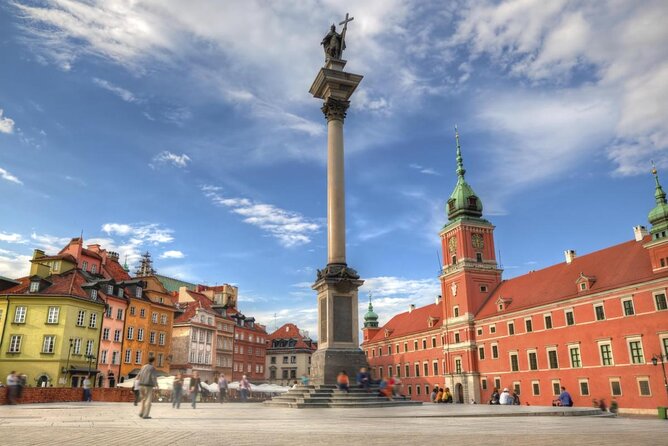
You spend about an hour exploring the Old Town area. Castle Square, or Plac Zamkowy, introduces the former residence of Poland’s monarchs. The square also gives you a useful view toward the Royal Route, the historic corridor lined with churches, palaces, parks, and important civic buildings.
You may visit an important Old Town church and hear about its role in Warsaw’s story. The guide also covers King Sigismund and why the royal capital moved from Kraków to Warsaw. These short explanations help connect the square to Poland’s political past instead of leaving it as a photogenic backdrop.
Expect some walking here. The ground is generally flat, but there are steps in places, and the tour is not a ride where you remain seated for four hours. Wear shoes you can use comfortably on cobblestones and pavement.
Old Town Square, the Mermaid, and the city walls
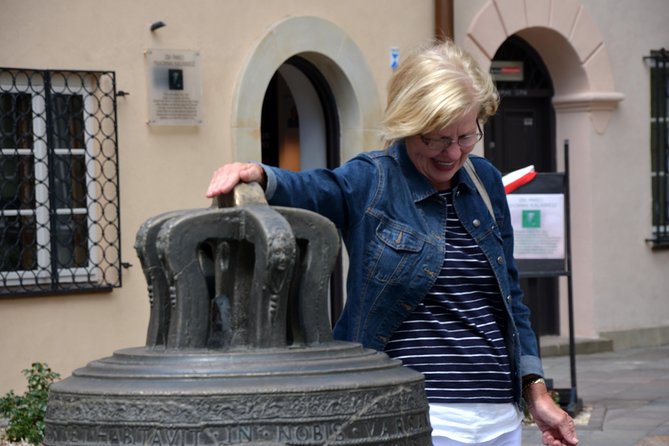
Rynek Starego Miasta is the heart of the old center. The square is compact enough to explore on foot, and the Warsaw Mermaid sculpture gives your guide a chance to explain one of the city’s best-known legends.
The mermaid is more than a statue for a quick photograph. It is a symbol used throughout Warsaw, and the local story adds a bit of folklore to the historical material. Your guide can also point out the remains of the fortifications that once encircled the city.
Other brief stops connect Warsaw to notable people and events. You may learn where the famous physicist Marie Curie was born, see a monument honoring Poles who fought the German Nazis, and hear how the wartime years shaped the city’s identity.
These stops are short, often about five minutes each. That is useful when you want an overview, but it means you should not expect a long museum-style presentation at every point. The value lies in the guide linking many small details into a larger explanation while you move through the city.
Same country, a completely different kind of day:
- Warsaw: Chopin Concert in the Old Town
★ 4.8 · 2,287 reviews - Warsaw: Traditional Galar Cruise on The Vistula River
★ 4.6 · 1,640 reviews - Warsaw: Old Town Highlights Walking Tour in English
★ 4.7 · 1,516 reviews - Warsaw Concert: Chopin – Painted by Candlelights with Wine
★ 4.8 · 1,442 reviews
The Royal Route and Łazienki Park
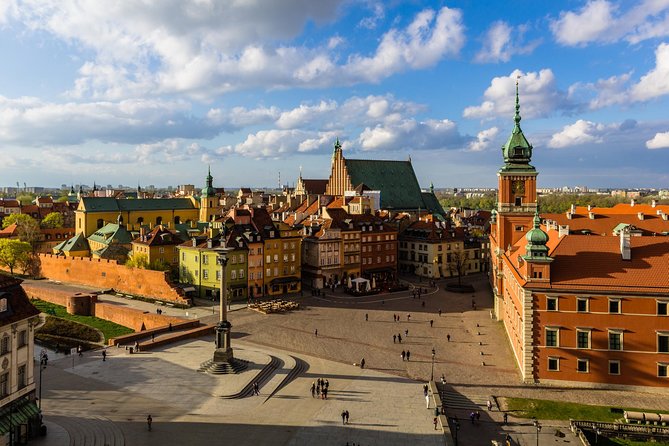
The route continues along the Royal Route, one of Warsaw’s most important sightseeing corridors. You pass churches, palaces, parks, and other buildings tied to Poland’s royal and national story.
Łazienki Królewskie, also called the Royal Baths Park, gives you a welcome change from city streets. About 30 minutes are planned here, enough to see part of Warsaw’s largest park and admire the palace complex.
Your guide explains the royal summer residences and points out details such as the initials above one of the buildings. The park is especially useful as a pause in the tour. After the dense architecture of the Old Town and central Warsaw, open paths and palace grounds give the afternoon a calmer rhythm.
The stop is not a full park tour. You will not see every corner in half an hour, and the exact amount of time can depend on traffic and your chosen route. Still, it gives you the basic setting and enough context to decide if you want to return later.
The itinerary may also include the National Stadium, built for the 2012 UEFA European Football Championship. It offers a look at modern Warsaw and helps show how the city has continued to change beyond its royal and communist chapters.
Communist Warsaw at Constitution Square and the Palace of Culture
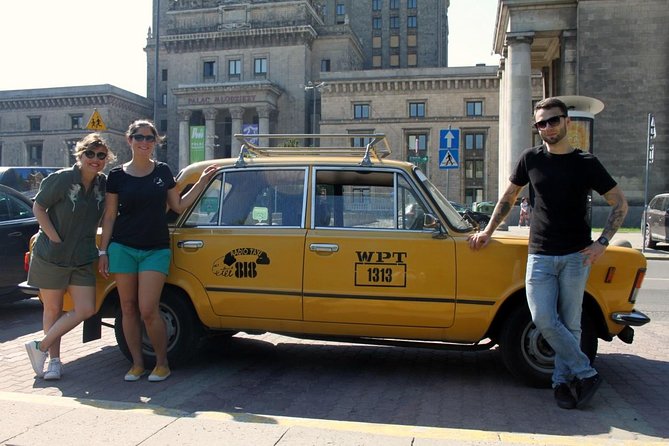
For many people, the most useful part of this tour is the explanation of postwar communist Warsaw. Constitution Square and the MDM neighborhood present the period through grand proportions, heavy stone decoration, housing blocks, mosaics, and broad streets.
A guide can point out details that are easy to miss from a normal taxi. Stone carvings and ceiling mosaics may look like decoration until you learn how they fit the design language and political message of the 1950s.
The Palace of Culture and Science is the largest symbol of this period. Its size makes it impossible to overlook, but its meaning is less obvious without context. The building was presented by the Soviet Union as a gift to Warsaw during the years when Poland was being rebuilt under communist rule.
Your guide explains the mixed feelings surrounding that gift, from the official message to the way many locals viewed the building. You may stop for about 30 minutes, but entry is not included. The tour focuses on seeing the building and understanding its place in the city rather than guaranteeing access to the interior or observation deck.
This is one place where a private guide earns the price. A photograph shows a tall building. A good explanation tells you why the building remains politically loaded and why it is still one of Warsaw’s clearest city symbols.
Praga: Warsaw across the river
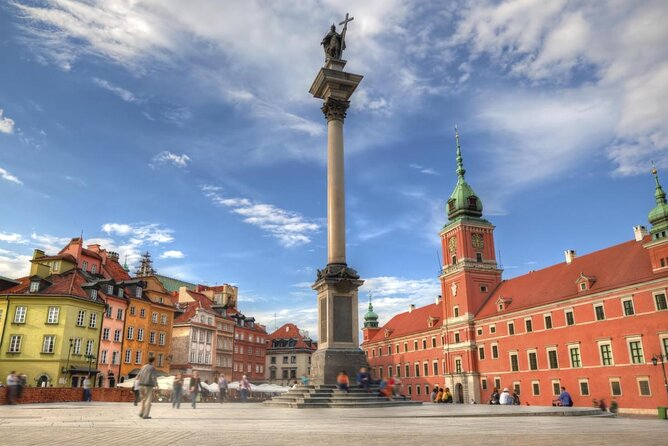
If time allows, the tour heads to Praga Północ on the eastern side of the Vistula. This district offers a contrast to the polished Old Town and central avenues.
Praga was once known for rougher streets and a reputation for danger. Today, the area is associated with bohemian bars, cafes, and a different urban mood. The tour can include a street once considered one of the most dangerous in Warsaw and the site of a famous black market during communist Poland.
The Praga stop is planned for about 30 minutes, but it is specifically time dependent. If traffic slows the route or you choose extra stops, your guide may shorten or skip it. If you want Praga, say so early in the tour.
I consider this one of the best reasons to choose a private car instead of a basic central sightseeing route. You get a look at the eastern side of Warsaw and see how the city’s districts developed differently. It is not a polished postcard stop, and that is exactly why it can add useful perspective.
The former Jewish Ghetto and custom stops
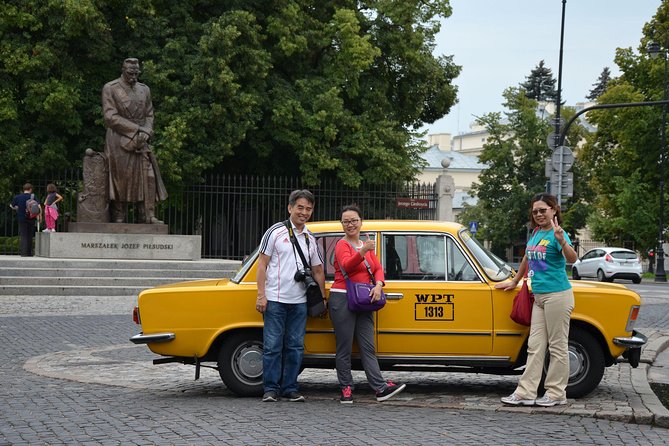
The route is not locked to the listed sights. You can ask to see the former Jewish Ghetto, add a museum of your choice, or request another point of interest in Warsaw.
Museum admission is not included, so the value of this option is flexibility rather than a free entry ticket. If you have a particular museum in mind, confirm the plan with your guide at the start and allow enough time for traffic, walking, and the visit itself.
The same applies to the former Jewish Ghetto. The tour can point you toward that important area, but the supplied information does not promise a set museum entry or a fixed length of stop. Ask for the exact plan before setting out.
Private touring works best when you arrive with two or three priorities rather than a long wish list. For example, you might choose Old Town, communist Warsaw, and Praga, or Old Town, Łazienki Park, and a museum. Trying to fit every possible district into four hours could turn the experience into a race.
Milk-bar food and the small onboard extras
A stop at a milk bar adds a distinctly Polish touch. These government-subsidized cafes served inexpensive home-style food during the communist period, and some continue to operate today.
You pay for the meal yourself. The point is not fine dining. It is a chance to try ordinary Polish fare in a setting tied to the country’s social history. Ask your guide to explain how milk bars worked and why they remain part of the national memory.
During the drive, the experience description also includes a snack with a beer or a shot of vodka. Treat this as a small social extra, not as a meal. If you do not drink alcohol, make your preference clear to the guide.
The larger meal stop may affect the sightseeing pace. If you want all the listed districts, keep the food break brief. If the milk bar is one of your main interests, accept that another stop may need to be shortened.
Timing, comfort, and value at $108.23 per person
The listed price is $108.23 per person for roughly four hours. That is not the cheapest way to see Warsaw, but this is a private tour with hotel pickup, a dedicated guide, and a custom route.
I see the best value for couples, families, and small groups who want to ask questions without competing with a busload of people. Group discounts are available, so the per-person cost may make more sense as your party grows.
You are paying for interpretation as much as transportation. A standard taxi can take you past the Palace of Culture or Łazienki Park, but it will not necessarily explain the political meaning of the buildings, the reconstruction of the Old Town, or the local story behind Praga’s black market.
The main tradeoff is physical comfort. The Fiat is small, and a review specifically notes that it lacks air conditioning. Another describes manual steering and manual transmission. On a hot day, the car may feel cramped, and on a busy day, traffic can reduce the time available at stops.
The tour also involves walking, including steps and uneven historic surfaces. Most people can participate, but you should be comfortable getting in and out of a small older vehicle and walking between nearby sights.
Who will get the most from this Warsaw tour
I would choose this tour if you want a fast but thoughtful introduction to Warsaw. It suits a first visit, a short stay, or a first morning before exploring museums and neighborhoods independently.
It is especially good for you if:
- You enjoy political and social history, not just landmark photographs.
- You want a private guide who can answer questions and change the route.
- You like unusual transportation and do not need modern-car comfort.
- You want to see both the tourist center and a less polished district such as Praga.
- You are traveling with a small group and can benefit from group discounts.
- You want hotel pickup and return without arranging city transport.
I would think twice if you dislike compact cars, need air conditioning, want extensive time inside museums, or prefer to explore each sight at a slow pace. The four-hour format covers a lot, but it does so by combining short stops with drive-by commentary.
Guide quality is important on a history-heavy tour. The supplied names include Jacob or Jakob, Karol, Maks or Max, Martin, Agata, and Conrad, but you should not assume you can select a particular person when booking. The strongest descriptions point to clear English, personal Warsaw knowledge, friendly conversation, and the ability to tailor explanations to your interests.
Should you book the retro Fiat tour?
Book it if you want Warsaw to make sense quickly, especially on a first day or during a short visit. The Fiat is fun, but the real reason to go is the combination of a private route and clear explanations of wartime rebuilding, communist rule, royal Warsaw, and modern districts.
The best plan is to tell your guide what matters most at pickup. Choose a few priorities, leave room for traffic, and decide if the milk bar or Praga matters more than a museum. If you can accept a small car and some walking, $108.23 per person is a reasonable price for a private four-hour overview with hotel service.
Skip it if you mainly want long interior visits or a cool, spacious vehicle. For everyone else, this is a lively way to get your bearings and see why Warsaw is far more complex than its neat reconstructed squares suggest.
FAQ
How long does the Warsaw retro Fiat tour last?
The tour lasts approximately four hours.
What vehicle is used?
You ride in a private, communist-era Fiat 125p.
Is hotel pickup included?
Yes. The guide picks you up from your hotel lobby or meets you in front of the building, depending on the hotel and pickup area.
Does the tour return to the hotel?
Yes. Hotel drop-off is included, and the activity ends back at the meeting point.
Is the tour private?
Yes. Only your own group participates.
Is the tour offered in English?
Yes. English is the listed tour language.
Does the tour visit Warsaw Old Town?
Yes. The route includes the UNESCO-listed Old Town, Castle Square, Old Town Square, the Warsaw Mermaid, city fortifications, and parts of the Royal Route.
Can the route include Praga or the former Jewish Ghetto?
Yes. You can ask to visit Praga or the former Jewish Ghetto, subject to available time and the route selected with your guide.
Is food included?
A snack with a beer or shot of vodka is described during the drive. A meal at a milk bar is at your own expense.
Are museum admissions included?
No. If you add a museum, admission is at your own expense.
Can I cancel for a full refund?
Yes, if you cancel at least 24 hours before the experience start time. Cancellations made less than 24 hours before the start time are not refunded.
Just added around Warsaw
- Taste of Poland, food tour and guided walk with 12 tasting★ 5.0 · 3 reviews
- Skip-the-Line Warsaw Royal Castle Private Guided Tour★ 5.0 · 4 reviews
- Secrets of Warsaw 4-hour Bike Tour★ 5.0 · 25 reviews
- Warsaw: Live Show at Sabat Theatre★ 4.5 · 11 reviews
- Private Warsaw City Tour★ 4.9 · 4 reviews
- Warsaw: WWII Private Tour by Retro Minibus with Hotel Pickup★ 5.0 · 7 reviews
- Private Tour From Warsaw: Łowicz Mazovian Countryside★ 5.0 · 10 reviews
- Packrafting kayaking guided tour Vistula river Warsaw Poland★ 4.5 · 14 reviews
City Tours, compared.
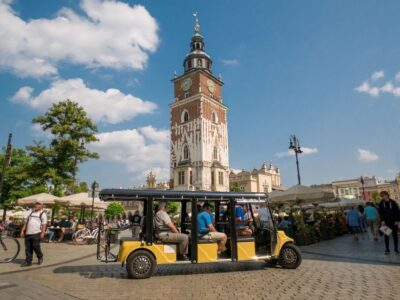
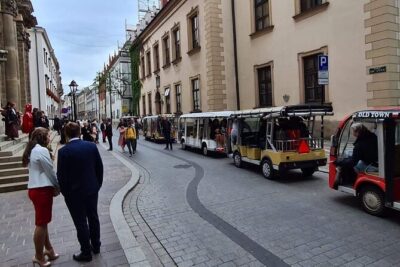
City Sightseeing Tour Eco Electric Buggy Golf Cart
Read our review →
Gdańsk City Sights & History Guided Walking Tour in English
Read our review →
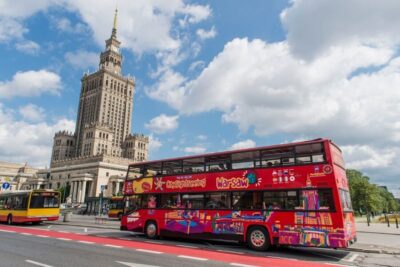
Extended City Sightseeing Tour – Eco Buggy Golf Cart
Read our review →
Browse the lists this tour appears in