
Reviewed · WALKING TOURS
Krakow: A Magical Walking Tour of the Old City – 120 min
Krakow’s story comes alive through its legends on this two-hour walk, from the dragon beneath Wawel Castle to the trumpet call at St. Mary’s Basilica. You’ll move through the city’s main square, royal route, medieval defenses, churches, and university quarter without paying separate admission at the listed stops.
I like the strong Old Town coverage and the way the route links famous sights with local tales. I also like that the guides can add personality: Vlad is praised for his command of Polish and Krakow history, while another guide led the tour in very good French. The main caution is the potential group size of 50, which may make questions and close contact with the guide harder.
Key points before you book
- Thirteen central stops: The route covers Krakow’s main square, Wawel, Kanonicza Street, churches, city gates, the Barbican, and Planty Park.
- Legends are part of the lesson: Expect stories about the Wawel Dragon, St. Mary’s Basilica, the Cloth Hall, and the towers of different heights.
- A useful first-day orientation: The tour links major sights in the Old Town and ends near Adam Mickiewicz’s monument on the central square.
- English is offered: The advertised language is English, with a guide also praised for leading an informative tour in French.
- About $36 per person: That is fair if you want a fast historical overview and help finding the city’s key landmarks.
- Large groups are possible: The maximum is 50 people, so arrive ready to walk at a steady pace and stay near the guide.
Starting on Wiślna Street and finding Krakow’s center
The walk begins at Wiślna 4, close to public transportation. The first stop is Rynek Glowny, Krakow’s central square, although the meeting point itself is listed separately from the square. For a smoother start, use the map in your confirmation and allow time to locate the exact address.
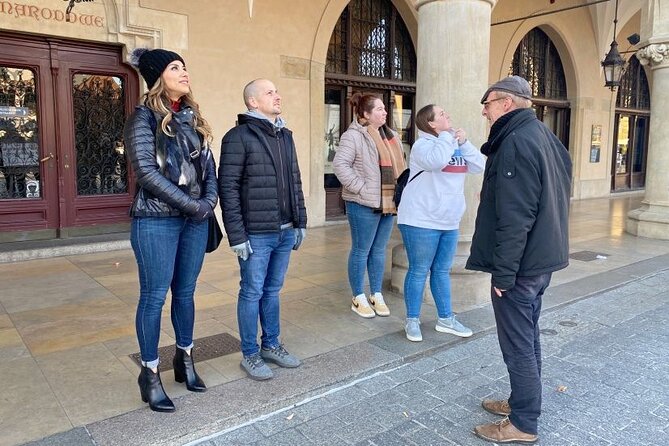
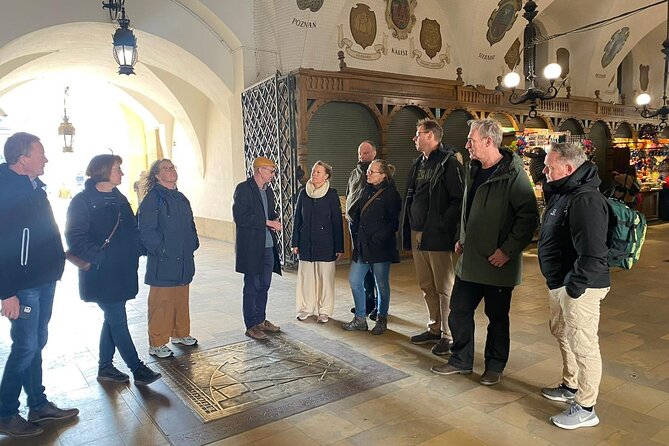
The opening discussion covers the square and its surrounding sights, including the Cloth Hall and St. Mary’s Church. This is a good place to begin because Krakow’s Old Town is not just a collection of pretty buildings. The square gives you the basic frame for understanding the city’s civic, religious, and commercial life.
The guide also brings in local legends. That matters in Krakow, where stories often explain why a building looks the way it does or why a particular custom continues. You should expect a spoken orientation rather than a museum visit. The listed admission is free, and the tour does not promise interior access to every church or building.
A few more Krakow trips to weigh up
- Old Town Krakow & Wawel Castle Walking Tour
★ 5.0 · 1,508 reviews - Creepy Krakow: 2-Hour City Walking Tour
★ 4.7 · 1,131 reviews - Krakow: The Old Town Walking Tour
★ 4.8 · 794 reviews
Following the Royal Way to Kanonicza Street
From the square, the route follows the Royal Way, or Droga Krolewska. The name points to Krakow’s past as a royal capital and to the ceremonial road leading toward Wawel. The guide explains why this route earned its grand title, giving you useful context for the streets you are walking.
Next comes Kanonicza Street, described as the oldest street in Krakow. This is one of the more appealing parts of the walk for anyone who prefers atmosphere over a checklist of monuments. The street connects the busy center with Wawel and offers a change of pace from the open square.
The stop at Church of St. Peter and St. Paul is brief, only about five minutes. That is enough for a focused explanation of the church, but not enough for a detailed architectural study or a long quiet visit. If this church matters to you, note its location so you can return independently.
Wawel Castle and the dragon below the hill
Wawel Royal Castle is the route’s major historical anchor. The guide discusses Poland’s kings and queens, making this stop especially useful if you are still sorting out Krakow’s place in Polish history. The scheduled talk is also short, about five minutes, so think of it as an introduction rather than a castle tour.
The itinerary does not list paid entry into Wawel Castle or its rooms. That keeps the walk simple and affordable, but you should not book it expecting a full castle admission experience. The value here is the guide’s explanation of the royal site and its place in the city.
The nearby Monument of the Wawel Dragon shifts the tone from royal history to folklore. The guide tells the Krakow dragon legend, a story with broad appeal for children and a lighter break after the castle discussion. This is a particularly good stop for families, though the short time means the tale will be told as part of the walk rather than developed into a long storytelling session.
Pope John Paul II and Franciscan Krakow
The route continues to Okno Papieskie, or the Papal Window. The guide explains why the place carries that name and adds related stories. This stop gives the walk a more recent religious and political connection, moving beyond medieval Krakow.
At Plac Franciszkanski, you hear more facts and local legends. The nearby Franciscan Basilica receives its own ten-minute explanation. Together, these stops create a compact look at Krakow’s religious life, including the way major churches and public spaces connect to the city’s identity.
The Franciscan Basilica stop may suit you if you enjoy church history and local tradition. Still, the tour description does not promise an interior visit, a service, or time for quiet reflection. You are paying for a guided explanation while walking between sights, not for a dedicated church tour.
Same country, a completely different kind of day:
- From Krakow: Auschwitz-Birkenau Guided Tour & Hotel Pickup
★ 4.5 · 33,358 reviews - From Krakow: Auschwitz-Birkenau Guided Tour & Hotel Pickup
★ 4.5 · 29,340 reviews - Krakow: Auschwitz Guided Tour with Optional Hotel Pickup
★ 4.5 · 15,280 reviews - Krakow–Zakopane: Cable Car, Chocholow Baths, Cheese & Vodka
★ 5.0 · 10,720 reviews
Planty Park and the Jagiellonian University quarter
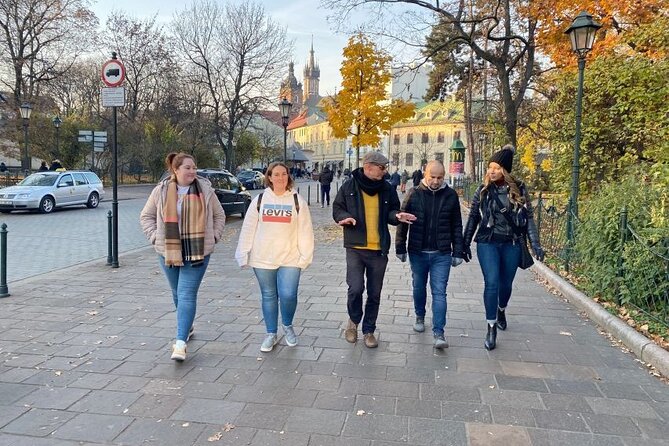
The route reaches Jagiellonian University, presented as Poland’s oldest university. Before arriving, you walk along Planty Park, the green belt that surrounds Krakow’s Old Town. The guide points out the park as a favorite place for Cracovians, giving you a glimpse of how the city uses the space around its historic core.
This is one of the tour’s most useful transitions. You see that Krakow is not only a medieval center for visitors. Planty Park wraps around the Old Town and provides a calmer edge to the dense streets and monuments inside it.
The stop is listed as Jagiellonian University, Collegium Medicum, and lasts about ten minutes. The available information does not promise entry into university buildings or a look inside lecture rooms. You will receive a historical account from outside or along the route, with the park adding visual variety to the walk.
The Barbican, old defenses, and Krakow’s changing walls
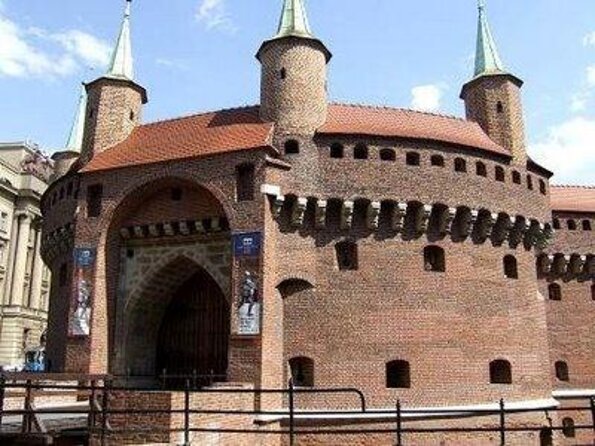
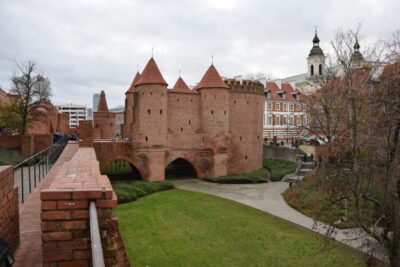
The Barbican, now connected with the Museum of Krakow, introduces the city’s defensive past. The guide explains how Krakow was protected and discusses changes during and after the partition of Poland. This adds an important national context that you may miss if you only photograph the Old Town’s churches and market buildings.
The stop also helps explain why the city’s surviving fortifications are so important. Krakow’s defensive system changed over time, and the tour points you toward what remains. The listed admission is free for the stop, but the experience does not state that museum entry is included.
At ten minutes, the Barbican talk should give you a clear outline without becoming a full military-history lesson. If you want to examine the fortification in detail, take photographs, or visit museum displays, plan separate time after the walk.
St. Mary’s Basilica and the uneven towers
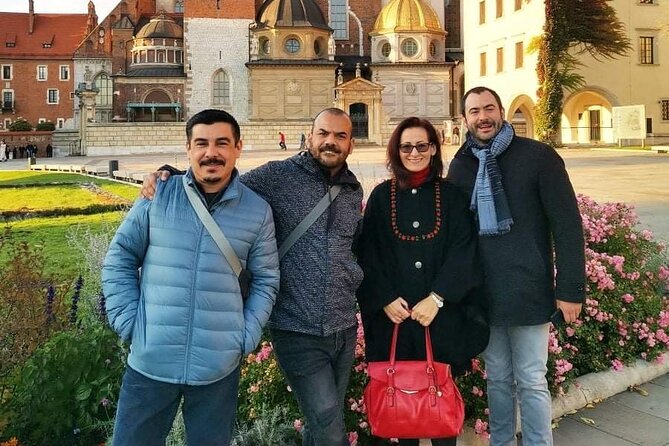
The stop at St. Mary’s Basilica returns you to the central square and one of Krakow’s best-known landmarks. The guide explains why its towers are different heights and shares other legends linked to the basilica. That is exactly the kind of detail that helps you look more closely at a familiar sight.
The square and basilica also connect back to the tour’s opening discussion of the Cloth Hall and surrounding buildings. You get a second chance to place these landmarks in the wider story of Krakow rather than seeing them as isolated photo stops.
The itinerary gives this stop ten minutes. That is enough for orientation and storytelling, but not a full basilica visit. If you want time inside, check separately for opening arrangements and any restrictions, since the tour information only confirms the guided stop and free admission listing.
St. Florian’s Gate and the walk’s finish
St. Florian’s Gate is described as the last remaining fragment of the wall that protected Krakow. The guide explains what happened to the rest of the wall and what you can find on the inner side of the surviving section.
This final stop gives the walk a satisfying historical shape. You begin in the central square, follow the royal route toward Wawel, pass churches and university grounds, and finish with the city’s medieval defenses. You are not simply moving from one famous address to another. You are tracing how Krakow developed and protected its center.
The tour ends at Sienna 2a, near the central square and the monument to Adam Mickiewicz. The end point is useful for continuing your day because you are returned to the heart of the Old Town rather than left at a distant neighborhood.
What the two-hour schedule really means
The tour lasts about 120 minutes and lists roughly ten minutes at most stops, with five minutes at St. Peter and St. Paul and Wawel Castle. That pace is brisk. You will hear a focused explanation, walk to the next location, and keep moving.
I like this format for a first afternoon or evening in Krakow. It gives you a mental map and shows you which places deserve a longer return visit. It is less suitable if you want long interior visits, extensive photography time, or a slow architectural study.
The walk is offered in English, and most people can participate. It is near public transportation, which makes the start and finish practical. The group can reach 50 people, however, so stay close to the guide and expect some waiting if the group has to gather at each stop.
One guide named Vlad receives specific praise for making the history engaging and for explaining both Polish history and Krakow itself. A separate experience was led in very good French, with an informative and funny style and room for questions. Guide quality can vary, and one booking ended badly after a disagreement over finding the meeting point. I would arrive prepared with the address already loaded on your phone and keep the start simple.
Is $36.09 a fair price?
At $36.09 per person, this is not the cheapest way to see Krakow’s Old Town. You can walk through many of these streets on your own, and the stops themselves have no admission charge listed.
The price makes more sense if you value a live explanation, a planned route, and local legends that tie the sights together. A good guide can save you time during a short stay and help you understand why the Royal Way, Wawel, the churches, the university, and the city walls belong in one story.
I would call it fair value for a visitor who wants orientation without arranging research in advance. It is weaker value if you already know Krakow well, want to explore at your own speed, or mainly want paid entry to Wawel Castle or church interiors. Those are not included as part of the described walk.
The tour is booked an average of 19 days in advance, suggesting that you should not leave it until the last minute if your schedule is fixed. Confirmation arrives at booking. Free cancellation is available up to 24 hours before the start time, with local-time cutoffs. Poor weather or an insufficient minimum group can lead to a new date, another experience, or a full refund.
Who will get the most from this Krakow walk?
I would choose this tour for a first visit, especially if you want the basic Old Town story before exploring alone. Families may enjoy the dragon legend, while history-minded visitors will appreciate the sections on royal Krakow, the partitions of Poland, and the defensive walls.
It also suits people who prefer a guide who can answer questions. The positive guide feedback points to strong delivery, historical detail, humor, and language ability. Ask questions when the group pauses, but remember that a group of up to 50 can limit individual attention.
You should look elsewhere if your main goal is a small private walk, a deep look inside Wawel Castle, or a slow tour of church art. The schedule is designed to cover a lot of ground in two hours, not to linger.
Should you book this tour?
Book it if you want a concentrated introduction to Krakow’s Old Town, with famous sights, royal history, city defenses, and memorable legends in one route. The best reason to go is the structure: you see the central square, Wawel, Planty Park, the university area, the Barbican, and St. Florian’s Gate without having to plan the sequence yourself.
I would book early, confirm the meeting point at Wiślna 4, and treat the walk as an orientation. Then return on your own to the sights that caught your attention. At $36.09, it earns its keep when the guide is strong, and the available feedback suggests that guides such as Vlad can make the two hours both useful and enjoyable. Just keep the possible 50-person group and the lack of listed interior admissions in mind.
FAQ
How long does the Krakow walking tour last?
The experience lasts approximately two hours, or 120 minutes.
What language is the tour offered in?
The tour is offered in English. A guide has also led a related tour in very good French, but English is the advertised language for this experience.
Where does the tour start?
The meeting point is Wiślna 4, 33-332 Kraków, Poland.
Where does the tour end?
The walk ends at Sienna 2a, 31-041 Kraków, near Krakow’s central square and the monument to Adam Mickiewicz.
What sights are included?
Stops include Rynek Glowny, the Royal Way, Kanonicza Street, Church of St. Peter and St. Paul, Wawel Royal Castle, the Wawel Dragon Monument, Okno Papieskie, Plac Franciszkanski, the Franciscan Basilica, Jagiellonian University, the Barbican, St. Mary’s Basilica, and St. Florian’s Gate.
Is admission included at the stops?
The listed stops show free admission. The experience does not state that paid entry to Wawel Castle, the Barbican Museum, or church interiors is included.
How many people can join the tour?
The activity can have a maximum of 50 participants.
Is the tour close to public transportation?
Yes. The additional information states that the tour is near public transportation.
Can most people participate?
Yes. The activity information says most people can participate.
What happens if I need to cancel?
You can cancel at least 24 hours before the start time for a full refund. Cancellations or changes made less than 24 hours before the start time are not accepted for a refund.
What happens if the weather is poor?
The experience requires good weather. If it is canceled because of poor weather, you will be offered another date or a full refund. A cancellation caused by too few participants also allows a different date or experience, or a full refund.
Just added around Krakow
- From Krakow: Zakopane and Dunajec River Rafting Tour★ 4.6 · 31 reviews
- From Krakow: Zakopane Full-Day Tour with Lunch Option★ 4.4 · 62 reviews
- From Krakow: Zalipie and Painted Village Guided Tour★ 4.0 · 4 reviews
- From Krakow: Zakopane and Gubałówka Cable Car Private Tour★ 4.3 · 12 reviews
- From Krakow: Zakopane Tatra Mountains & Hot Springs Tour★ 3.0 · 29 reviews
- From Krakow: Zakopane and the Tatra Mountains★ 4.7 · 36 reviews
- From Krakow: Hot Springs and Zakopane with Gubałówka★ 4.7 · 25 reviews
- Zakopane & Tatra Mountains Private Full-Day Tour from Krakow★ 4.5 · 33 reviews
Walking Tours, compared.
Gdańsk City Sights & History Guided Walking Tour in English
Read our review →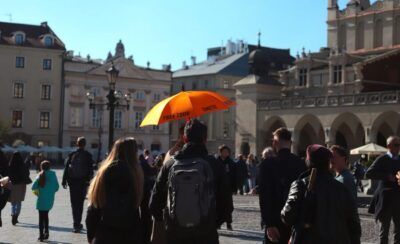
Browse the lists this tour appears in