
Reviewed · JEWISH GHETTO TOURS
Krakow: Jewish Ghetto Guided Tour
Kraków’s former Jewish Ghetto is not a preserved historic district. Much of modern Podgórze looks ordinary, which makes the remaining wall fragment and the empty chairs of Ghetto Heroes Square especially powerful. This short walking tour helps you read the streets and understand what happened here during World War II.
I like the focused route: three closely connected stops in about an hour, with no wasted time and no risk of missing the wall fragment. I also like the guides’ clear, personal approach. Olga, Phil, Anna, and Phillip are praised for explaining difficult history with care, answering questions, and keeping a steady pace. The main consideration is that the tour is brief, and the pharmacy museum admission is not included.
Key points at a glance
- The wall fragment is easy to miss alone: Your guide takes you to a surviving section of the Kraków Ghetto wall.
- Ghetto Heroes Square gives the tour its emotional center: The Chair Memorial recalls those deported from this place.
- Under the Eagle Pharmacy adds a human story: Tadeusz Pankiewicz and his staff helped people trapped inside the ghetto.
- The route lasts about one hour: It fits neatly before or after other Kraków sights.
- A small group keeps the walk manageable: The maximum is 20 people, though groups may be much smaller.
- Comfortable shoes matter: The tour runs outdoors in all weather, so bring suitable clothing and footwear.
Why this short walk matters in Podgórze
The former Kraków Ghetto occupies Podgórze, across the Vistula River from the Old Town. If you simply walk through the area today, you may see apartment blocks, roads, shops, and traffic rather than an obvious memorial site. The tragedy is still present, but it is not always easy to recognize without help.
That is the central value of this tour. Your guide connects ordinary-looking streets with the forced confinement of Kraków’s Jewish population during the Nazi occupation. You are not just being shown three points on a map. You are being given the basic geography needed to understand how the ghetto functioned and where deportations took place.
The walk is especially useful if you have already visited Schindler’s Factory or plan to do so. The two experiences cover related history from different angles. This route keeps your attention on the ghetto itself, its boundaries, its public square, and the people who tried to help those trapped inside.
At $15.60 per person, the tour is priced as an inexpensive introduction rather than a full historical program. You receive an English-speaking guide, a planned route, and context that would take time to assemble on your own. The tradeoff is simple: you get a compact overview, not a long museum visit or an extended examination of wartime Kraków.
More Jewish Ghetto Tours in Krakow:
- Krakow: Schindler’s Factory & Ghetto Guided Tour
★ 4.7 · 1,694 reviews - Krakow: Jewish Quarter and Former Ghetto Tour
★ 4.9 · 1,441 reviews - Krakow: Bike Tour of Old Town, Jewish Quarter and the Ghetto
★ 4.9 · 1,155 reviews
Finding the surviving ghetto wall fragment
The tour begins at Lipowa 4, 32-051 Kraków. From there, the walk reaches a remaining section of the former ghetto wall. Allow yourself extra time to get to the meeting point, and arrive at least 10 minutes early. Once the group has left, late arrivals cannot join and the ticket is not refunded.
This first stop receives about 20 minutes, which is enough time for your guide to explain what the wall represented and why this fragment matters. The wall was not simply a boundary on a map. It marked the forced separation of people from the rest of the city and helped turn the ghetto into a controlled space.
The fragment is one of the most useful parts of the route for a first-time visitor because it gives you something physical to look at. The rest of the area has changed considerably, and it can be hard to picture the ghetto from modern streets alone. A remaining section of wall provides a direct link between the present-day neighborhood and the period being discussed.
Do not expect an untouched wartime setting. One important point to keep in mind is that the ghetto does not look as it did during the war. The tour works by placing surviving traces into their historical setting, not by presenting a complete reconstruction.
A guide also saves you from spending your limited time searching for the fragment. This is a small but real advantage. If you are visiting Kraków for only a few days, you can follow the route without stopping repeatedly to check a map or wonder if you have reached the right place.
Ghetto Heroes Square and the Chair Memorial
The walk continues to Plac Bohaterów Getta, known in English as Ghetto Heroes Square. The tour allocates another 20 minutes here, and this is the emotional center of the experience.
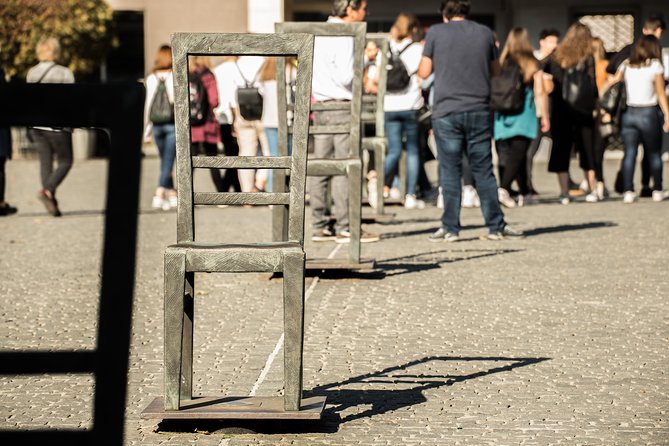
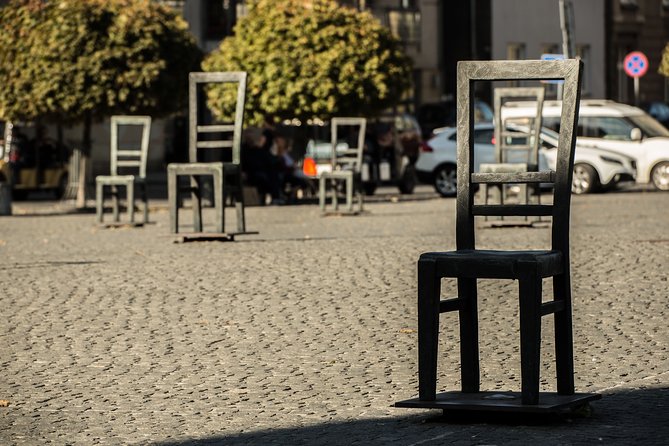
During the occupation, the square was connected with the forced movement and deportation of people from the ghetto to extermination camps. Today, the square is marked by rows of empty chairs. These chairs represent the lives lost and the belongings left behind when people were removed from their homes.
The design is stark without being complicated. You do not need a long explanation to understand the basic image: a public space filled with seats, but no one sitting in them. Your guide adds the facts and context that make the memorial more than a striking photograph.
This is a place where the guide’s manner matters. The strongest comments about the tour focus on calm explanations, clear storytelling, and sensitivity. Anna is described as approachable and measured, while Phil and Phillip are praised for setting a good pace and explaining the area carefully. Olga is noted for her enthusiasm and passion. Individual guides will differ, but the experience depends heavily on having someone who can discuss mass deportation without turning the subject into a performance.
You should expect to pause here rather than rush through for a quick photograph. The square is open and public, so the atmosphere can change with weather and city activity. That contrast is part of the experience, but it also means this is not a controlled museum setting.
The square helps you understand the scale of what happened. The wall shows confinement. The chairs show removal. Together, the two stops create a clear progression before you reach the pharmacy.
Under the Eagle Pharmacy and the story of help
The final stop is Apteka pod Orłem, or Under the Eagle Pharmacy, at Plac Bohaterów Getta 18. The tour ends here, and the pharmacy museum admission is not included in the $15.60 price.
The pharmacy is linked with Tadeusz Pankiewicz and his staff, who helped people inside the ghetto. Their work included providing medicine and offering support in a place where even small acts of assistance carried great risk. This stop adds a more personal dimension to the tour. The earlier points explain the system of confinement and deportation, while the pharmacy brings attention to people trying to preserve health, dignity, and hope.
You should clarify whether you want to enter the museum as a separate visit, since admission is excluded. The guided walk can explain the site from outside, but the interior museum requires its own ticket. If you are planning a longer day of World War II history, this is a logical place to continue.
The ending point is practical as well as historical. You finish at a clearly identified address rather than returning to the starting point. That makes it easier to continue exploring Podgórze, visit the pharmacy museum, or make your own way elsewhere in Kraków.
A few more Krakow trips to weigh up
- From Krakow: Auschwitz-Birkenau Guided Tour & Hotel Pickup
★ 4.5 · 33,358 reviews - From Krakow: Auschwitz-Birkenau Guided Tour & Hotel Pickup
★ 4.5 · 29,340 reviews - Krakow: Auschwitz Guided Tour with Optional Hotel Pickup
★ 4.5 · 15,280 reviews - Krakow: Auschwitz-Birkenau Guided Tour with Pickup & Lunch
★ 4.5 · 9,800 reviews
The guide makes the difference
A short history walk rises or falls on the person leading it. Here, the guide is responsible for more than navigation. The route itself is compact, but the subject is complex and painful. You need someone who can provide enough background without flooding a one-hour visit with dates and names.
The strongest guide descriptions point to a few consistent qualities: clear explanations, a comfortable pace, friendliness, and sensitivity. Phil is praised for pacing the walk and giving a useful account of the ghetto and its surrounding history. Phillip is described as polite and well informed. Anna receives praise for detailed explanations delivered in a calm tone. Olga is noted for making the history engaging through her enthusiasm.
You may not receive one of these exact guides, but these names give you an idea of the expected style. The experience is not built around theatrical acting or elaborate equipment. It is a walking lesson led by someone who can answer questions and point out details you might miss.
One Spanish-speaking account describes a particularly small group of four family members and notes that the guide used printed images to make the past easier to picture. Group size will vary, but the tour can sometimes feel almost private. The official maximum is 20 people, which is still small enough for a walking group to move through the stops without becoming unwieldy.
The tour is offered in English, and group tours operate in only one language. Choose your preferred language when booking, since you should not expect a multilingual presentation on the same walk.
Timing, walking pace, and weather
The advertised duration is about one hour, with roughly 20 minutes at each of the three stops. That makes this a useful add-on rather than a major half-day commitment. You can place it before or after another Kraków activity without giving up an entire afternoon.
The route is on foot, and comfortable shoes are a smart choice. One practical tip from the experience is simple: wear footwear you can walk in easily. The tour is short, but you will be outside and moving between locations.
The activity goes ahead in rain or shine. Check the forecast and bring suitable clothing. In wet or cold weather, the open square may be less comfortable, and poor conditions can make it harder to listen while standing outside. In warmer weather, sun protection and water may make the hour more pleasant, though those details are not supplied as part of the tour.
The walk is near public transportation, which helps if you are staying outside Podgórze. The meeting point and ending point are different, so plan your onward route rather than assuming you will return to where you began.
Most people can participate, according to the tour information. No special access restrictions are listed. Still, this is an outdoor walking experience, so you should be comfortable standing and walking for the duration.
What the $15.60 price gets you
The price is low for a guided experience in Kraków, but value depends on what you want. At $15.60, you are paying for a concise English-language explanation, route planning, historical context, and help locating the wall fragment and other key sites.
That is worthwhile if you would otherwise walk through Podgórze without understanding what you were seeing. The route can save you research time and helps you connect three places that make more sense together than separately.
The price does not include entry to Under the Eagle Pharmacy. That matters if you are comparing this walk with a museum ticket or a longer guided program. Think of the tour as an introduction to the district, with the option to add the museum afterward.
The 4.8 rating from 22 evaluations and full recommendation rate suggest strong satisfaction, but the number of evaluations is not huge. I would treat that as encouraging rather than conclusive. The comments repeatedly praise the guides, the useful information, and the manageable length. The one recurring limitation is also clear: the modern neighborhood does not visually recreate the ghetto.
Who should book this Kraków ghetto walk?
I would choose this tour if you want a short, guided introduction to Kraków’s World War II history. It suits you especially well if you have limited time, prefer walking to a vehicle-based tour, or want help finding the wall fragment.
It is also a good fit after Schindler’s Factory. One evaluation notes a delayed start while the group waited for people coming from the factory, so you should avoid scheduling the two activities too tightly. Give yourself a little breathing room between them.
Families and small groups may find the format easy to manage, particularly if you want a clear account without spending several hours in a museum. The route is also useful for people who prefer local explanation to reading plaques alone.
I would not choose it as your only World War II experience in Kraków if you want extensive detail. One hour cannot cover every part of the ghetto, the occupation, or the extermination camps. It gives you a strong framework, then leaves room for a museum visit or further reading.
The subject is serious, and the tour is not entertainment. You should book it if you want a respectful, grounded explanation of what happened in this part of the city.
Practical details before you reserve
Confirmation is provided at booking, and the activity is offered in English. The group can include up to 20 people, though smaller groups are possible.
Arrive 10 minutes before the stated start time at Lipowa 4. Late arrivals cannot join after the group has departed, and late tickets cannot be refunded. That rule makes early arrival important, especially if you are relying on public transportation.
Free cancellation is available up to 24 hours before the start time for a full refund. Cancellations or changes made less than 24 hours before the experience are not accepted, and the local start time controls the cutoff.
Pack for the weather. Since the tour runs in all conditions, a rain jacket and suitable shoes are more useful than trying to rely on luck.
Should you book the Jewish Ghetto Guided Tour?
Book it if you want an affordable, tightly organized walk that gives meaning to three important places in Podgórze. The surviving wall, the chairs in Ghetto Heroes Square, and Under the Eagle Pharmacy create a strong one-hour sequence, while guides such as Olga, Phil, Anna, and Phillip bring the history into focus with care.
Skip it if you want a full-day historical program or a preserved district that looks much as it did during the war. The modern surroundings can feel visually disconnected from the past, and the pharmacy museum costs extra.
For most visitors interested in Kraków’s wartime history, I think the $15.60 price is fair. Just arrive early, wear comfortable shoes, allow time for the pharmacy if you want to go inside, and treat the tour as a thoughtful starting point rather than the last word on the subject.
FAQ
How long does the Kraków Jewish Ghetto Guided Tour last?
The walking tour lasts about one hour. The route includes roughly 20 minutes at each of its three main stops.
Where does the tour begin?
The tour begins at Lipowa 4, 32-051 Kraków, Poland.
Where does the tour end?
The tour ends at Under the Eagle Pharmacy, Apteka pod Orłem, Plac Bohaterów Getta 18, 33-332 Kraków, Poland.
What places are included on the walking route?
The route visits a fragment of the former ghetto wall, Ghetto Heroes Square with its Chair Memorial, and Under the Eagle Pharmacy.
Is admission to Under the Eagle Pharmacy included?
No. Entry to the Eagle Pharmacy Museum is not included in the tour price.
Is the tour available in English?
Yes. The tour is offered in English. Group tours operate in one language, so select your preferred language when booking.
What happens if I arrive late or need to cancel?
You should arrive 10 minutes early. Late arrivals cannot join once the group has left, and those tickets cannot be refunded. You can cancel for a full refund up to 24 hours before the start time.
Just added around Krakow
- From Krakow: Zakopane and Dunajec River Rafting Tour★ 4.6 · 31 reviews
- From Krakow: Zakopane and Gubałówka Cable Car Private Tour★ 4.3 · 12 reviews
- From Krakow: Zakopane Full-Day Tour with Lunch Option★ 4.4 · 62 reviews
- From Krakow: Zalipie and Painted Village Guided Tour★ 4.0 · 4 reviews
- From Krakow: Zakopane Tatra Mountains & Hot Springs Tour★ 3.0 · 29 reviews
- From Krakow: Zakopane and the Tatra Mountains★ 4.7 · 36 reviews
- From Krakow: Hot Springs and Zakopane with Gubałówka★ 4.7 · 25 reviews
- From Krakow: Zakopane & Tatra Mountains Tour★ 3.8 · 42 reviews
Jewish Ghetto Tours, compared.
Bike Tour of Old Town, Jewish Quarter and the Ghetto
Read our review →
Kazimierz, Schindler’s Factory & Ghetto Guided Tour
Read our review →
Full Bike Tour – the Old Town, Jewish Qtr & the Ghetto NEW BIKES
Read our review →
Warsaw Ghetto Private Walking Tour with Hotel Pickup
Read our review →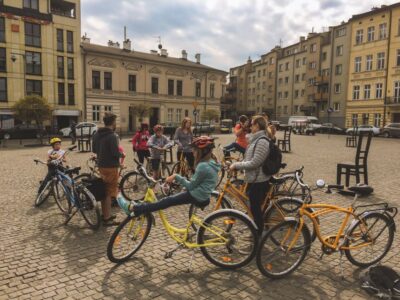
Bike Tour of the Old Town, Kazimierz, and the Ghetto
Read our review →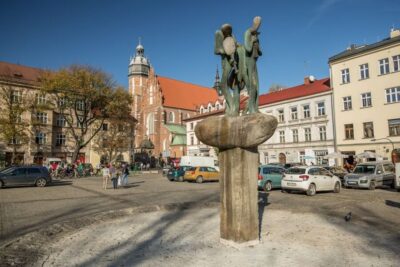
Browse the lists this tour appears in