
Reviewed · HISTORICAL TOURS
Private Tour: Warsaw’s Jewish Heritage by Retro Fiat
Warsaw’s Jewish story is spread across modern streets, memorials, fragments of walls, a cemetery, and a few surviving buildings. This private tour ties those pieces together from the back seat of a vintage Fiat 125p, with a guide explaining what you are seeing and what has vanished. I like the personal pace and the chance to ask direct questions. I also like the old car, which adds a memorable Warsaw touch without taking over the serious subject.
The main thing to watch is timing. Nożyk Synagogue and the Jewish Cemetery are closed from Friday evening through Saturday, and a late afternoon departure may not allow entry even on other days. Museum admission is extra, and groups of four or more ride in a vintage minivan rather than the smaller Fiat.
Key points to know before booking
- A private four-hour route: Your group rides with its own English-speaking driver-guide, so you can ask questions and request points tied to family history or The Pianist.
- A vintage Fiat 125p: The Communist-era car is part of the experience, though groups of four or more use a retro minivan.
- Important sites across former Warsaw: The route connects the ghetto wall, Chłodna Street, Muranów, memorials, Nożyk Synagogue, and the Jewish Cemetery.
- The cemetery and synagogue need careful timing: Both close from Friday evening through Saturday, and their admission fees are not included.
- POLIN is mainly an outside stop: You see the museum building during the tour. The guide can leave you there afterward if you choose to pay for entry.
- Hotel pickup helps: Pickup and return are included in central Warsaw, with the Palace of Culture and Science listed as the meeting point.
Why the Fiat works for this Warsaw history tour
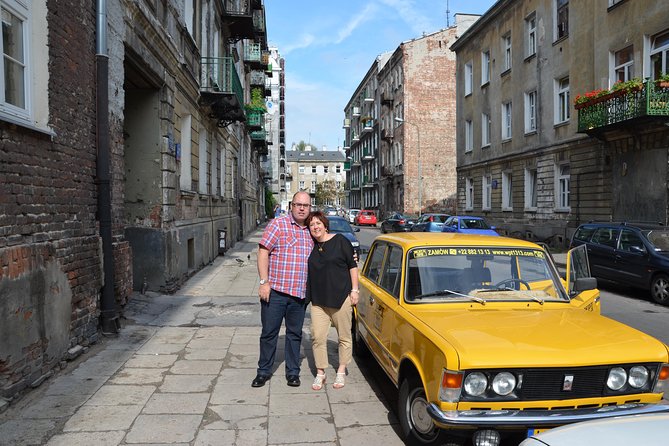
The car is not just transport. The Fiat 125p was a familiar sight in Communist-era Poland, and it gives the outing a strong sense of place. You move through present-day Warsaw in a vehicle linked to the city’s more recent past while discussing the Jewish community that was nearly destroyed during the Nazi occupation.
I would not book this simply as a novelty car ride. The important part is the guide-led interpretation. Many of the sites are easy to pass without understanding what happened there. A small plaque, a street corner, or a modern apartment block can mark the location of an event that changed thousands of lives.
The private format matters here. You are not waiting for a large group to gather or following a fixed script without interruption. You can ask about a family name, a particular building, the Warsaw Ghetto Uprising, prewar Jewish life, or film locations from The Pianist. Guides named in past bookings include Alec, Karol, Marcin, Martin, Conrad, Konrad, Max, and others, so your exact guide will vary. The strongest accounts describe guides who were warm, careful drivers and able to answer detailed questions.
The Fiat is compact. That makes it best for a small party and for people who enjoy the charm of an older vehicle more than modern comfort. Four or more people are placed in a vintage minivan, which is practical but changes the feel of the outing.
A few more Warsaw trips to weigh up
- Warsaw: POLIN Museum of the History of Polish Jews Ticket
★ 4.7 · 1,142 reviews - Warsaw: Chopin Concert at Historical Venue in Old Town
★ 4.7 · 445 reviews - Small-Group Historical Guided Tour of Warsaw with pick up/drop off. Public Tour.
★ 4.5 · 343 reviews
The ghetto wall fragment gives Warsaw a starting point
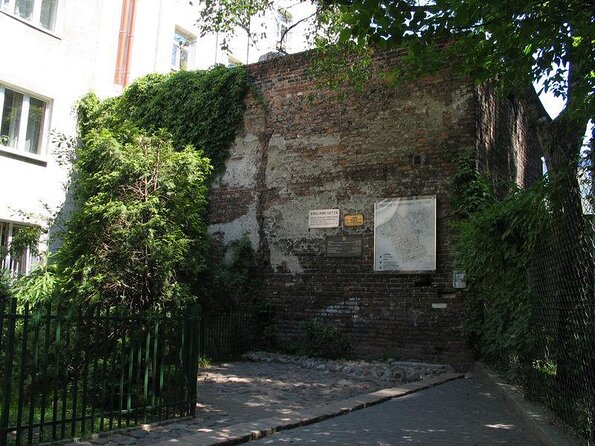
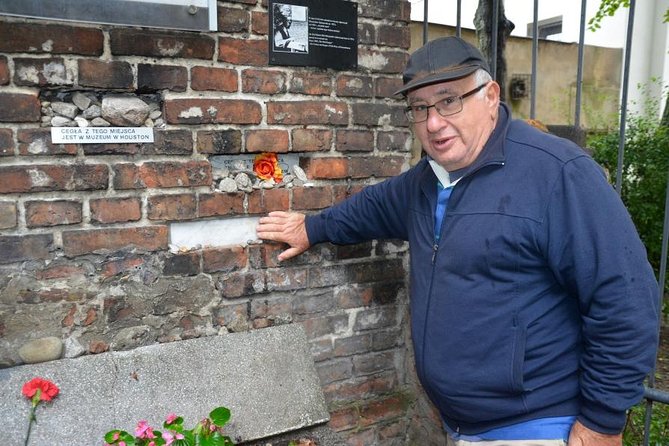
The first stop is a surviving fragment of the wall built in 1940 to enclose the Jewish Ghetto. More than 400,000 Jews were forced into the ghetto, so even a short stop here carries enormous weight.
You spend about 15 minutes at the wall and its commemorative plaques. Do not expect a large preserved fortification. What remains is modest, tucked into the modern city, and easy to miss without a guide. That contrast is part of the lesson. Warsaw was almost completely destroyed during the war, and much of the old Jewish district no longer exists in its earlier form.
This is a good place for your guide to establish the basic timeline: Jewish life before the war, forced confinement, deportations, the uprising, and the city’s postwar rebuilding. The tour is strongest when those events are tied to the exact streets around you rather than delivered as a general lecture.
Chłodna Street shows how the ghetto was divided
At Chłodna Street, you see the location of the former footbridge, often called the Footbridge of Memory. It connected the two parts of the ghetto over a road that remained outside the enclosed district. The bridge itself is gone, but its location helps you picture the strange and cruel geography imposed on the people trapped there.
You also see the building associated with Adam Czerniakow, head of the Jewish Council, or Judenrat. This brief 10-minute stop adds a personal layer to the political and moral pressures inside the ghetto.
The stop is visual rather than museum-like. You are not entering a preserved wartime interior. Your guide’s photos and explanations are especially useful here, since modern Warsaw can make the old arrangement difficult to imagine. One past booking specifically praised the use of wartime images to show how the area looked then and how it appears now.
Muranów turns a modern district into a historical document
The route continues through Muranów, the former Large Ghetto area. Today, you see modern buildings, reconstructed streets, and public art rather than a preserved wartime quarter. Plan for about 30 minutes in this part of the tour, including time to look around on foot.
Muranów requires patience. If you arrive expecting a continuous old neighborhood, you may find the modern setting unsettling or confusing. The absence of buildings is part of the story, but it is not always obvious what you are looking at. A good guide helps you read the streets and points out the surviving traces.
This is also where the tour can move beyond wartime suffering. Warsaw’s Jewish community existed for centuries before 1939, with religious, political, commercial, and cultural life spread across the city. The guide can place the ghetto within that longer story, rather than treating Jewish Warsaw as something that began and ended with World War II.
Street art and new architecture add another layer. They show how the district is being remembered and reinterpreted today, but they do not replace the original places. I appreciate that the tour lets you see both realities: a living modern neighborhood and ground marked by loss.
Same country, a completely different kind of day:
- Warsaw: Chopin Concert in the Old Town
★ 4.8 · 2,287 reviews - Warsaw: Traditional Galar Cruise on The Vistula River
★ 4.6 · 1,640 reviews - Warsaw: Old Town Highlights Walking Tour in English
★ 4.7 · 1,516 reviews - Warsaw Concert: Chopin – Painted by Candlelights with Wine
★ 4.8 · 1,442 reviews
The Ghetto Heroes Monument needs time and quiet
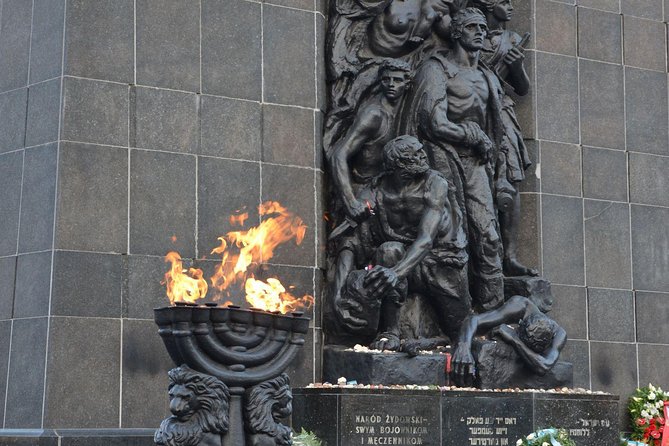
The Monument to the Ghetto Heroes commemorates the Warsaw Ghetto Uprising of 1943. The planned stop lasts about 15 minutes, though your private format may allow you to linger or ask questions.
This is one of the most important memorials in Warsaw. Your guide can explain the uprising, the resistance fighters, and the difference between remembering armed resistance and remembering the larger population imprisoned in the ghetto. The subject is difficult, but the guides described in the supplied material generally present it with care and a clear sense of proportion.
Nearby points on the route include a memorial connected with a group suicide during the uprising and the street that survived on both sides through the former ghetto area. These are easy details to miss on an independent drive. They help show how desperate choices and small surviving fragments fit into the wider story.
The monument is also close to POLIN Museum, making it a natural point to decide how much more time you want to give the subject.
POLIN Museum is worth planning as a separate visit
During the tour, you see POLIN Museum of the History of Polish Jews from outside, with about 15 minutes assigned to the stop. Museum entry is not included. If you want to visit, the guide can leave you there after the driving tour.
That arrangement is useful, but do not mistake the outside stop for a museum visit. POLIN presents more than 1,000 years of Polish Jewish history, and the building deserves far more time than a quick look from the pavement. If the museum is a priority, I would consider booking the tour early enough to enter afterward, or reserving a separate block of time.
The museum can also correct a common imbalance in wartime sightseeing. The ghetto and uprising are essential subjects, but they represent only part of Jewish life in Poland. The museum’s broader story gives context to the communities, institutions, and cultural achievements that existed before the Holocaust and continued in changed form afterward.
Nożyk Synagogue is a rare surviving place of worship
Nożyk Synagogue is described as the only surviving prewar Jewish house of prayer in Warsaw. The visit lasts about 30 minutes, and admission is not included.
This is not only a memorial stop. It remains an active place of worship, which gives the visit a different tone from the monuments and former ghetto sites. You should dress and behave respectfully, and you may be required to cover your head at some Jewish sites.
The synagogue is closed from Friday evening throughout Saturday for the Sabbath. This is the single most important scheduling point in the tour. A 5 p.m. summer departure may still have plenty of daylight, but it does not mean the synagogue will be open. One otherwise excellent booking lost part of its value because the departure time was not clearly matched to synagogue and cemetery opening hours.
Ask about access when you book, especially if entering the synagogue is important to you. The tour can still visit the exterior and explain its place in Warsaw’s Jewish story, but that is not the same as going inside.
The Jewish Cemetery adds a human scale
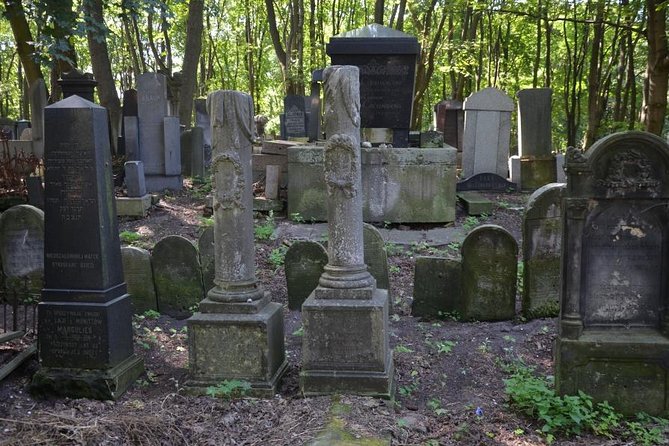
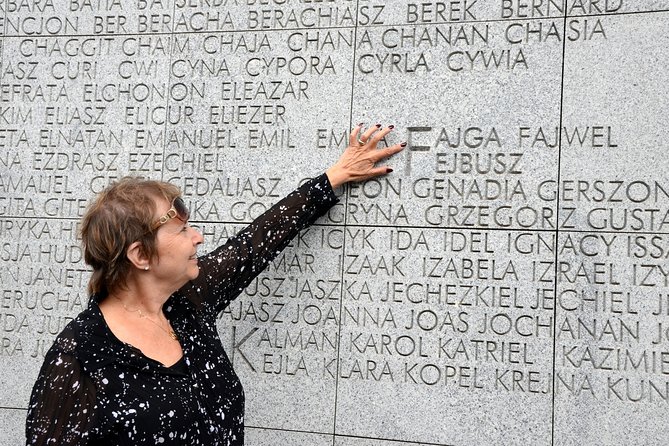
The Jewish Cemetery is scheduled for about 30 minutes. You see graves belonging to more than 200,000 people, including religious and political leaders, figures in Jewish culture, and many people whose names are no longer known.
This is likely to be the most personal stop on the route. The cemetery is not just a monument to wartime victims. It contains many generations of Jewish Varsovians, allowing you to see the community as a long-standing part of the city rather than only as a wartime population.
The grounds can also be emotionally heavy. You may find worn stones, crowded sections, and memorials that require explanation. The guide’s role is important, since names, symbols, and locations may not make sense at first glance. One past booking singled out the cemetery as especially meaningful and worth the extra admission cost.
As with the synagogue, the cemetery is closed from Friday evening through Saturday. Entry is not included in the tour price, so bring that extra cost into your planning. If you are visiting for family research, tell your guide in advance. The private format is well suited to personal questions, though the information provided does not promise genealogical research or a specific family grave.
What the four-hour pace feels like
This is a driving tour with short walks, not a full-day walking program. The Fiat handles the distance between sites, while you get out at the wall, monuments, cemetery, synagogue, and other points where seeing the place on foot matters.
Four hours is enough for a strong orientation, but not enough for a slow visit at every location plus a full museum tour. You will need to choose your priorities. If you want every stop, time inside the synagogue, a cemetery visit, and POLIN Museum, ask about the schedule before setting off.
The route is also shaped by traffic and opening hours. Pickup is offered from central Warsaw hotels, and the stated meeting point is the Palace of Culture and Science at Plac Defilad 1. If your hotel is outside the pickup area, contact the provider for another arrangement. The tour returns to the original departure point unless your plan changes around a museum drop-off.
Most people can participate, and the route is near public transportation. Still, the experience includes getting in and out of an older car and walking at several stops. The provided details do not specify a full accessibility setup, so ask directly if you have mobility needs.
Is $108.28 per person good value?
At $108.28 per person, this is not the cheapest way to see Warsaw. It can be good value if you want four hours of private transport, a dedicated English-speaking guide, hotel pickup and return, and a route focused on Jewish Warsaw rather than a general city tour.
The price makes more sense for two or three people sharing a private experience. You are paying for the guide’s time and the ability to shape the conversation, not simply for entry tickets. Museum, synagogue, and cemetery admission are extra, so calculate the final cost if you plan to enter all three.
Groups of four or more receive a vintage minivan rather than the Fiat 125p. That may offer more space, but the car itself will feel less distinctive. Group discounts are offered, though the exact reduction is not specified here, so check the current price for your party.
The 4.9 rating from 208 published ratings and the 98 percent recommendation rate point to consistently strong satisfaction, especially with the guides. The one clear negative account focused on the condition of the car and a mismatch between the guide’s focus and the customer’s stated interests. That is a useful reminder to repeat your priorities before pickup.
Who should book this experience?
I would choose this tour if you want a serious introduction to Warsaw’s Jewish past but prefer not to piece together distant sites by tram or taxi. It suits first-time visitors, people with a strong interest in World War II, and anyone with a family connection to Warsaw or Polish Jewish history.
It is also a good fit if you value conversation. Guides have been praised for clear English, personal warmth, careful driving, useful wartime photos, and the ability to explain a complex timeline in understandable terms. Names and assignments vary, so no particular guide can be guaranteed, but you can state your interests when booking.
I would look elsewhere if your main goal is a long museum visit, a purely walking tour, or a guaranteed entry to every site. I would also avoid booking a late afternoon start without confirming access to the synagogue and cemetery.
Book at least several weeks ahead if your dates are fixed. The activity is booked an average of 38 days in advance, which suggests that popular times can fill early. Free cancellation is available up to 24 hours before the start time. Changes or cancellations inside that period are not refunded.
Should you book Warsaw’s Jewish Heritage by Retro Fiat?
Yes, if you want a focused, personal tour that connects Warsaw’s surviving Jewish sites with the city’s wartime past. The best parts are the private guide, the ability to ask for extra context, the cemetery, and the unusual Fiat ride. The experience gives you a much clearer sense of how scattered places fit together.
Book carefully. Choose a morning or earlier departure if entering Nożyk Synagogue and the Jewish Cemetery matters to you. Add the cost of admissions, and reserve separate time for POLIN Museum. With those points handled, this is a thoughtful and practical way to approach one of Warsaw’s most important subjects.
FAQ
How long does the tour last?
The tour lasts approximately four hours.
Is hotel pickup included?
Yes. Hotel pickup and drop-off are included for hotels in central Warsaw. The guide can collect you from the hotel lobby or meet you in front of the building.
Where is the listed meeting point?
The listed meeting point is the Palace of Culture and Science, Plac Defilad 1, Warsaw. The activity normally ends back at the original meeting point.
What vehicle is used?
A private retro Fiat 125p is used for smaller groups. Groups of four or more are driven in a vintage minivan instead.
Is the tour offered in English?
Yes. The tour is offered in English with a professional driver-guide.
Can I visit POLIN Museum during the tour?
The tour includes an outside view of POLIN Museum. Admission is not included, but the guide can leave you at the museum after the tour if you choose to visit.
Are the synagogue and cemetery open every day?
No. Nożyk Synagogue and the Jewish Cemetery are closed from Friday evening through the whole of Saturday because of the Sabbath. Their admission is not included.
Just added around Warsaw
- Taste of Poland, food tour and guided walk with 12 tasting★ 5.0 · 3 reviews
- Skip-the-Line Warsaw Royal Castle Private Guided Tour★ 5.0 · 4 reviews
- Secrets of Warsaw 4-hour Bike Tour★ 5.0 · 25 reviews
- Warsaw: Live Show at Sabat Theatre★ 4.5 · 11 reviews
- Private Warsaw City Tour★ 4.9 · 4 reviews
- Warsaw: WWII Private Tour by Retro Minibus with Hotel Pickup★ 5.0 · 7 reviews
- Private Tour From Warsaw: Łowicz Mazovian Countryside★ 5.0 · 10 reviews
- Packrafting kayaking guided tour Vistula river Warsaw Poland★ 4.5 · 14 reviews
Historical Tours, compared.
POLIN Museum of the History of Polish Jews Ticket
Read our review →
Gdańsk City Sights & History Guided Walking Tour in English
Read our review →

Small-Group Historical Guided Tour of Warsaw with pick up/drop off. Public Tour.
Read our review →Browse the lists this tour appears in