
Reviewed · JEWISH GHETTO TOURS
Tour of the Warsaw Ghetto
Warsaw’s former Jewish ghetto is not a single preserved quarter waiting behind a gate. Most of it was destroyed, rebuilt, or folded into the modern city. This tour helps you find the small surviving fragments, then links them with photographs, maps, personal stories, and the streets where the events took place.
I like two things right away: the route gives you a clear story from the ghetto’s creation to the 1943 uprising and deportations, and the guides use old images to show what has vanished. Marzena is often praised for her calm, detailed storytelling and thoughtful answers. The main drawback is simple: you walk a lot, and the subject is painful. This is not a light sightseeing outing.
Key points to know before you book
- You see real remnants rather than a reconstructed set: Próżna, Waliców, Chłodna Street, and fragments of the ghetto wall make the past easier to place.
- The route covers about 2.5 hours on foot: The remaining 30 minutes use Warsaw’s bus, tram, or underground system.
- The tour is private: Only your own group participates, which gives you room to ask questions and set the pace within the schedule.
- The guide’s photos and maps do much of the teaching: They show the streets and buildings before wartime destruction.
- The POLIN Museum is visited from the outside: Entry to its main exhibition is not part of this tour, so plan a separate museum visit.
- The synagogue costs extra and may be skipped: Nożyk Synagogue admission is €5, and the visit is not offered on Friday afternoons, Saturdays, or Jewish holidays.
Why this route matters in modern Warsaw
A map can make the former ghetto look tidy. The reality is more scattered. A street corner may hold a wall fragment, a memorial, or a surviving building, while apartment blocks and broad roads occupy the rest of the old district.
That is why a guide adds real value here. You are not just moving between monuments. You are learning how the ghetto was formed, how people lived under German occupation, how the two ghetto sections were linked, and how resistance grew despite overwhelming force.
The tour also puts wartime events into the older story of Warsaw’s Jewish community. The city once had one of Europe’s largest Jewish populations. The route does not treat the ghetto as an isolated episode. Instead, it shows you the remains of a community, the machinery of persecution, and the people who resisted.
The tone is serious without needing to be theatrical. Marzena, one of the guides most often named by guests, uses photographs and maps to make vanished streets visible. Another guide, Olivia, has also been praised for bringing the story to life through images and clear explanation. Since guides can vary, you should expect a well-prepared English-speaking professional, but not assume a particular person is guaranteed unless the operator confirms it.
More Jewish Ghetto Tours in Warsaw
- Warsaw: Warsaw Ghetto Private Walking Tour with Hotel Pickup
★ 4.9 · 369 reviews - Warsaw: Ghetto, Jewish Cemetery & POLIN Museum Private Tour
★ 4.8 · 132 reviews - Warsaw: 2-Hour Tour of Daily Life in the Ghetto Warsaw
★ 4.9 · 26 reviews
Starting at Próżna and Nożyk Synagogue
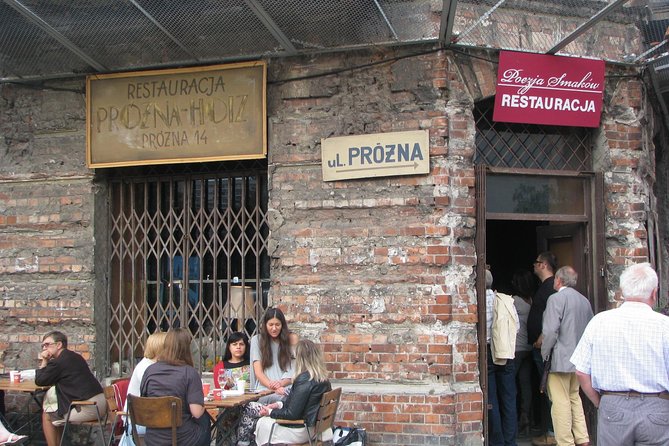
The route begins at Próżna 11, though the guide may meet you at your city-center hotel. If you stay in an apartment, you are asked to wait outside. Look for the guide carrying a PolinTours sign.
Próżna is one of the last surviving streets connected with the former ghetto. Its importance comes from the physical remains. Old façades and the shape of the street help you picture a place that otherwise can be hard to imagine amid modern Warsaw.
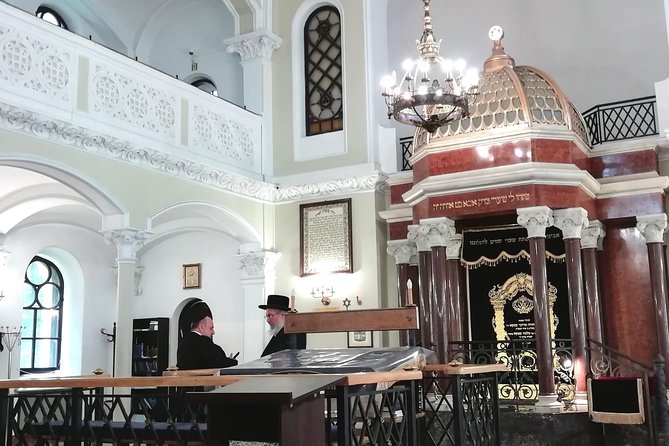
From there, the group visits Nożyk Synagogue, the only synagogue in Warsaw to survive the Second World War and remain in operation. Admission costs €5 per person and is not included in the tour price.
This stop is scheduled for about 15 minutes, so it is more of an introduction than a full religious or architectural visit. You should also check the day of your booking. On Friday afternoons from 1 p.m., Saturdays, and Jewish holidays, the synagogue stop is omitted.
That limitation is worth knowing before you pay. If visiting a functioning synagogue matters to you, choose a weekday morning when possible. If it is closed, the tour still covers the major outdoor sites, but the opening loses one of its most direct links with Warsaw’s Jewish life.
Waliców and the surviving wall fragments
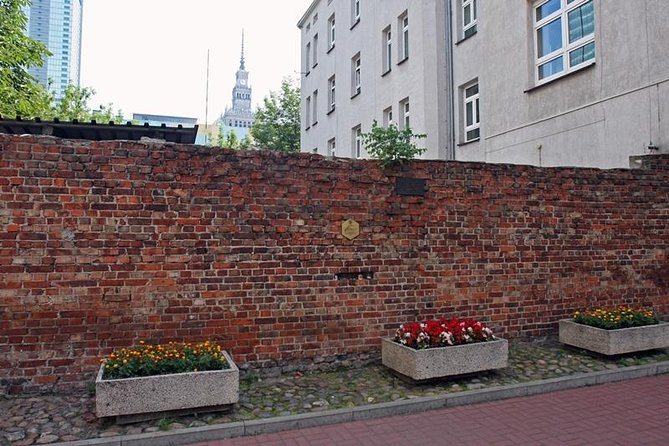
At Waliców, you see fragments of the ghetto wall and hear about the ghetto’s origins, daily conditions, and the uprising of 1943. The planned stop lasts about 15 minutes, but the subject can easily prompt questions.
The wall fragments are powerful partly because they are so modest. You may find it difficult to grasp the scale of the sealed district from one remaining piece of brickwork. This is where the guide’s visual material matters. Before-and-after photographs help you compare the wartime streets with the city in front of you.
Expect the guide to explain more than dates. The important point is how policy became lived reality: confinement, overcrowding, hunger, fear, and the steady removal of rights. The setting makes those facts less abstract, though it cannot recreate what was destroyed.
One practical note: this is an outdoor history lesson. You will be standing on city streets, listening, then walking onward. Comfortable shoes and weather-ready clothing are sensible, even if Warsaw’s weather looks friendly when you leave the hotel.
Chłodna Street and the bridge between two ghettos
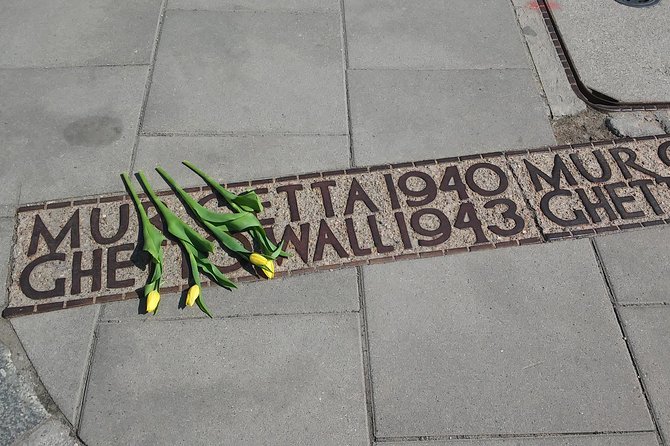
Chłodna Street marks the former location of the bridge linking the Small Ghetto and the Large Ghetto. The bridge became one of the best-known symbols of the Warsaw Ghetto because it made the physical separation visible.
Today, the bridge itself is gone. You see the location and use the guide’s explanation to understand how the crossing worked. This is a recurring feature of the tour: the place survives as a point on the ground, while photographs and testimony supply the missing structure.
The stop also connects with the story of Władysław Szpilman, the pianist whose wartime experience became known through Roman Polański’s film. Hearing those stories at the actual locations gives the route a personal scale. Instead of treating history as one large block, the guide ties it to streets, crossings, decisions, and individual lives.
The scheduled time here is about 20 minutes. It is one of the stops where a careful guide can make a big difference. You need enough context to understand why the bridge mattered, but also enough quiet to take in the place without rushing.
Same country, a completely different kind of day:
- Warsaw: Chopin Concert in the Old Town
★ 4.8 · 2,287 reviews - Warsaw: Traditional Galar Cruise on The Vistula River
★ 4.6 · 1,640 reviews - Warsaw: Old Town Highlights Walking Tour in English
★ 4.7 · 1,516 reviews - Warsaw Concert: Chopin – Painted by Candlelights with Wine
★ 4.8 · 1,442 reviews
Umschlagplatz and the machinery of deportation
Umschlagplatz is one of the hardest stops. This was the place where people were assembled before deportation as the Nazi plan for mass murder was put into action.
The memorial’s meaning is central to the stop. You learn how deportations operated and why this location matters within the history of the ghetto. The tour does not soften the subject, and it should not. Expect a sober explanation of a system designed to deceive, control, and destroy.
The stop is listed at about 15 minutes. That may sound brief, but the route covers many locations in three hours, and the emotional weight accumulates. I would not plan a demanding museum visit or a cheerful group activity immediately afterward. Give yourself a little quiet time if you need it.
This is also a place where a private format helps. You can ask a question without holding up a large group, or simply listen. The guide’s job is to keep the account clear and respectful rather than turn the stop into a performance.
POLIN Museum, Willy Brandt, and the 1943 uprising
The tour continues toward the POLIN Museum of the History of Polish Jews and the Ghetto Heroes Memorial. You learn about life in the ghetto, the reasons people took up arms, and the help offered by others.
The route also explains the memorial’s symbolism and its connection with Willy Brandt’s famous kneeling gesture. At the nearby spot named for Brandt, you stop where he knelt in 1970 while visiting the memorial. The gesture became a lasting act of remembrance and humility.
The exact stop at the Willy Brandt memorial lasts about 10 minutes. It is not just a political anecdote. It shows how the meaning of the ghetto continued to shape public memory long after the war.
The POLIN Museum itself is not entered for the main exhibition during this tour. That is one of the most important booking details. The route introduces the museum and its setting, but you need a separate visit for the indoor exhibition.
Plan about 2.5 hours if you want to see the main exhibition with an audio guide. The stated museum hours are Monday and Thursday through Friday, 10 a.m. to 6 p.m.; Wednesday, Saturday, and Sunday, 10 a.m. to 8 p.m. Tuesday is closed. The schedule as provided does not list Tuesday as an opening day, so do not count on visiting then.
If you have only one day in Warsaw, this tour gives you the outside framework. If Jewish history is a major reason for your visit, add POLIN as a separate appointment. The two experiences serve different purposes: the tour gives you place and chronology, while the museum provides a longer indoor exhibition.
Miła 18 and Pawiak Prison
At Miła 18, you see the former location of the bunker used by Jewish resistance fighters during the Warsaw Ghetto Uprising. The stop is planned for about 10 minutes, but it carries unusual weight because the site marks a final act of resistance.
There is no large original bunker to enter. The value is in knowing what happened at that location and understanding its role in the uprising. The guide’s explanation helps you connect the memorial site with the larger sequence of events already discussed.
Pawiak Prison adds another layer. The stop covers the prison’s role during the occupation and its place in Warsaw’s wartime story. It is scheduled for about 10 minutes.
Together, Miła 18 and Pawiak keep the tour from focusing only on walls and deportations. You also learn about resistance, imprisonment, and the people caught in the occupation’s wider system. The route moves quickly, but the guide can connect each stop to the next rather than presenting isolated facts.
Walking, public transport, and the pace
The tour lasts about three hours, with roughly 2.5 hours walking and 30 minutes using public transport. That split matters more than the headline duration. You are not sitting in a vehicle for a city tour. You are walking through the places being discussed.
The public transport section uses Warsaw’s bus, tram, or underground system. One account of the experience included two forms of public transport and a farmers market along the way. The precise route can change because the order of stops is adapted to the location of your hotel.
That flexibility is useful for pickup, but it means your visit may not follow the stop order listed here. You should think of the tour as a connected route rather than nine fixed stops in a guaranteed sequence.
Wear shoes you can use comfortably for several hours. The subject is demanding, and tired feet make it harder to listen. The route is near public transportation, and most people can participate, but the operator specifically says it is not suitable for children.
The private format is another plus. Only your group takes part, so the guide can answer questions about maps, dates, resistance, daily life, and the meaning of the memorials. It also makes the experience less awkward if your group needs a quiet pause.
Is $102.78 good value?
At $102.78 per person, this is not a bargain-priced stroll. But the price includes hotel pickup in central Warsaw, a licensed city guide, private participation, and a route that combines walking with public transport.
I think the value depends on how much preparation you would otherwise do. Many of these locations are easy to miss when seen alone. A wall fragment can look like an ordinary remnant, and the former bridge location has no surviving bridge to announce itself. The guide supplies the missing map.
The price does not include the €5 Nożyk Synagogue admission or entry to the POLIN Museum’s main exhibition. Add those costs if you want the full experience. Group discounts are offered, so the per-person value may improve for a larger private party.
The tour is often booked about 64 days ahead. That suggests you should reserve early for a particular date, especially if you want a city-center pickup or hope to request a guide such as Marzena. Free cancellation is available up to 24 hours before the start time. Changes or cancellations made inside that window are not refunded.
Who should book this experience?
I would choose this tour if you want a clear, place-based account of Warsaw’s Jewish history and the ghetto’s destruction. It is especially useful if you have limited time and want a guide to connect sites that would otherwise seem unrelated.
It also suits people who like asking questions. The private setup gives you more freedom than a large group tour, and the guides are prepared to explain difficult points rather than rush from monument to monument.
You should think twice if you want a gentle sightseeing walk, dislike public transportation, or have trouble walking for several hours. The subject includes mass persecution, deportation, imprisonment, and murder. It is important, but it is not easy entertainment.
Should you book the Warsaw Ghetto tour?
Yes, if you can give the subject your full attention. The strongest parts are the surviving wall fragments, Chłodna Street, Umschlagplatz, Miła 18, and the guide’s use of old photographs and maps. Those details let you see the modern city while keeping the vanished one in view.
Book on a weekday morning if Nożyk Synagogue matters to you. Add a separate POLIN Museum visit if you want the indoor exhibition. For a serious, well-organized introduction to Warsaw’s former ghetto, this tour earns its place in your schedule. Just bring good shoes and leave room afterward to think.
FAQ
How long does the Warsaw Ghetto tour last?
The tour lasts approximately three hours. About 2.5 hours are spent walking, with roughly 30 minutes using Warsaw’s bus, tram, or underground system.
Is hotel pickup included?
Pickup is offered from the reception of hotels in Warsaw’s city center. If you are staying in an apartment, you should wait outside for the guide, who carries a PolinTours sign.
Where does the tour begin?
The listed starting point is Próżna 11, 00-107 Warszawa, Poland. The exact order of the route may be adapted to the location of your hotel.
Where does the tour end?
The listed endpoint is at Mordechaja Anielewicza 6, 00-157 Warszawa, near the POLIN Museum.
Is admission to Nożyk Synagogue included?
No. Admission costs €5 per person and is paid separately. The synagogue visit is not included on Friday afternoons from 1 p.m., Saturdays, or Jewish holidays.
Does the tour include the main POLIN Museum exhibition?
No. The tour visits the POLIN Museum area but does not include the main exhibition. You should allow about 2.5 hours for a separate museum visit with an audio guide.
Is this tour suitable for children?
The operator states that the tour is not suitable for children.
Can I cancel for a full refund?
You can cancel at least 24 hours before the experience’s start time for a full refund. Cancellations and changes made less than 24 hours before the start time are not refunded or accepted.
Just added around Warsaw
- Taste of Poland, food tour and guided walk with 12 tasting★ 5.0 · 3 reviews
- Skip-the-Line Warsaw Royal Castle Private Guided Tour★ 5.0 · 4 reviews
- Secrets of Warsaw 4-hour Bike Tour★ 5.0 · 25 reviews
- Warsaw: Live Show at Sabat Theatre★ 4.5 · 11 reviews
- Private Warsaw City Tour★ 4.9 · 4 reviews
- Warsaw: WWII Private Tour by Retro Minibus with Hotel Pickup★ 5.0 · 7 reviews
- Private Tour From Warsaw: Łowicz Mazovian Countryside★ 5.0 · 10 reviews
- Packrafting kayaking guided tour Vistula river Warsaw Poland★ 4.5 · 14 reviews
Jewish Ghetto Tours, compared.

Bike Tour of Old Town, Jewish Quarter and the Ghetto
Read our review →
Kazimierz, Schindler’s Factory & Ghetto Guided Tour
Read our review →
Full Bike Tour – the Old Town, Jewish Qtr & the Ghetto NEW BIKES
Read our review →
Warsaw Ghetto Private Walking Tour with Hotel Pickup
Read our review →
Bike Tour of the Old Town, Kazimierz, and the Ghetto
Read our review →
Browse the lists this tour appears in