
Reviewed · JEWISH GHETTO TOURS
Krakow: Jewish Ghetto Walking Tour
The most powerful part of this one-hour Krakow Jewish Ghetto tour is that the history unfolds on ordinary streets. Trams run, cars pass, and people go about daily business, yet the sidewalks and walls still mark a place where more than 15,000 people were forced into a few city blocks during World War II. I like the surviving wall fragment and the empty chairs in Ghetto Heroes Square because they make the past physical, not just something you hear in a museum.
I also like the human scale of the tour. Guides such as Olga, Joanna, Ewa, Helen, and Phil have been praised for clear explanations, sensitivity, and strong storytelling. The main drawback is the short length: one hour gives you a focused introduction, but a particularly gifted guide could easily need several more hours to cover the subject properly.
Key points at a glance
- The remaining ghetto wall gives you a direct link to the boundary that confined more than 15,000 people.
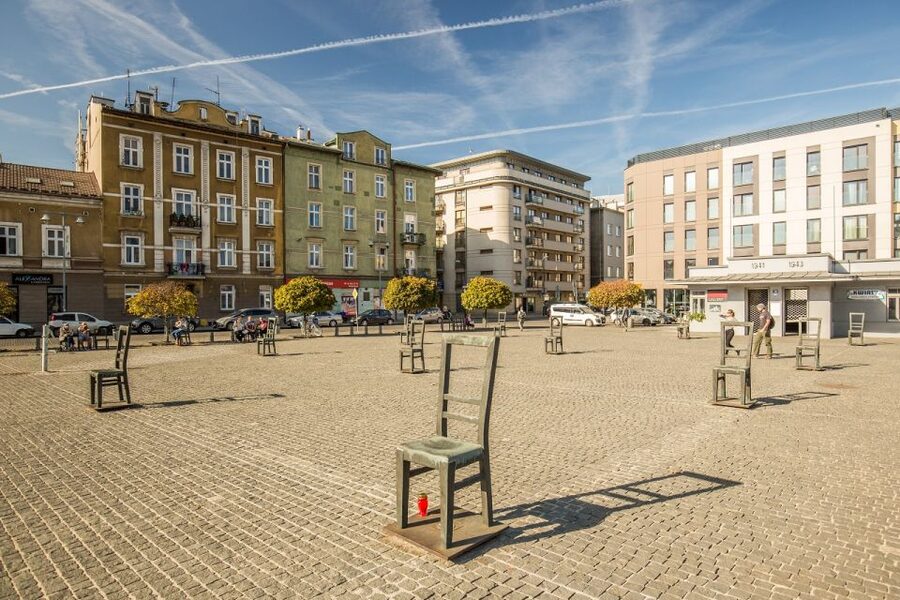
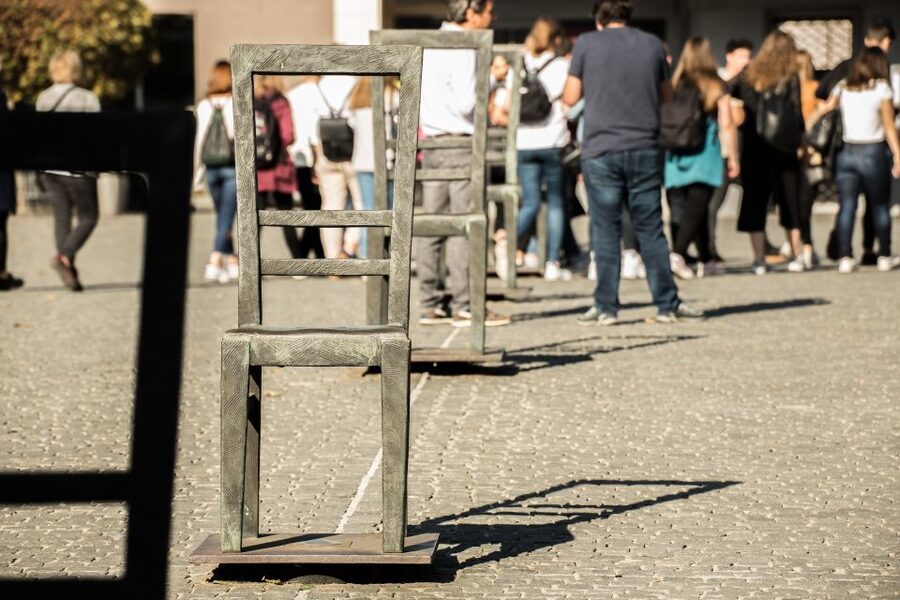
- Ghetto Heroes Square is marked by empty metal chairs, a quiet memorial to lives destroyed during the Holocaust.
- Under the Eagle Pharmacy recalls the courage of Tadeusz Pankiewicz and his staff, who helped people inside the ghetto.
- Podgórze’s surviving streets and buildings show how daily life took place within the ghetto’s cramped limits.
- The one-hour route is flat and manageable, but you will be walking continuously between several sites.
- The $11 price makes this a strong-value orientation before or after visiting Schindler’s Factory.
Walking into Podgórze’s wartime streets
The tour takes place in Podgórze, the district used for the Krakow Ghetto during the Nazi occupation of Poland. This is not a reconstructed historical park. It is a living part of Krakow, and that contrast matters. You are looking at real streets, original layouts, surviving buildings, and a few remaining physical traces among the city of today.
I find this setting more affecting than a simple display of photographs. The guide helps you picture the barriers, crowding, fear, and uncertainty that shaped everyday life. You learn how residents came to be confined there, how they managed daily routines, and what happened as deportations began.
The route is a walking tour rather than a museum visit. You should expect a steady pace and several stops for explanation. One hour is enough for a clear outline of the ghetto and its most important landmarks, but not for every detail. If you want a full study of Krakow’s Jewish community, the Holocaust, or the German occupation, use this as one part of a larger day of history.
A few people found the tour especially useful after visiting Schindler’s Factory. That pairing makes sense: the factory offers an indoor historical setting, while this walk places the story on the streets where people lived. Some departures may begin near Schindler’s Factory, but the meeting point can vary with the option you book, so check your confirmation carefully.
More Jewish Ghetto Tours in Krakow:
- Krakow: Schindler’s Factory & Ghetto Guided Tour
★ 4.7 · 1,694 reviews - Krakow: Jewish Quarter and Former Ghetto Tour
★ 4.9 · 1,441 reviews - Krakow: Bike Tour of Old Town, Jewish Quarter and the Ghetto
★ 4.9 · 1,155 reviews
The surviving ghetto wall
One of the tour’s clearest stops is a remaining section of the original Ghetto Wall. Only fragments survive, which makes this stop easy to underestimate at first. The guide supplies the missing scale and context: more than 15,000 people were enclosed within just a few city blocks.
The wall was not simply a boundary on a map. It controlled movement, separated families and neighbors from the rest of Krakow, and helped create the conditions for hunger, fear, and disease. Here, the guide explains the daily hardships faced by people trapped inside, along with the acts of solidarity that helped some residents endure.
I like this stop because it is concrete. You can look at the masonry while listening to the larger story. There is no grand ruin to photograph, and that is part of the point. The fragment is modest, but what it represents is enormous.
Do not expect a long stop with a large preserved complex. Very little of the original ghetto remains in one piece. Without a guide, you could easily walk past the wall and miss its importance. With photographs or clear descriptions, the present-day street becomes easier to compare with the wartime scene.
Ghetto Heroes Square and the Chair Memorial
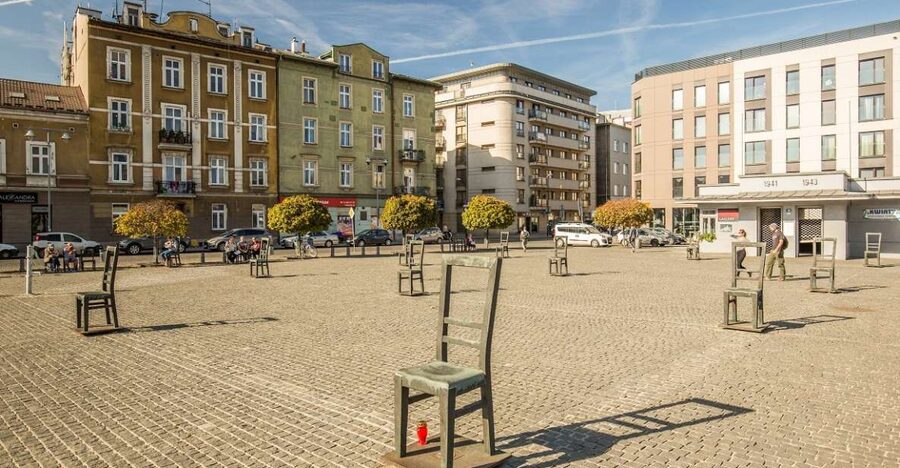
The route continues to Ghetto Heroes Square, the emotional center of the walk. During the war, this was connected with deportations to concentration camps. Today, dozens of empty metal chairs occupy the square.
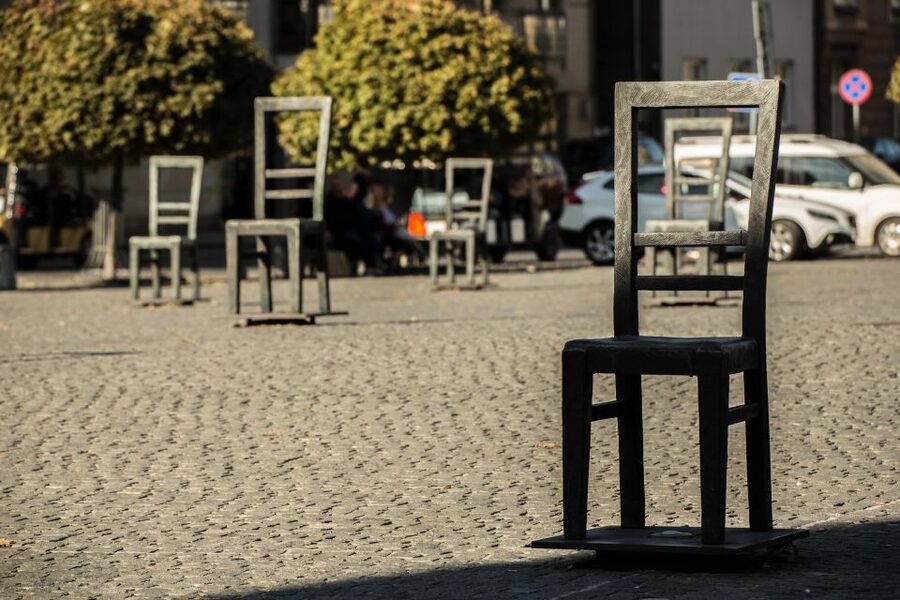
The chairs are a strong memorial because they suggest absence without needing a long explanation. They can represent furniture and belongings left behind, but also the people who were taken away. The open space gives the guide room to explain what happened here, while giving you a place to pause and think.
This is usually the moment when the tour shifts from facts to reflection. A good guide does not rush the square or turn it into a collection of dramatic anecdotes. The most praised guides, including Ewa and Helen, were described as compassionate and careful when telling painful stories. That tone is important on a tour dealing with murder, deportation, and survival.
The square also helps you understand the ghetto as a place where ordinary routines continued under impossible pressure. People still had to find food, care for relatives, work when possible, and respond to constant danger. The chairs bring the finality of deportation into a space that otherwise looks calm.
Under the Eagle Pharmacy and stories of courage
Across the square is the historic Under the Eagle Pharmacy. The guide tells the story of Tadeusz Pankiewicz and his staff, who risked their lives to help ghetto residents. They provided medicine and shelter, offering practical aid at a time when even small acts of assistance could carry great danger.
This stop gives the tour a necessary human balance. The ghetto story is one of cruelty and loss, but it also includes courage, compassion, and resistance. The pharmacy helps you see how support could take place in a specific building, through specific actions, rather than as an abstract idea.
The pharmacy is also described as a highly informative museum. However, the tour information confirms the stop and the storytelling, not an included museum admission. You should not assume that entry is part of the $11 walking tour. The route may end nearby, and the pharmacy’s opening status can vary. One booking found the chemist closed on the day, so check ahead if seeing the interior matters to you.
That possible limitation does not erase the value of the stop. Even from the outside, the guide can explain why the pharmacy mattered and how Pankiewicz and his staff helped people. If you want an indoor visit, treat it as a separate plan rather than a guaranteed part of this walk.
A few more Krakow trips to weigh up
- Old Town Krakow & Wawel Castle Walking Tour
★ 5.0 · 1,508 reviews - Creepy Krakow: 2-Hour City Walking Tour
★ 4.7 · 1,131 reviews - Krakow: The Old Town Walking Tour
★ 4.8 · 794 reviews - Krakow: Kazimierz Jewish Quarter Walking Tour
★ 4.8 · 571 reviews
What the guide adds to the experience
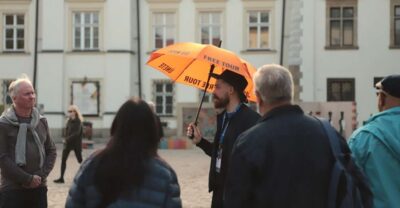
The guide is the main reason to book this rather than walk Podgórze alone. The remaining sights are scattered through a modern neighborhood, and their meaning is not always obvious. A guide connects the wall, square, pharmacy, buildings, and street plan into one story.
The strongest feedback centers on clear, personal storytelling. Olga was praised for answering questions and helping visitors picture the ghetto. Joanna was noted for a steady pace and friendly manner. Phil used photographs to show how places looked in the past, which can be particularly useful when little of the original architecture remains.
Ewa’s approach was described as sensitive and thoughtful, connecting the events of the occupation with the need to remember how hatred harms real people. Aga was praised for explaining the complexity and horror of the German occupation of Poland while encouraging reflection on the present. These examples suggest that the guide’s personality can shape the tour, but the common thread is care and strong command of the subject.
You may receive headphones or an ear microphone, depending on the group and guide. This has helped some people hear clearly while walking. One person found that a guide spoke too quickly and could be hard to hear on a cold day, so stay near the guide and ask for a repeat if needed. Group tours are conducted in one selected language, not several languages at once.
Available languages include English, French, German, Italian, Spanish, Russian, Portuguese, Swedish, and Slovak. A private group option is also available if you want more control over questions, pace, and discussion.
Why one hour can be enough, and why it may not be
The one-hour format is both a strength and a limit. I like it as a compact introduction, especially if you have only a short time in Krakow or want to fit the ghetto walk around another visit. The route is described as flat, and one booking found the walking distance manageable. Another person liked the steady pace, particularly for slower walkers.
At the same time, this is not a leisurely stroll with long breaks. You move between several sites while the guide continues explaining the history. In warm weather, the hour may feel just right. In bitter cold, rain, or snow, you will appreciate the short schedule, but you will need suitable clothing and shoes because the tour runs in all weather.
The short format can also leave you wanting more. One guide had so much material that an hour seemed unable to contain it. That is not a failure of the route. It is a sign that the subject is larger than the time available.
I would book this tour when I want orientation, context, and the main memorials in a single hour. I would not book it as my only Holocaust-related experience in Krakow. Pair it with a longer museum visit or another historical site if you want a fuller picture.
Value at $11 per person
At $11 per person, this is inexpensive for a live guided walk in a major European city. The price covers an expert guide and the walking tour itself. Food and drink are not included, though the short length means you do not need to plan refreshments during the route.
The real value comes from interpretation. You can see the wall and the square without paying for a tour, but you may miss why the surviving fragment matters or how the deportation site relates to the wider ghetto. You also gain stories about people who lived, helped others, and tried to survive there.
The value is strongest if you are new to Krakow’s wartime history or if you tried walking the area alone and felt that the context was missing. One person booked the tour after a brief independent look around and found that the guide supplied the information that made the places meaningful.
The price also makes this a low-risk choice. Free cancellation is available up to 24 hours before the start, and you can reserve now and pay later. Arrive 10 minutes early, though. Once the group leaves, late arrivals cannot join and tickets cannot be refunded.
Planning the route with Schindler’s Factory
Several people found the tour especially useful alongside Schindler’s Factory. Starting near the factory is a practical way to connect the industrial story of the occupation with the streets of the ghetto. The two experiences address different parts of the same period, so they work well together.
Do not assume that every tour begins at Schindler’s Factory. The meeting point may change according to the option booked. Also note that the walk may finish in a different place from where it begins, sometimes at or near Ghetto Heroes Square. That is easy to manage, but you should check the ending before scheduling a tight appointment or transport connection.
Allow a little extra time around the one-hour estimate if you want to ask questions, look at the memorial, or continue to the pharmacy. The guided portion is short, but the subject deserves more than a hurried dash to the next attraction.
Who should book this walk
I recommend it for anyone who wants to understand Krakow beyond the Old Town. It suits first-time visitors, students of World War II history, and people who have already visited Auschwitz but want to learn how persecution affected daily life inside an urban ghetto.
It is also a good choice for mixed groups. Someone who feels they have already had enough difficult history may still find the one-hour length manageable, while a history-minded companion gets useful local context. The tone is serious, but the walk remains accessible and clearly organized.
You should think twice if you want a long, slow tour with extensive time inside preserved buildings. There is not much of the old ghetto architecture left, and the tour relies on the guide to explain what has disappeared. You should also prepare yourself emotionally. The subjects include forced confinement, deportations, suffering, and death.
Should you book the Krakow Jewish Ghetto tour?
Book it if you want a short, affordable, well-guided introduction to Podgórze’s wartime past. The surviving wall, empty chairs, pharmacy, and original street layout create a meaningful route, while guides such as Olga, Joanna, Ewa, Helen, and Phil have brought clarity and humanity to the experience.
Do not expect a complete history course or guaranteed entry to Under the Eagle Pharmacy. Think of this as a focused one-hour walk that gives you the context to see Krakow more clearly. At $11, it offers excellent value, especially before or after Schindler’s Factory.
FAQ
How long is the Krakow Jewish Ghetto walking tour?
The tour lasts one hour. Check availability for the departure times offered on your chosen date.
How much does the tour cost?
The listed price is $11 per person.
What places does the tour visit?
The route includes the remains of the original Ghetto Wall, Ghetto Heroes Square, the Chair Memorial, Under the Eagle Pharmacy, and authentic wartime buildings and street layouts in Podgórze.
Is a guide included?
Yes. The tour includes a live licensed guide.
Which languages are available?
The tour is offered in French, German, Italian, English, Spanish, Russian, Portuguese, Swedish, and Slovak. Group tours operate in one selected language.
Is the tour private?
A private group option is available. Other bookings may operate as group tours.
Is entry to Under the Eagle Pharmacy included?
The supplied details include a stop at the historic pharmacy and stories about its role, but they do not confirm that museum admission is included. Check your selected option if entering the pharmacy is important to you.
Where does the tour meet?
The meeting point can vary according to the option booked. Some departures have met near Schindler’s Factory, so check your booking details carefully.
What should I wear?
Wear suitable clothing and comfortable footwear. The tour goes ahead in all weather, including rain, so check the forecast and prepare accordingly.
What happens if I arrive late?
You should arrive 10 minutes before the start. Once the group has departed, latecomers cannot join and tickets cannot be refunded.
Can I cancel the tour?
You can cancel up to 24 hours in advance for a full refund. A reserve-now, pay-later option is also available.
Just added around Krakow
- Tour to Wadowice: Hometown of Pope Saint John Paul II★ 4.6 · 12 reviews
- The Jewish Quarter – Walking Tour★ 5.0 · 4 reviews
- From Kraków; to Białka Thermal Baths private tour★ 5.0 · 5 reviews
- St. Mary’s Basilica and more – a short walk with a guide★ 4.7 · 56 reviews
- Krakow: Auschwitz-Birkenau and Wieliczka Salt Mine Day Trip★ 4.7 · 84 reviews
- Krakow: Skip-the-Line Wawel Castle & Old Town Guided Tour★ 4.9 · 23 reviews
- Krakow: Schindler’s Factory Guided Tour★ 4.2 · 12 reviews
- Shooting Range Experience!★ 4.8 · 66 reviews
Jewish Ghetto Tours, compared.
Bike Tour of Old Town, Jewish Quarter and the Ghetto
Read our review →
Kazimierz, Schindler’s Factory & Ghetto Guided Tour
Read our review →
Full Bike Tour – the Old Town, Jewish Qtr & the Ghetto NEW BIKES
Read our review →
Warsaw Ghetto Private Walking Tour with Hotel Pickup
Read our review →
Bike Tour of the Old Town, Kazimierz, and the Ghetto
Read our review →
Jewish Quarter and Ghetto Electric Golf Cart Tour
Read our review →Browse the lists this tour appears in