
Reviewed · HISTORICAL TOURS
Historical Walking Tour of Jewish Warsaw
Warsaw’s Jewish past is not laid out like an open-air museum. Much of the former ghetto was destroyed, so the most important part of this walk is learning how to read the city’s fragments: a wall remnant, a surviving synagogue, a street plan, a memorial, and the empty spaces where whole communities once lived. The tour follows that story for about three hours, ending at Umschlagplatz.
I like the small group limit of 10, which gives guides such as Aga, Agnieszka, and Oliwia room to answer questions and show maps and photographs. I also like the route’s range. It includes Nozyk Synagogue, the ghetto wall, Miła 18, the Jewish Ghetto memorial, and Umschlagplatz rather than stopping at one famous monument.
The main drawback is simple: this is a long walk, and there is less surviving architecture than some people expect. Wear sturdy shoes, especially for cobblestones, and do not plan another demanding museum visit immediately afterward unless you are happy spending most of the day on your feet.
Key points to know before you go
- The route covers about three hours on foot, beginning at Sienna 53 and ending at Umschlagplatz.
- Only a few physical traces remain, so photographs, maps, and explanation are central to the experience.
- Nozyk Synagogue is the only Warsaw synagogue to survive the war and remain in use today, but its 20 PLN entry fee is extra.
- The walk includes Miła 18, the Heroes of the Jewish Ghetto memorial, the ghetto wall fragment, and Umschlagplatz, giving you a broad view of the former ghetto.
- The maximum group size is 10, and the tour is offered in English with a mobile ticket.
- The $28.87 price is good value if you want a guided historical route rather than simply finding the memorials on your own.
Starting at Sienna 53, where modern Warsaw meets its past
The meeting point is Baguette Mi, a banh mi bistro at Sienna 53, on the corner with Jana Pawla II Avenue. This is a practical starting place near public transportation, and the short introduction gives you time to meet the guide and understand the basic shape of the route.
That opening matters because Jewish Warsaw can be confusing at first. The wartime ghetto no longer appears as one clearly marked district, and postwar apartment blocks now fill much of the area. A good guide helps you picture the prewar streets and understand where the ghetto boundaries once ran.
You receive visual aids during the walk, along with a pre-tour information pack containing frequently asked questions, useful links, and suggestions for other places to visit, eat, and drink. Those extras are not just filler. Maps and old photographs help bridge the gap between the present-day city and the Warsaw that disappeared.
A few more Warsaw trips to weigh up
- Warsaw: POLIN Museum of the History of Polish Jews Ticket
★ 4.7 · 1,142 reviews - Warsaw: Chopin Concert at Historical Venue in Old Town
★ 4.7 · 445 reviews - Small-Group Historical Guided Tour of Warsaw with pick up/drop off. Public Tour.
★ 4.5 · 343 reviews
Nozyk Synagogue, one of the few survivors
Nozyk Synagogue is the first major stop. It is described as the only Warsaw synagogue that survived World War II and still remains today. That makes it a valuable anchor for the tour, since so many other buildings connected to Jewish life were destroyed.
You spend about 10 minutes here. The entry fee is not included and costs 20 PLN, so bring enough Polish currency or check the current payment arrangements before you arrive. The tour can still be understood without entering, but going inside adds a useful sense of place when admission is available.
The synagogue also helps correct an easy mistake. Jewish Warsaw was not only a wartime story. Before the occupation, it was a large, active part of the city, with religious institutions, homes, businesses, schools, political groups, and cultural life. The tour aims to explain that earlier world before moving into the years of persecution and destruction.
The ghetto wall fragment and the problem of missing buildings
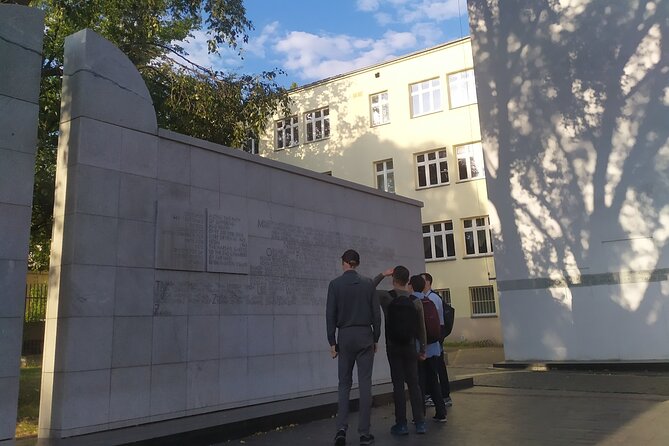
The route then reaches one of the few remaining sections of the Warsaw ghetto wall. The stop lasts about 15 minutes, giving the guide time to explain how the wall divided neighborhoods and restricted the movement of Jewish residents.
This is one of those places where expectations matter. You are not walking through a preserved medieval quarter with rows of original buildings. The wall fragment is small, and the surrounding city has changed greatly. Its importance comes from what it represents and from the guide’s ability to place it within the larger ghetto map.
I find this kind of stop more useful with visual material in hand. Old photographs and maps can show the wall’s former scale and position far better than the surviving bricks alone. Take a moment to look at the current street, then compare it with the historical image. The contrast is the point.
Two hours through the former Warsaw ghetto
The central section lasts about two hours and five minutes. This is where the tour earns its price. Instead of treating the ghetto as a single memorial stop, the guide connects a long series of locations across the former district.
The route includes the Jewish Ghetto memorial, the courthouse on Solidarności Street, the Muranów residential district, the place where the Ringelblum Archive was discovered, the Church of St. Augustine, the Heroes of the Jewish Ghetto memorial, and Miła 18, also known as Anielewicz’s Bunker.
You will hear about life before the war, the creation of the ghetto, daily conditions under occupation, resistance, deportation, and the destruction of the district. The focus is not only on dates and military events. It also concerns how people lived, worked, worshiped, suffered, organized, and tried to preserve evidence of what was happening.
Same country, a completely different kind of day:
- Warsaw: Chopin Concert in the Old Town
★ 4.8 · 2,287 reviews - Warsaw: Traditional Galar Cruise on The Vistula River
★ 4.6 · 1,640 reviews - Warsaw: Old Town Highlights Walking Tour in English
★ 4.7 · 1,516 reviews - Warsaw Concert: Chopin – Painted by Candlelights with Wine
★ 4.8 · 1,442 reviews
Muranów and the city built over the ruins
Muranów is particularly important because the present-day residential district can hide the shape of the former ghetto. Modern buildings occupy ground tied to the wartime district, so you need the guide to point out what cannot be seen directly.
The walk turns the neighborhood into a historical map. A regular street corner may mark a former boundary. An apartment block may sit in an area once filled with Jewish homes. A quiet space may carry more meaning than a preserved façade.
This is also the section most likely to challenge visitors who expect a large number of original structures. Warsaw suffered immense wartime destruction, and the former ghetto has few intact prewar buildings. The tour’s value comes from connecting the remaining sites, not from presenting a complete architectural district.
The Ringelblum Archive and the importance of testimony
The Ringelblum Archive is one of the most meaningful subjects on the route. The archive preserved documents, accounts, and evidence of Jewish life and suffering in wartime Warsaw. Its survival shows the deliberate effort to record events even while the ghetto was being destroyed.
This adds an important layer to the walk. You are not only seeing places connected to violence. You are also learning about people who worked to preserve names, documents, observations, and personal accounts for the future.
Miła 18 and the resistance story
Miła 18, associated with the bunker of Jewish resistance leader Mordechai Anielewicz, is another major stop. The location is not a grand building that you enter. Its force comes from the story attached to the site and the memorial that marks it.
The guide uses this stop to explain the Warsaw Ghetto Uprising and the people who chose to resist despite overwhelming odds. Photographs and maps help make the site easier to understand, since the physical remains are limited.
The tone here should be serious rather than theatrical. The walk deals with mass persecution, deportation, resistance, and murder. Several guides named in the tour feedback, including Oliwia and Aga, were praised for combining clear facts with humanity. That balance is important on a subject where dramatic presentation can easily become too much.
Memorials that give the route its emotional shape
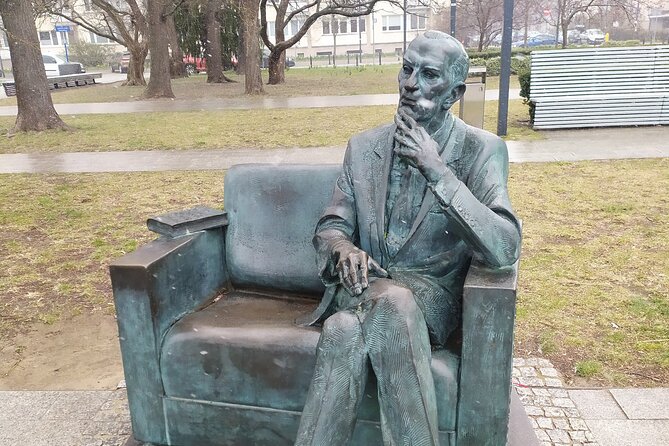
The Laweczka Jana Karskiego stop takes about 15 minutes. The bench monument honors Jan Karski, the Polish resistance courier who reported on the destruction of European Jewry. It is one of several monuments on the route recalling both the suffering of Jewish Warsaw and the struggle against the ghetto’s destruction.
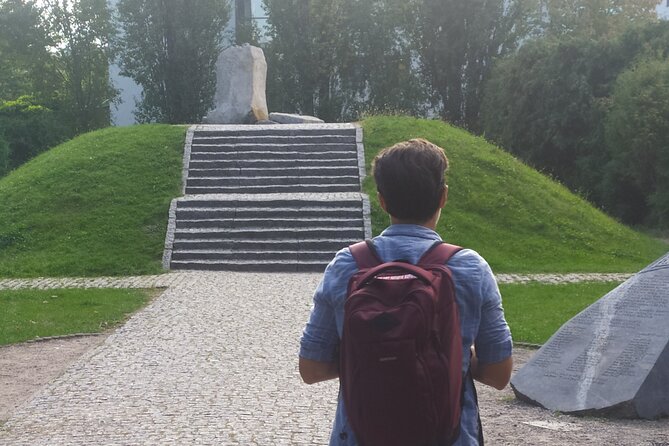
The walk also includes the Jewish Ghetto memorial and the Heroes of the Jewish Ghetto memorial. These sites are not interchangeable. Each carries its own history and visual language, and the guide explains how they fit into the larger story.
The memorials help compensate for the lack of surviving buildings. You are not simply passing through an ordinary residential area. You are moving between carefully placed markers that preserve memory in a city rebuilt after catastrophe.
Umschlagplatz, the powerful end point
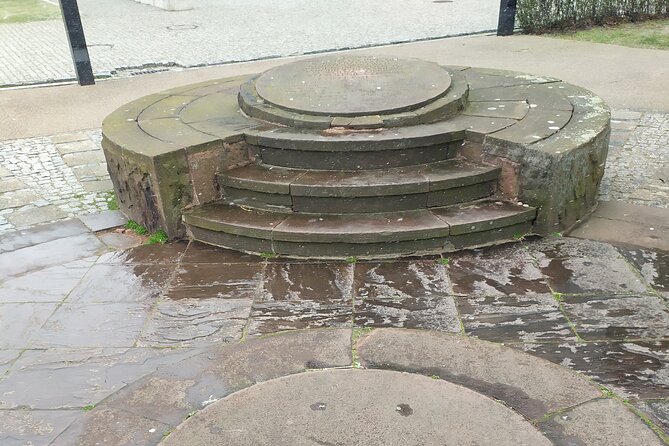
The tour ends at the Umschlagplatz Monument on Stawki Street, after about 10 minutes at the final stop. This is the location from which roughly 300,000 Jews were transported to Treblinka.
Ending here gives the route a clear and difficult final note. You have started with Jewish life and Warsaw’s surviving religious heritage, followed the boundaries and daily reality of the ghetto, visited resistance sites and memorials, and finished at the deportation point.
The monument is also a practical end point. From here, you can continue with your own plans, but the tour provider does not promise transportation onward. One guide helped a visitor find the correct tram after the walk, but you should still check your own route in advance if you have a train or timed appointment.
How the guiding style affects the experience
The tour is offered in English, and the guides use visual aids, maps, and photographs. The strongest part of the experience is likely to be the guide’s storytelling and ability to connect scattered locations.
Aga, Agnieszka, and Oliwia are among the guides specifically named in the feedback. Their styles may differ, but the descriptions point to clear explanations, steady pacing, strong command of the subject, and useful local recommendations. One guide even helped with a tram connection after the tour, which is the kind of small practical help that can save a rushed afternoon.
Do not expect a light sightseeing walk. Some guides may present the subject in a restrained, factual way rather than with visible outrage. That can feel too cool for some people, especially when discussing the Holocaust. At the same time, a factual approach can help keep the focus on evidence and historical accuracy.
The tour also addresses an important distinction about German occupation and the Nazi concentration camp system. The camps were German camps, while Poland was occupied and Polish people were also victims of German persecution. The history of Polish-Jewish relations is painful and complex, and this tour provides context, but it cannot settle every part of that discussion in three hours.
Distance, cobblestones, and what to bring
The route is not recommended for people who have trouble walking long distances. Plan on three hours of walking, with some stops where the guide explains the sites and lets the group catch up or take photographs.
Wear sturdy, comfortable shoes. Cobblestones and the length of the route are the two practical issues most likely to affect your enjoyment. Bring an umbrella, since the walk operates outdoors and the tour does not promise indoor shelter at each stop.
A mobile ticket is provided, and the meeting point is near public transportation. The group maximum of 10 is a real advantage here. Large groups can make it hard to hear explanations at memorials or view a map, while a small group makes it easier to ask about family history, architecture, or the route itself.
Is $28.87 a fair price?
At $28.87 per person, this is a reasonable price for a three-hour guided walk with a small group, visual aids, a pre-tour information pack, and recommendations for further places to visit.
You are not paying for admission to a major museum. The route is mostly outdoors and admission is free at the main memorial sites. The 20 PLN fee for Nozyk Synagogue is extra. The value comes from the guide’s historical framework and the amount of ground covered.
I would especially consider this good value if you know little about Jewish Warsaw or if you have already visited the city but missed the subtle traces of the former ghetto. You can find the memorials independently, but it is much harder to understand their relationship to one another without maps, photographs, and a clear route.
If you want preserved interiors, original streets, and a large collection of objects, spend time at the POLIN Museum as well. The museum and this walk serve different purposes. The museum gives you indoor exhibits and a broad historical timeline, while the walking tour places you directly in the streets and memorial spaces of the former ghetto.
Who should book this walk?
I would recommend it to anyone with a serious interest in World War II, Jewish history, Warsaw, resistance movements, or the way cities preserve memory after destruction. It is also a strong choice for families with older children who can manage three hours of walking and engage with difficult material.
It suits you less if you want a quick sightseeing loop or a route filled with intact historic buildings. The walk can feel sparse if you judge it only by what remains above ground. Its purpose is to show how to read a rebuilt city and to explain why the missing buildings matter.
Book well ahead if your dates are fixed, since it is often reserved about 46 days in advance. Free cancellation is available until 24 hours before the start time. A full refund is not available for cancellations or changes made inside that 24-hour window.
Should you book the Historical Walking Tour of Jewish Warsaw?
Book it if you want a carefully guided introduction to the former Warsaw ghetto and are prepared for a long, serious walk. The small group, visual aids, broad route, and final stop at Umschlagplatz make it more useful than a quick monument-to-monument stroll.
Skip it if you need an indoor activity, have limited walking ability, or mainly want to see intact prewar Jewish architecture. For most visitors who want to understand what happened here, though, this is a worthwhile three hours. Wear good shoes, allow time afterward to think, and consider pairing it with POLIN on a separate day.
FAQ
How long is the Historical Walking Tour of Jewish Warsaw?
The tour lasts approximately three hours.
Where does the tour begin?
It begins at Sienna 53, 00-820 Warszawa, Poland, at Baguette Mi on the corner with Jana Pawla II Avenue.
Where does the tour end?
The tour ends in front of the Umschlagplatz Monument at Stawki 10, 00-178 Warszawa, Poland.
Is the tour offered in English?
Yes. English is the listed language.
What is included in the price?
The experience includes a pre-tour information pack with frequently asked questions and useful links, visual aids, and recommendations for other places to visit, eat, and drink.
Is admission to Nozyk Synagogue included?
No. Entry to Nozyk Synagogue is not included and costs 20 PLN.
How many people can join the tour?
The maximum group size is 10 people.
Is the tour suitable for anyone with limited mobility?
The tour is not recommended for people who have problems walking long distances. It lasts about three hours and includes outdoor walking.
Can I cancel for a refund?
Yes. You can cancel at least 24 hours before the experience starts for a full refund. Cancellations or changes made less than 24 hours before the start time are not accepted for a refund.
Just added around Warsaw
- World War II Warsaw Old Town, Military Cemetery Walking Tour★ 4.7 · 3 reviews
- Wilanów Palace: 2-Hour Guided Tour with Entrance Tickets★ 4.8 · 8 reviews
- Warsaw: Wolf’s Lair & Swieta Lipka Small-Group Tour + Lunch★ 5.0 · 3 reviews
- Warsaw Zoo Skip-the-Line Entry Ticket with Private Transport★ 4.8 · 3 reviews
- Warsaw Wolf’s Lair with St. Lipka and Mamerki Private Guided★ 4.2 · 3 reviews
- Warsaw: Vistula River Cruise with Your Music & City Views★ 4.6 · 78 reviews
- Warsaw: Private Vodka Tasting Night with Snacks and Pickup★ 5.0 · 7 reviews
- Warsaw Private Wilanow Palace & Garden Tour★ 4.6 · 30 reviews
Historical Tours, compared.

POLIN Museum of the History of Polish Jews Ticket
Read our review →
Gdańsk City Sights & History Guided Walking Tour in English
Read our review →

Small-Group Historical Guided Tour of Warsaw with pick up/drop off. Public Tour.
Read our review →Browse the lists this tour appears in