
Reviewed · OLD TOWN WALKING TOURS
Private 4h Tour in Warsaw Old Town
Warsaw’s Old Town looks centuries old, yet much of it was rebuilt after World War II. That tension is the heart of this four-hour private walking tour. You move from royal squares and churches to war memorials, while your guide explains how a city destroyed in 1944 rebuilt itself with remarkable care.
I like the one-group format, which lets you ask questions and set the pace more easily than on a large city walk. I also like the route’s range: you see the royal center, medieval defenses, the Warsaw Uprising Monument, grand theaters, and the Royal Route instead of spending four hours circling one square.
The main drawback is the amount of ground covered on foot. Most stops are short, and the tour does not include admission to the Royal Castle or other paid interiors, so you will need another visit if you want to see the collections inside.
Key points at a glance
- Private guide for your group: You avoid a large tour crowd and can ask about family history, architecture, war, or daily life in Warsaw.
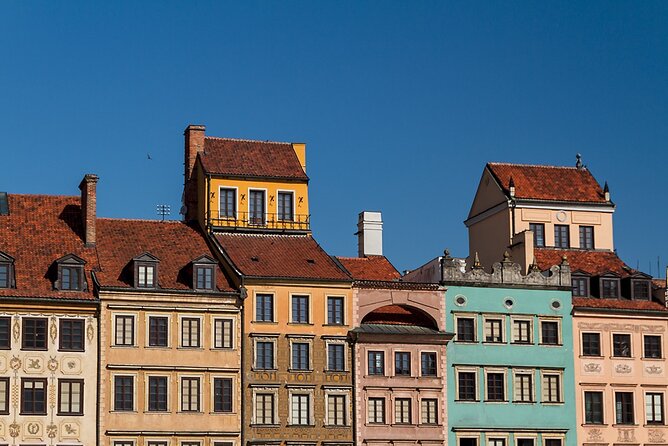
- A rebuilt Old Town: The colorful facades are historic in design, but roughly 90 percent of the Old Town was destroyed in 1944.
- Eleven linked stops: The walk connects Castle Square, the Old Town Marketplace, the Barbican, Theatre Square, and the Royal Route.
- Strong wartime context: The Warsaw Uprising Monument and Tomb of the Unknown Soldier add weight to the sightseeing.
- No admission fees included: The listed stops are viewed from outside or in free-access areas, while the guide’s time is included.
- A useful finish: The tour ends near the Nicolas Copernicus Monument on Krakowskie Przedmieście, a good point for continuing on your own.
Why Warsaw’s rebuilt center deserves a guided walk
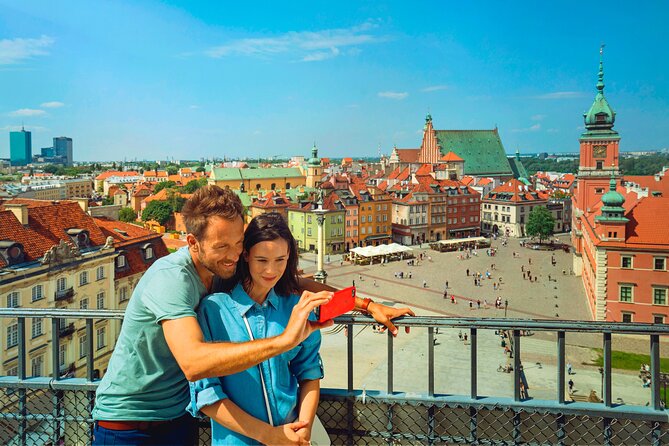
If you arrive expecting an untouched medieval quarter, Warsaw may surprise you. Its Old Town is a faithful reconstruction, not a preserved pocket that escaped the 20th century. German forces destroyed about 90 percent of the area during the Warsaw Uprising and its aftermath, and the rebuilding took years.
That fact changes how you read every facade. The narrow streets, defensive walls, church interiors, and market square recreate the old city’s shape, but the story is also about loss, memory, and civic determination. I find that a local guide helps you see both sides at once.
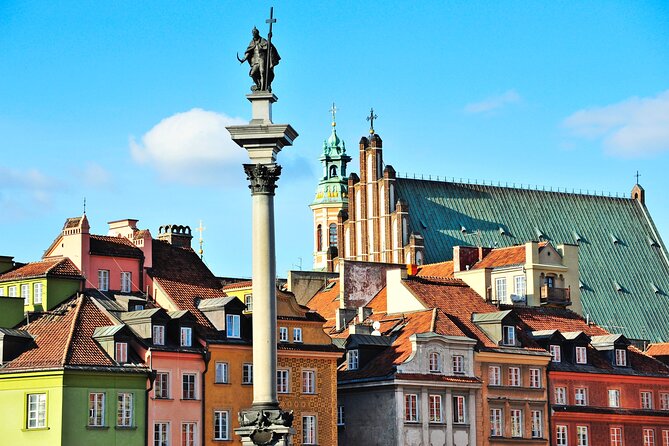
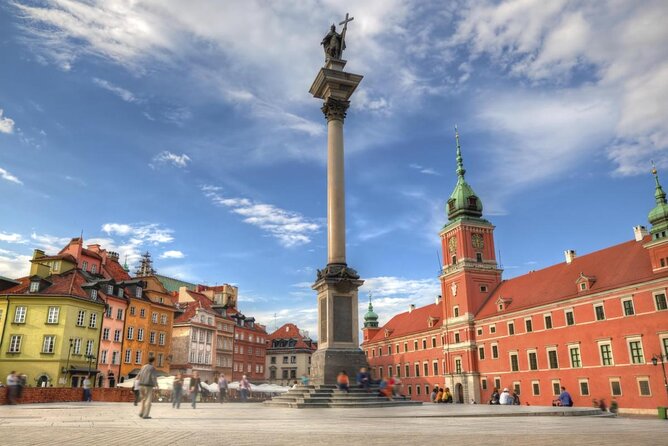
The route begins at King Sigismund’s Column, beside Castle Square. This is the city’s oldest public memorial and one of Warsaw’s main symbols. The column has been moved more than once, and German troops brought it down on September 2, 1944. The statue and column were reconstructed in 1949.
You can also see earlier versions of the column beside the Royal Castle walls, viewed from the WZ route. That small detail is easy to miss on a self-guided walk, but it gives the opening stop a useful sense of time and change.
More Old Town Walking Tours in Warsaw
- Warsaw: Chopin Concert in the Old Town
★ 4.8 · 2,287 reviews - Warsaw: Old Town Highlights Walking Tour in English
★ 4.7 · 1,516 reviews - Warsaw: Old Town Guided Walking Tour
★ 4.9 · 599 reviews
From Castle Square to the Old Town Marketplace
Castle Square is the natural gateway into the Old Town. From here, the guide can explain Warsaw’s royal past before leading you into the streets where merchants, craftsmen, and wealthy residents once lived.
The city grew beside a river route that supported trade between the Baltic Sea and the Black Sea. Wooden buildings gradually gave way to masonry tenements, while earthen defenses became stone walls. A town hall was built in 1429, although it no longer survives, and the parish church became today’s Cathedral of St. John.
The Old Town stop lasts about 45 minutes, the longest pause on the route. That makes sense. You need time to look beyond the tidy facades and understand the rebuilding. A guide who uses before-and-after photographs can make this part especially effective. One guide was praised for showing Warsaw before and after the war, which is exactly the visual help you need here.
The Royal Castle Gardens follow. The castle became a royal residence in the 16th century after Masovia joined the Crown. It was damaged and rebuilt several times, then bombed and burned at the start of World War II. In 1944, it was blown up after much of its remaining contents had already been looted.
Reconstruction began in 1971, financed largely through public donations, and the castle opened to visitors in 1984. The gardens offer a calmer setting and a chance to appreciate the scale of the rebuilding. Since this tour includes only a short exterior visit, plan a separate castle visit if you want the paintings, rooms, and exhibitions.
Churches, mermaids, and the defensive walls
The Archcathedral Basilica of St. John the Baptist is one of Warsaw’s oldest churches. It witnessed important national events, including the oath connected with the Constitution of May 3, described as the first of its kind in Europe. Its crypt contains the tombs of notable Polish figures, including the Chapel-Mausoleum of the Primate of the Millennium.
The church also hosts International Organ Music Festival concerts every Sunday at 4 PM from July through September. The walking tour does not include a concert, but that seasonal detail may help you plan a return visit.
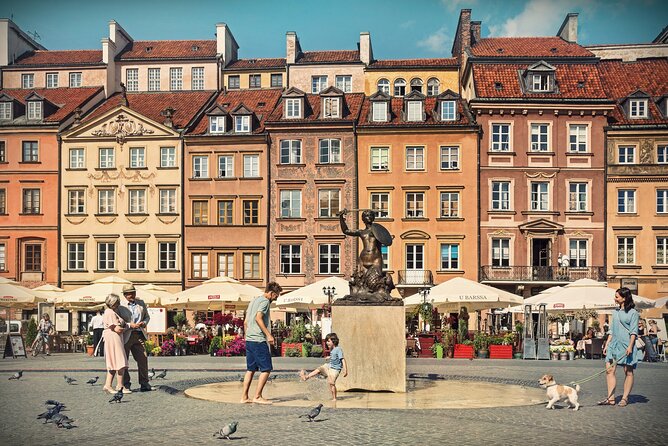
Next comes Rynek Starego Miasta, the Old Town Marketplace. Tenement buildings surround the square, now filled with restaurants, cafes, clubs, galleries, and museums. At the center is the Warsaw Mermaid, the city’s best-known symbol.
The square is divided into four sections named for Enlightenment-era activists: Kołłątaj, Dekert, Barss, and Zakrzewski. This is a pleasant point to pause, look around, and note down a cafe or restaurant for later. The tour is not built around a meal, but Carolina, one of the named guides, is known for offering food and snack suggestions.
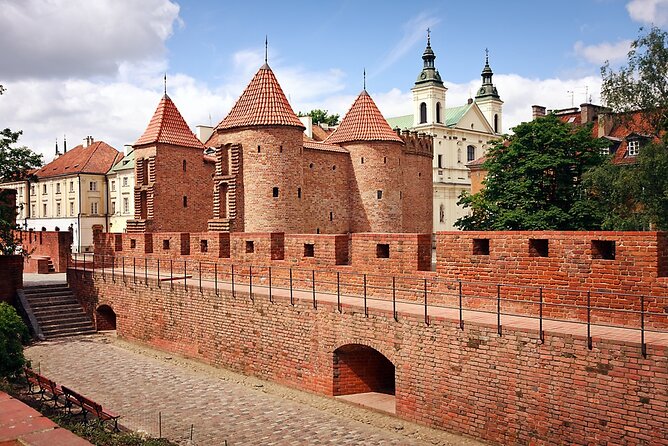
The Warsaw Barbican gives you a different view of the old city. Built in 1548, it formed part of roughly 4,000 feet of defensive ramparts. Today, painters and musicians often use the area, giving the old fortification a present-day purpose without hiding its military role.
From May through October, an exhibition inside the Barbican presents old photographs and models of Warsaw’s defensive lines and towers. The display is useful because it lets you compare the lost walls with the city you see today. Admission to the listed stop is free, but the tour description does not promise entry into the seasonal exhibition, so ask your guide if it is open during your visit.
The Warsaw Uprising and the cost of freedom
The Warsaw Uprising Monument shifts the tone of the walk. Its figures show insurgents in battle, recalling the 1944 uprising that ended in defeat and the deaths of about 200,000 Poles. This is not a decorative stop. It is one of the places where Warsaw’s modern identity comes into sharp focus.
Nearby, Krasiński Palace offers a contrast. The Baroque palace, now connected with special collections of the National Library, is considered one of Warsaw’s most appealing Baroque structures. Its reliefs draw on antique designs, and the park behind it gives you a short break from the streets.
The tour also points out the green building across the street, home to the Supreme Court. These details show how old royal and noble spaces now sit beside modern civic institutions.
Miodowa Street continues the architectural story. This narrow street is lined with former aristocratic and religious residences. The Collegium Nobilium once occupied number 24 and now houses the Academy of Theatre. Number 17 is the Palace of Warsaw’s Archbishops, while number 16 is the city’s only Eastern Catholic Church.
You will also see Pac Palace and the Capuchin Church. The church contains the heart of Jan III Sobieski at the right side of the altar, a small but memorable detail. Farther along, you can look toward the Monument of Warsaw’s Heroes, often called the Monument of Nike.
Same country, a completely different kind of day:
- Warsaw: Traditional Galar Cruise on The Vistula River
★ 4.6 · 1,640 reviews - Warsaw Concert: Chopin – Painted by Candlelights with Wine
★ 4.8 · 1,442 reviews - Warsaw: City Sightseeing Hop-On Hop-Off Bus Tour
★ 3.6 · 1,415 reviews - Warsaw: POLIN Museum of the History of Polish Jews Ticket
★ 4.7 · 1,142 reviews
Theatre Square and the Tomb of the Unknown Soldier
At Plac Teatralny, the route broadens into grand civic Warsaw. The Late Baroque Blank Palace borders the square, while the rebuilt Jabłonowski Palace recalls the former city hall. The original building was destroyed in the war, and the modern reconstruction keeps only the historic facade and clock tower.
Walk through the gate beneath the tower to see foundations laid in the 19th century. This is another place where Warsaw asks you to look past the polished exterior and think about what was lost.
The Grand Theatre faces the square. It houses the National Opera and National Theatre, and its opera stage is one of Europe’s largest. If you attend a performance, you can see the chandeliers, columns, foyer, and tiled floors inside. The walking tour itself does not include a performance, so treat this stop as a useful orientation for a future evening.
The Petrykus Tenement House closes the square, with restaurants and clubs inside. The guide may point out places worth returning to, but this is not a food tour.
The Tomb of the Unknown Soldier brings the focus back to national memory. The symbolic tomb honors soldiers who died fighting for Poland’s freedom. It includes the ashes of a defender of Lviv and soil from World War I battlefields, along with urns from later places where Polish troops died.
An eternal flame burns beside the tomb, watched by a military honor guard. The guard changes daily at noon. If your timing allows, that ceremony could add a precise moment to an otherwise flexible walking route.
The Royal Route and a practical finish
The final stretch follows the Royal Route, once linking Castle Square with Trzech Krzyży Square. The tour covers part of this long ceremonial road, including Krakowskie Przedmieście and the beginning of Nowy Świat.
You may see St. Anne’s Church, with its tower view, and Polonia House, once the Museum of Industry and Trade where Maria Skłodowska-Curie worked. The Radziwiłł Palace is now the residence of Poland’s president.
The route also passes Warsaw University, Kazimierzowski Palace, Czapski Palace, and elegant shops and restaurants on Nowy Świat. This final section feels less like a museum visit and more like an introduction to the city you can continue exploring afterward.
The official end is near the Nicolas Copernicus Monument on Krakowskie Przedmieście. The guide leaves you there, so you are free to keep walking the Royal Route, stop for food, or return to a place that caught your attention earlier.
That ending is useful. You do not finish in an isolated parking area or far from the action. You finish on one of Warsaw’s best-known streets, with several easy options for the rest of your afternoon.
How much value do you get for $111.75?
At $111.75 per person, the price is not aimed at the cheapest city walk. Its value depends heavily on how many people are in your private group. A couple or small family may find the personal guide, flexible questions, and focused history worth the cost. A larger group can benefit from the stated group discounts.
There are no admission tickets included for the listed sights. That is not a problem if your goal is an informed orientation walk, but it matters if you expect a castle tour, museum visit, or church concert. You are paying mainly for the guide’s time and the structure of the route.
The four-hour length is another value point. You cover a large part of central Warsaw in one session, including sites that are easy to treat as separate visits. The tradeoff is speed. With eleven stops, you will often spend 10 to 20 minutes at a place rather than settle in for a long interior visit.
The tour is offered in English, and the named guides include Maria, Cesar, Carolina, and Mariola. Maria is praised for making the city’s story clear and for bringing warmth to the experience. Cesar is associated with detailed explanations at each site. Carolina is noted for practical food suggestions, while Mariola is described as passionate about Warsaw, Poland, and the links between Polish and French history.
Those descriptions point to the tour’s strongest quality: the guide makes the connections. The buildings alone are worth seeing, but the city becomes much easier to understand when someone explains why a royal castle was rebuilt, why a column was moved, and why a bright Old Town square carries such painful memories.
Who should book this walk?
I would choose this tour for a first visit to Warsaw, especially if you want the city’s major sights explained in one concentrated morning or afternoon. It suits history-minded visitors, families who prefer a private pace, and anyone who wants to ask direct questions without speaking over a large group.
It is also a good fit if you want local advice for the rest of your stay. The guides can point out food and snack options, and the final stop leaves you on the Royal Route rather than ending your day at the edge of town.
I would think twice if you dislike walking, need long indoor visits, or want a tour built around museum admission. The route is mostly an outdoor introduction, and some stops are brief. In hot, cold, or wet weather, four hours on historic streets may feel long.
Free cancellation is available up to 24 hours before the start time. The tour begins at Sigismund’s Column in Castle Square, is near public transportation, and is described as suitable for most participants. Since it is private, only your group takes part.
Should you book the Private 4h Tour in Warsaw Old Town?
Book it if you want Warsaw explained as a city of kings, war, rebuilding, and everyday life, not just photographed from a market square. The private format, wide route, and strong guide focus make the $111.75 price easier to justify for a small group.
Skip it if you mainly want castle interiors or a slow museum visit. In that case, use this walk as a city orientation and budget extra time for the Royal Castle, the seasonal Barbican exhibition, or a concert at St. John’s Cathedral. For a first look at Warsaw’s central story, though, this is a well-planned and thoughtful choice.
FAQ
How long is the Private 4h Tour in Warsaw Old Town?
The tour lasts approximately four hours.
Where does the tour begin?
It begins at King Sigismund’s Column in Castle Square, Warsaw.
Where does the tour end?
The guide leaves you at the Nicolas Copernicus Monument on Krakowskie Przedmieście, along the Royal Route.
Is this a private tour?
Yes. Only your group participates in the activity.
Is the tour offered in English?
Yes, English is listed as an available language.
Are admission tickets included?
The experience includes a professional local guide, while the listed stops show free admission. The tour does not list paid entry to the Royal Castle, concerts, or other attractions as included.
Just added around Warsaw
- World War II Warsaw Old Town, Military Cemetery Walking Tour★ 4.7 · 3 reviews
- Warsaw: Wolf’s Lair & Swieta Lipka Small-Group Tour + Lunch★ 5.0 · 3 reviews
- Wilanów Palace: 2-Hour Guided Tour with Entrance Tickets★ 4.8 · 8 reviews
- Warsaw Zoo Skip-the-Line Entry Ticket with Private Transport★ 4.8 · 3 reviews
- Warsaw Wolf’s Lair with St. Lipka and Mamerki Private Guided★ 4.2 · 3 reviews
- Warsaw: Vistula River Cruise with Your Music & City Views★ 4.6 · 78 reviews
- Warsaw: Private Vodka Tasting Night with Snacks and Pickup★ 5.0 · 7 reviews
- Warsaw Private Wilanow Palace & Garden Tour★ 4.6 · 30 reviews
Old Town Walking Tours, compared.

Bike Tour of Old Town, Jewish Quarter and the Ghetto
Read our review →


Sightseeing EcoCruise around the Old Town of Gdansk
Read our review →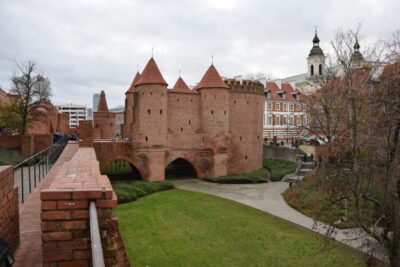
Browse the lists this tour appears in