
Reviewed · HISTORICAL TOURS
Private tour: Jewish heritage in Warsaw
Warsaw’s Muranów district is built on the ruins of the former Jewish ghetto, so the past is not confined to a museum here. It appears in memorial stones, fragments of brick wall, street art, and the open spaces where major wartime events took place. This private walk connects those pieces with a clear account of the ghetto uprising, deportations, and Jewish life in Warsaw.
I like the small private format, which lets you stop and ask questions without trying to keep up with a large group. I also like the way the walk includes less obvious traces, such as street art and two wall fragments tucked into a backyard. The main consideration is its short length: at about two and a half hours, it gives you a focused introduction rather than a full study of Warsaw’s Jewish past.
Key points to know before booking
- Muranów was rebuilt over the former ghetto, making the modern neighborhood part of the historical story.
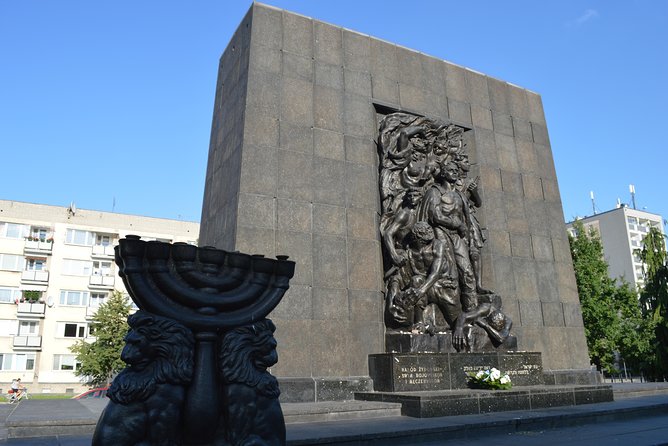
- The Ghetto Heroes Monument marks the place where the uprising began, with time to hear about both the 1942 deportations and the 1943 revolt.
- Umschlagplatz is a quieter memorial stop connected to the deportation of thousands of people to Treblinka.
- Two surviving wall fragments sit in a backyard, so the tour reaches beyond the major monuments.
- Anna leads the walk, and her clear explanations cover wartime and Communist-era Poland as well as the ghetto.
- The $161.95 price covers your private group of up to 10, which can be good value when shared among several people.
Why Muranów makes the best starting point
The walk begins at Cinema Muranów, at General Władysław Andersa 5. This is a useful starting place because you enter a district where the present city and wartime history overlap in a very direct way.
Muranów was built on the ruins of the Warsaw ghetto. That fact changes how you read the streets around you. Modern buildings, paved roads, memorials, and public art occupy ground shaped by destruction and rebuilding. You are not simply moving between isolated sights. The neighborhood itself provides the setting.
The first part lasts about 40 minutes and includes street art dedicated to people who once lived in the area, most of them Polish Jews. These works add a human scale to a subject that can otherwise become a list of dates and military events. You get a sense that the district was once a home, not only the site of imprisonment and death.
I appreciate this opening because it gives you time to ask basic questions before reaching the major memorials. Anna is described as calm, clear, and willing to explain events beyond the ghetto, including other periods of Polish history. That wider frame matters. Warsaw’s Jewish story did not begin in 1939, and it did not end with the war.
The street art also makes this section less formal than a sequence of monuments. It may appeal to you if you want to see how present-day Warsaw remembers the people who lived here. If you prefer a strictly chronological museum-style presentation, though, this opening may feel a little loose.
A few more Warsaw trips to weigh up
- Warsaw: POLIN Museum of the History of Polish Jews Ticket
★ 4.7 · 1,142 reviews - Warsaw: Chopin Concert at Historical Venue in Old Town
★ 4.7 · 445 reviews - Small-Group Historical Guided Tour of Warsaw with pick up/drop off. Public Tour.
★ 4.5 · 343 reviews
The Ghetto Heroes Monument and the start of the uprising
The next stop is the Monument to the Ghetto Heroes, or Pomnik Bohaterów Getta. You spend around 20 minutes here, at the place identified as where the Warsaw Ghetto Uprising began.
This is the central stop for understanding the armed resistance. Anna explains what happened in 1942 and 1943, including the deportations to Treblinka and the fight by Jewish insurgents against the Nazis. The setting gives those events a physical location, which helps you understand the difference between reading about the uprising and seeing where its opening moments took place.
The monument is one of Warsaw’s best-known Jewish memorials, but a private guide adds value that a quick visit alone cannot provide. You can ask about the sequence of events, the meaning of the memorial, or details that are not obvious from the site itself. The private setting is especially helpful here because the subject is serious and complex. You do not have to wait for a guide to finish a standard speech before asking for clarification.
Expect a sober stop rather than a sightseeing photo opportunity. The tour treats the uprising with respect and places it within the wider story of deportation and persecution. I would give this stop your full attention, even though the scheduled time is only 20 minutes.
Umschlagplatz and the road to Treblinka
The walk continues to Umschlagplatz, where you spend another 20 minutes. This site was the departure point for thousands of people deported to Treblinka in 1942. Today, a memorial marks the location.
Umschlagplatz can be difficult to absorb because its meaning is tied to mass deportation. The memorial offers a place to pause, while the guide supplies the historical detail needed to understand what happened there. Without that context, you might see a memorial and move on without grasping its role in the machinery of forced removal.
I value the contrast between this stop and the Ghetto Heroes Monument. The first focuses on resistance and armed revolt. Umschlagplatz brings the deportations into view and reminds you that the history of the ghetto includes both organized resistance and the systematic removal of its residents.
The walk gives you 20 minutes here, so do not expect a long museum-style lesson. Instead, this is a concentrated stop within a larger route. If you want an even more detailed study of deportation records, survivor accounts, or Treblinka itself, you will need to visit other sites or arrange additional time in Warsaw.
Two wall fragments in an ordinary backyard
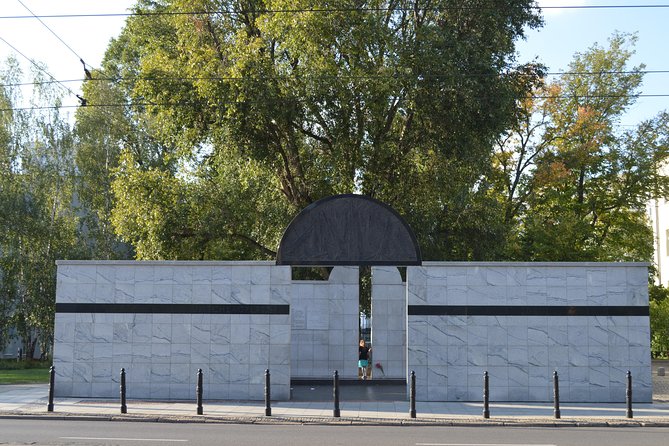
One of the more unusual stops is a pair of surviving fragments of the ghetto wall, located in a backyard. You spend about 15 minutes here.
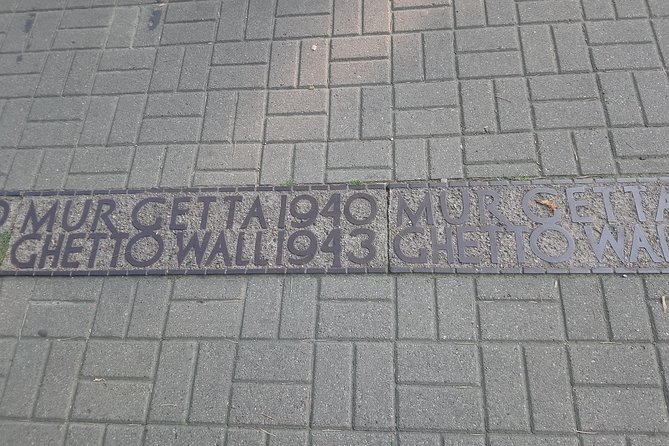
This is the sort of detail that can be easy to miss when exploring Warsaw on your own. The fragments are not presented as a grand public monument. Their setting is more modest, which makes the physical remains feel especially striking. You are looking at part of the boundary that confined the ghetto, but the surrounding city has changed around it.
The stop also shows why a guide is useful in Muranów. Major memorials are easy to locate. Small remnants in courtyards are not. A private guide can point out places that would otherwise remain outside your route.
There is a practical point to keep in mind: the supplied information does not describe the exact access arrangements for the backyard. The guide takes you there as part of the walk, but you should not assume that it is a large public attraction with extensive facilities or signage.
Same country, a completely different kind of day:
- Warsaw: Chopin Concert in the Old Town
★ 4.8 · 2,287 reviews - Warsaw: Traditional Galar Cruise on The Vistula River
★ 4.6 · 1,640 reviews - Warsaw: Old Town Highlights Walking Tour in English
★ 4.7 · 1,516 reviews - Warsaw Concert: Chopin – Painted by Candlelights with Wine
★ 4.8 · 1,442 reviews
Nozyk Synagogue, the final stop
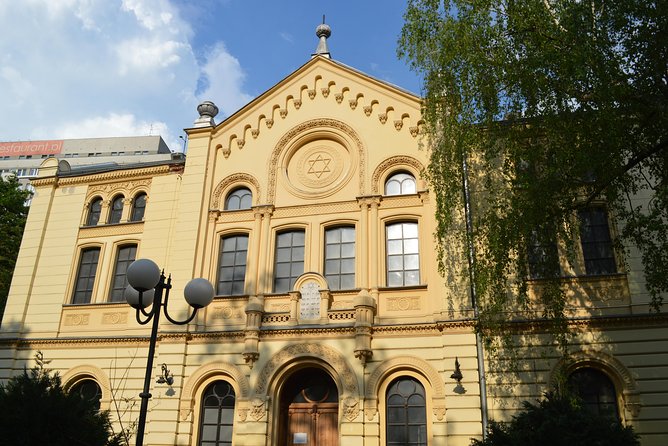
The tour ends at Nozyk Synagogue on Plac Grzybowski. The visit lasts around 15 minutes, and admission is not included in the tour price.
Nozyk Synagogue is described as the only synagogue in Warsaw to survive the Second World War. That makes it an important counterpoint to the destroyed buildings and memorial sites in Muranów. It represents continuity, even within a city where so much Jewish life was lost.
The synagogue also shifts the focus from wartime death and resistance to Jewish religious presence in Warsaw. You get a chance to end the walk with a living place of worship rather than another memorial. That change in tone is welcome.
Because admission is not included, allow for a separate entry cost. The available details do not give the fee or opening arrangements, so you should check those before booking if entering the synagogue is essential to your plans. The tour ends at Plac Grzybowski, which is different from the starting point at Cinema Muranów.
Anna’s guiding style and the value of a private walk
Anna is the guide named for this experience. Her strongest qualities are her clear explanations, broad command of the subject, and thoughtful treatment of Warsaw’s Jewish past. She also places the wartime story alongside Poland’s Communist era and other periods, helping you see how the city’s identity changed over time.
That wider view is useful because Warsaw’s history does not fit neatly into one chapter. The ghetto, the uprising, postwar rebuilding, and Communist rule all left marks on the city. You may arrive expecting a narrow walk about wartime memorials and leave with a better sense of how those events fit into Poland’s modern story.
The private format is the real advantage. Your group alone takes part, with a maximum of 10 people. You can ask questions throughout, slow down at a memorial, or request clarification when a date or event becomes hard to follow. One person also appreciated the guide’s flexibility when the weather was warm and the group stopped for a cool drink.
That flexibility should not be confused with a fully customized tour. The published route has five planned stops and a set duration of about two hours and 30 minutes. Still, a private guide can respond to your interests far better than a standard group outing.
Is $161.95 good value for up to 10 people?
The price is $161.95 per group, not per person, for up to 10 people. For one or two people, that is a fairly substantial cost for a walking tour. For a family or group of friends, the calculation looks much better. Split among 10 people, it comes to about $16.20 each, before any synagogue admission.
The value comes from the guide rather than from paid attractions. Most stops have no admission charge, and the tour is built around public monuments, memorials, neighborhood streets, and surviving wall fragments. You are paying for interpretation, access to lesser-known locations, and the ability to ask questions in a private setting.
I would consider it good value for a group that wants a serious introduction without spending a full day in museums. It is less compelling if you are traveling alone and already plan to read extensively or visit Warsaw’s Jewish history sites independently.
The fact that this experience is often booked well in advance also suggests that you should not leave it until the last day of your Warsaw stay. A booking average of 63 days ahead is not a guarantee that every date sells out, but it is a useful warning for busy travel periods.
Timing, walking, and practical details
The tour lasts about two hours and 30 minutes. The scheduled time at the five stops adds up to one hour and 50 minutes, leaving the rest for walking between locations and explanations along the way.
You should expect a walking route through an urban district, with stops at streets, memorials, a backyard wall fragment, and a synagogue. The supplied details do not state the total distance or the surface conditions, so plan for ordinary city walking and wear comfortable shoes.
The starting point is Cinema Muranów, General Władysław Andersa 5, 00-147 Warsaw. The endpoint is Plac Grzybowski. Both locations are near public transportation, which makes it easier to fit the walk into a day of sightseeing.
A mobile ticket is provided, and confirmation arrives when you book. Service animals are allowed, and most people can participate. Since the tour includes emotionally difficult subjects, it is also worth considering your own comfort with memorial sites and wartime history before reserving.
Free cancellation is available if you cancel at least 24 hours before the local start time. Canceling or changing the booking within 24 hours means no refund.
Who will get the most from this experience?
I would choose this walk if you want a guided foundation for understanding Warsaw’s Jewish heritage and prefer asking questions to listening to a fixed audio guide. It suits couples, families, and small groups who can share the private price.
It is also a good match for anyone drawn to details beyond the headline monuments. The street art and backyard wall fragments give the route a more local feel, while the Ghetto Heroes Monument and Umschlagplatz provide the major historical anchors.
You may want something longer if you are a specialist in Jewish history or want extensive time inside religious and museum sites. The 15-minute synagogue visit and short memorial stops provide an introduction, not a full research program.
I would also avoid treating this as a light sightseeing stroll. The subject includes ghetto confinement, deportation to Treblinka, and the destruction of a community. The guide’s warm and flexible manner helps, but the material remains painful.
Should you book the Muranów Jewish heritage walk?
Book it if you want a focused, private introduction to Warsaw’s Jewish history, especially if you are traveling with several people and value a guide who can answer questions in plain language. Anna’s careful approach, the street art, and the lesser-known wall fragments add more than a checklist of famous memorials.
Think twice if you need extensive museum time, a long route, or a low per-person price for a solo booking. For most small groups with limited time in Warsaw, though, this is a thoughtful way to connect the city’s streets with the people and events that shaped them.
FAQ
Where does the tour begin?
The tour begins at Cinema Muranów, General Władysław Andersa 5, 00-147 Warsaw, Poland.
Where does the tour end?
The tour ends at Plac Grzybowski in Warsaw.
How long does the tour last?
The tour lasts approximately two hours and 30 minutes.
How many people can join the private tour?
Only your group participates, with a maximum of 10 people.
What is the price of the tour?
The price is $161.95 per group of up to 10 people.
Is admission to Nozyk Synagogue included?
No. Admission to Nozyk Synagogue is not included in the tour price.
Which major memorials are included?
The route includes the Monument to the Ghetto Heroes and the Umschlagplatz memorial.
Does the tour visit a surviving section of the ghetto wall?
Yes. The route includes two fragments of the ghetto wall located in a backyard.
Is the tour suitable for most people?
Most people can participate. The tour is near public transportation, and service animals are allowed.
Can I cancel for a full refund?
Yes, if you cancel at least 24 hours before the experience start time. Cancellations or changes made within 24 hours are not refunded.
Just added around Warsaw
- World War II Warsaw Old Town, Military Cemetery Walking Tour★ 4.7 · 3 reviews
- Warsaw: Wolf’s Lair & Swieta Lipka Small-Group Tour + Lunch★ 5.0 · 3 reviews
- Wilanów Palace: 2-Hour Guided Tour with Entrance Tickets★ 4.8 · 8 reviews
- Warsaw Zoo Skip-the-Line Entry Ticket with Private Transport★ 4.8 · 3 reviews
- Warsaw Wolf’s Lair with St. Lipka and Mamerki Private Guided★ 4.2 · 3 reviews
- Warsaw: Vistula River Cruise with Your Music & City Views★ 4.6 · 78 reviews
- Warsaw: Private Vodka Tasting Night with Snacks and Pickup★ 5.0 · 7 reviews
- Warsaw Private Wilanow Palace & Garden Tour★ 4.6 · 30 reviews
Historical Tours, compared.
POLIN Museum of the History of Polish Jews Ticket
Read our review →
Gdańsk City Sights & History Guided Walking Tour in English
Read our review →

Small-Group Historical Guided Tour of Warsaw with pick up/drop off. Public Tour.
Read our review →Browse the lists this tour appears in