
Reviewed · CITY TOURS
Warsaw City Tour – PRIVATE (4h)
Warsaw’s remarkable story is the heart of this tour. You see a city nearly erased in 1944, then walk through an Old Town rebuilt so carefully that UNESCO recognized it as a model of historic reconstruction. The contrast between old stone walls, wartime memorials, Soviet-era architecture, and modern Warsaw gives you a useful first look at Poland’s capital.
I like the private format, since the guide can adjust the route to your interests. I also like the mix of walking and driving, especially the chance to reach Łazienki Park and sights beyond the Old Town without arranging taxis yourself. The main caution is important: this is not four hours in a vehicle. Much of the historic center is explored on foot, and the transport arrangements have not always matched what people expected.
Key points to know before booking
- Warsaw’s rebuilt Old Town: See the UNESCO-listed center, Royal Castle area, cathedral, marketplace, and Barbican largely on foot.
- A private guide shapes the day: Guides named in past bookings include Anya, Karolina, Grazyna, and Margarita, though your guide will vary.
- Transport needs clarification: An air-conditioned vehicle is included for the driving portions, but cars cannot enter some pedestrian areas.
- Łazienki Park adds breathing room: The Rose Garden and Chopin Monument provide a quieter change from the city streets.
- Many sights are exterior visits: Optional admission fees are not included, and the four-hour schedule leaves little time for museum interiors.
- Best for first-time visitors: You get a broad overview of Warsaw’s history, but not a slow, detailed museum tour.
Why Warsaw’s destruction shapes this four-hour tour
The most useful way to understand Warsaw is to keep its wartime destruction in mind. Around 90 percent of the Old Town was destroyed in 1944, and the Royal Castle was later blown up after the Warsaw Uprising. Yet the center you see today was rebuilt with enough care to earn UNESCO World Heritage status.
That story gives nearly every stop extra weight. A pretty square is not simply a pretty square. A reconstructed façade represents years of work, old plans, paintings, photographs, and public effort. Your private guide can explain this better than a quick self-guided walk, especially when you compare present-day Warsaw with photographs of the ruins.
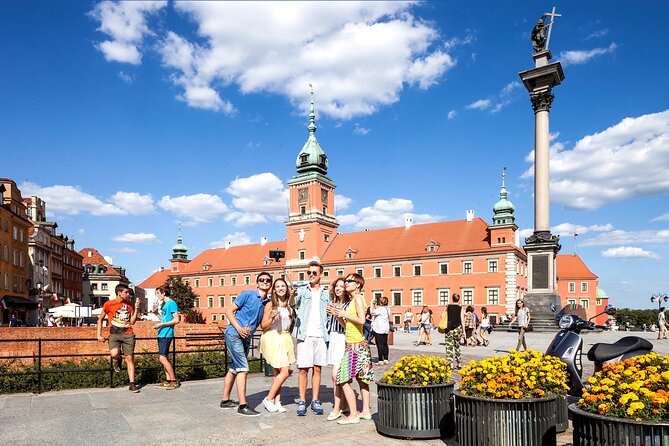
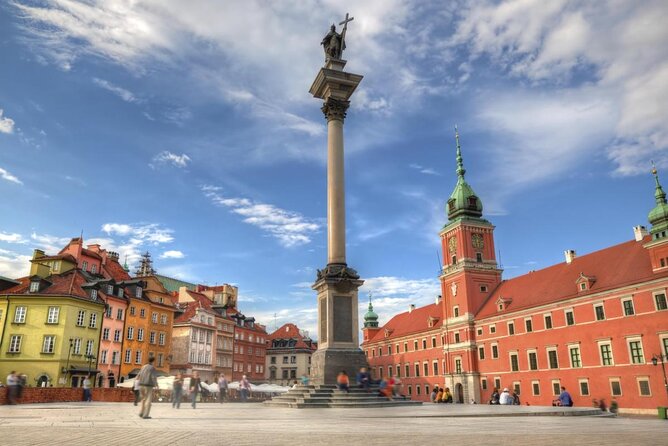
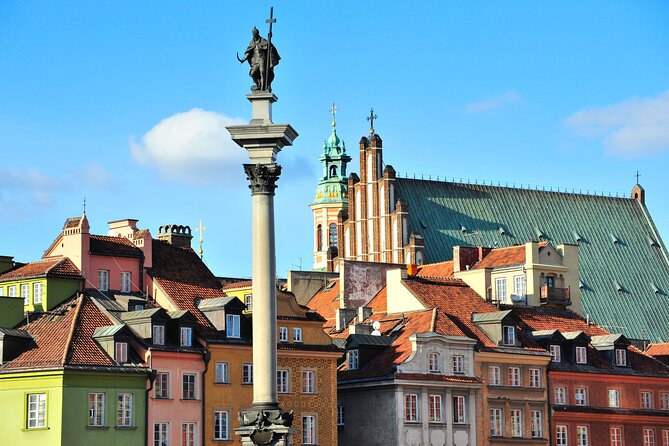
The tour begins at the King Sigismund Column on Castle Square. This is Warsaw’s oldest public memorial, although the column has been moved more than once. German troops brought it down in September 1944, and the statue and column were reconstructed by 1949. Earlier versions are displayed beside the Royal Castle walls.
Allow about ten minutes here. It is a short stop, but the column is one of the city’s key symbols and a natural starting point for the Old Town.
A few more Warsaw trips to weigh up
- Private Tour: Warsaw City Sightseeing by Retro Fiat
★ 5.0 · 562 reviews - Warsaw: Warsaw Ghetto Private Walking Tour with Hotel Pickup
★ 4.9 · 369 reviews - Private Tour: Warsaw’s Jewish Heritage by Retro Fiat
★ 5.0 · 208 reviews
Walking from Castle Square into the Old Town
The Old Town walk is the main historical portion of the experience. Warsaw grew here because the river route supported trade between the Baltic and Black seas. Wealthy merchants and craftsmen settled in the area, and wooden buildings gradually gave way to masonry houses, defensive walls, churches, and civic buildings.
You will see the broad outline of that medieval town, even though much of what appears old is reconstructed. The route includes Castle Square, the cathedral, the Old Town Marketplace, and the Barbican. The guide can connect the buildings to the city’s earlier growth and its near destruction during World War II.
The Royal Castle is one of the most important stops. It became a royal residence in the sixteenth century when Masovia joined the Polish Crown. The building suffered damage and rebuilding more than once, then was bombed at the beginning of World War II and destroyed after the 1944 uprising.
Reconstruction began only in 1971 and was funded largely by public generosity. The castle opened to visitors in 1984. If you want to go inside, remember that entry is optional and not included in the tour price. With only four hours, the visit is more likely to focus on the exterior and the story of reconstruction than on a full museum visit.
St. John’s Cathedral and the Old Town Marketplace
The Archcathedral Basilica of St. John the Baptist is one of Warsaw’s oldest churches. It has been the setting for major events, including the oath connected with the Constitution of May 3, described as the first of its kind in Europe.
The crypt contains the tombs of important Polish figures, including the Chapel-Mausoleum of the Primate of the Millennium. The published timing gives this stop about fifteen minutes, so you should ask your guide at the start whether an interior visit is practical during your departure time.
From the cathedral, the route continues to the Old Town Marketplace. Tenement houses surround the square, with restaurants, cafés, clubs, galleries, and museums. The Warsaw Mermaid statue occupies the center and recalls one of the capital’s best-known symbols.
The square is divided into four sections named for Enlightenment activists: Kołłątaj, Dekert, Barss, and Zakrzewski. You receive about fifteen minutes here, enough for photographs and an explanation of the square, but not enough for a relaxed meal or museum stop.
The Barbican follows. Built in 1548, it formed part of roughly 4,000 feet of defensive ramparts. Today, artists and musicians often use the area, giving the old fortification a social life beyond its military purpose.
From May through October, an exhibition inside the walls presents historic photographs, defensive plans, and models of towers that no longer exist. The exhibit can help you picture what Warsaw looked like before the war. Entry is not listed as included, so confirm the current arrangement if you want to go inside.
Warsaw Uprising sites and the Royal Route
The Warsaw Uprising Monument is a short but serious stop. Its figures show insurgents in battle, recalling the 1944 uprising that ended in defeat and the deaths of about 200,000 Poles. This is one of the places where a guide adds real value, since the monument’s design and the surrounding buildings make more sense with the wider story.
Nearby, the Krasiński Palace is considered one of Warsaw’s finest Baroque buildings. Its reliefs draw on ancient models, and the park behind it offers a quiet place to pause. The building now houses special collections for the National Library, so you should expect an exterior view rather than a scheduled library visit.
The route may continue along Miodowa Street, a narrow historic street lined with grand residences. Points of interest include the former Collegium Nobilium, now connected with the Academy of Theatre, the Palace of Warsaw’s Archbishops, Pac Palace, the Capuchin Church, and the heart of King Jan III Sobieski preserved near the church altar.
You may also see the Monument of Warsaw’s Heroes, often called the Nike Monument. These details are easy to miss on your own, especially if your guide is adjusting the walking route for weather or mobility.
The Tomb of the Unknown Soldier is another brief stop. An eternal flame burns beside the tomb, which contains urns connected with battlefields where Polish troops died during the last century. A military guard changes daily at noon.
The timing here is about ten minutes. If your schedule brings you at noon, the guard change may add a formal moment to the visit. The tomb sits in a surviving section of the Saxon Palace colonnade, a reminder of how much of central Warsaw disappeared.
The Royal Route then links the castle area with Trzech Krzyży Square. Along Krakowskie Przedmieście and Nowy Świat, you may see St. Anne’s Church, the Polonia House, Radziwiłł Palace, Warsaw University, Kazimierzowski Palace, Czapski Palace, shops, restaurants, and elegant townhouses.
Radziwiłł Palace is now the residence of Poland’s president. The route is pleasant, but it is also a walking zone in places. That matters because one booking found the vehicle could not reach the hotel area or parts of the Royal Route. If you want less walking, tell the operator before the day of the tour, not only when the guide arrives.
Same country, a completely different kind of day:
- Warsaw: Chopin Concert in the Old Town
★ 4.8 · 2,287 reviews - Warsaw: Traditional Galar Cruise on The Vistula River
★ 4.6 · 1,640 reviews - Warsaw: Old Town Highlights Walking Tour in English
★ 4.7 · 1,516 reviews - Warsaw Concert: Chopin – Painted by Candlelights with Wine
★ 4.8 · 1,442 reviews
Theatre Square and modern Warsaw
Theatre Square gives you another look at Warsaw’s reconstruction. The Jabłonowski Palace once served as the city hall, was destroyed in the war, and was rebuilt in the 1990s. Much of the present building is a reconstruction, with the façade and clock tower recalling the earlier design.
The Grand Theatre faces the square. It houses the National Opera and National Theatre and has one of Europe’s largest opera stages. You can see its grand interiors only by attending a performance or arranging an appropriate visit, so the tour normally provides an outside view.
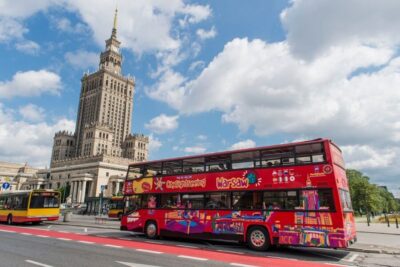
Depending on traffic and the route chosen, the vehicle portion may show you the Palace of Culture and Science. Built from 1952 to 1955 as a gift from the Soviet people, the 230.5-meter building remains Poland’s tallest. Its 30th-floor observation deck offers wide city views, but admission is not included.
The National Stadium is another modern landmark. Built for the 2012 European Football Championship, it occupies the site of the former Tenth Anniversary Stadium. After 1989, the surrounding area became home to the huge Jarmark Europa market before the current stadium complex was built.
The Copernicus Science Centre brings the route toward the Vistula. Opened in 2010, it has hundreds of hands-on attractions, including an earthquake simulator and a magic carpet. A rooftop garden provides views, and nearby spaces include an art gallery, climbing wall, and park with art installations.
The Copernicus Centre requires a separate admission fee. With a ten-minute scheduled stop, you should treat it as an exterior orientation unless you have arranged extra time and tickets.
A green pause at Łazienki Park
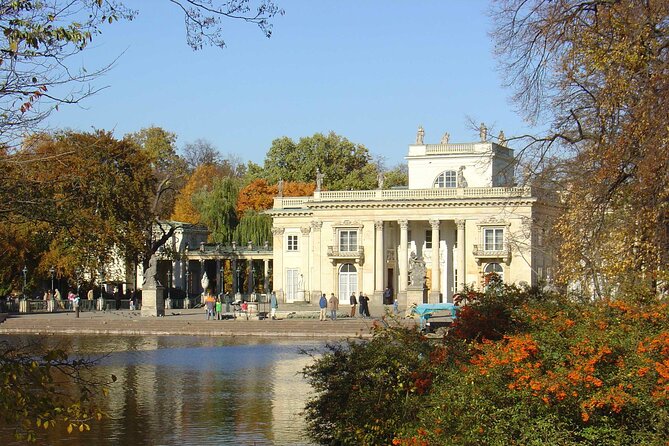
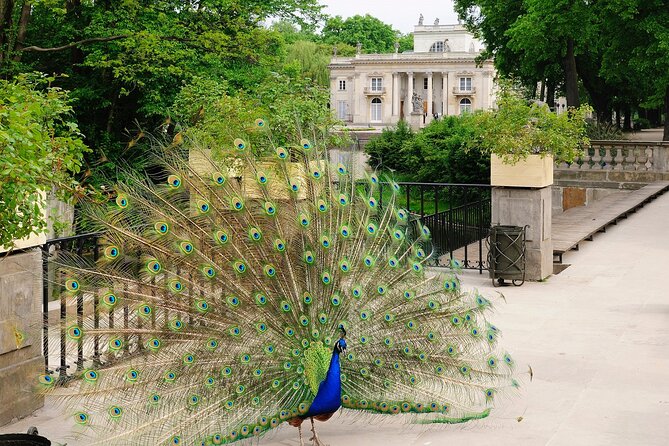
Łazienki Park is the tour’s most relaxing stop. This palace and garden complex occupies what was once wild forest and includes historic buildings, museum spaces, cultural events, and broad paths for walking.
The Rose Garden gives you a chance to slow down after the dense Old Town schedule. The park also contains the famous Chopin Monument. Summer weekend piano concerts have taken place nearby for decades, drawing both local classical music fans and visitors.
The scheduled visit lasts about thirty minutes. That is enough to see a section of the grounds and hear the park’s main story, but not enough to explore every monument or museum. If Łazienki is your top priority, ask whether the guide can protect that half hour rather than adding too many small city-center stops.
How the private format affects the experience
A private tour is useful when you want to shape the day. One guide, Anya, adjusted the route around the group’s interests, and another guide, Karolina, modified the plan when walking became difficult in hot weather. Margarita has also been praised for making the explanation complete and entertaining, while Grazyna was described as friendly and helpful even though the transport arrangement became a problem.
The guide quality can vary. One booking described poor English, disorganization, and uncomfortable driving. That contrasts with several highly positive accounts of the guide’s explanations, friendliness, and flexibility. I would treat the guide as the tour’s biggest variable and ask at pickup for a clear outline of the walking and driving portions.
The transport wording deserves special attention. Private transportation and an air-conditioned vehicle are included, but cars cannot enter pedestrian sections of the Old Town and parts of the Royal Route. One booking ended up using public transport for sights outside the Old Town, which was not the expected service.
That problem is avoidable in part if you confirm the plan before departure. Ask these three questions:
- Which sights will be reached by vehicle?
- How much walking is expected in the four-hour period?
- Can the route be changed for a participant with limited mobility or in very hot weather?
The operator says most people can participate, but the route is not presented as wheelchair-specific. If someone in your group has a disability, share that information when booking. The tour can be adjusted, but the guide needs notice.
Is $195.18 per person a fair price?
At $195.18 per person, this is a premium half-day experience. The price makes more sense for a small private group that values hotel pickup, a dedicated guide, and an efficient first orientation to Warsaw.
It is less attractive if you expect four hours of continuous private driving or several museum admissions. Most listed stops are free exterior visits, and optional entry fees are extra. The schedule also covers a lot of ground, so many stops last only ten or fifteen minutes.
Group discounts are offered, although the exact savings are not provided. A larger private group may find the per-person cost easier to justify. A couple or solo visitor should compare the price with a regular walking tour plus public transport or taxis.
The strongest value comes from the historical connections. You are not only checking off the Mermaid, Barbican, Royal Castle, Łazienki Park, and Palace of Culture. You are learning how trade, royal power, occupation, uprising, destruction, reconstruction, and modern city life fit together.
Practical details for a smooth day
Hotel pickup and drop-off are included. The guide waits in the hotel lobby with your name, so be ready at the agreed time. The tour is offered in English, and confirmation is provided when you book.
Wear comfortable shoes and plan for real walking in the Old Town and along the Royal Route. In hot weather, the stone streets and open squares can feel demanding, so carry water and tell the guide early if your group needs shade or shorter walks.
Keep your timing flexible. Traffic can affect the driving sections, while pedestrian restrictions shape the route. The itinerary lists more sights than most people can study closely in four hours, so think of this as a city introduction, not a museum-heavy day.
Free cancellation is available until 24 hours before the start time. Changes or cancellations made later are not accepted for a refund.
Should you book the Warsaw private city tour?
Book it if you want a fast, private introduction to Warsaw with a guide who can connect the rebuilt Old Town to the city’s painful twentieth-century story. It is especially useful early in your stay, before you return to selected museums or neighborhoods on your own.
Book with caution if you need guaranteed door-to-door vehicle service at every stop, dislike walking, or want long interior visits. Confirm the vehicle plan, tell the operator about mobility needs, and decide which two or three sights matter most to you.
For many visitors, the tour’s best moments will be the Old Town reconstruction story, the Warsaw Uprising Monument, and the calm of Łazienki Park. If those appeal to you and you accept the walking, the private format can be worth the higher price.
FAQ
How long is the Warsaw City Tour?
The tour lasts approximately four hours.
Is the tour private?
Yes. Only your group participates in the activity.
Is hotel pickup included?
Yes. Hotel pickup and drop-off are included, and the guide waits in the hotel lobby with your name.
Is transportation provided?
Yes. Private transportation in an air-conditioned vehicle is included for the driving portions. Vehicles cannot enter some pedestrian areas, including parts of the Old Town and Royal Route.
Is the tour offered in English?
Yes. English is the listed tour language.
Are attraction admission fees included?
No. Optional entry or admission fees are not included. The Copernicus Science Centre specifically lists admission as not included.
Does the tour visit Warsaw’s Old Town?
Yes. The route includes Castle Square, the Old Town Marketplace, St. John’s Cathedral, and the Warsaw Barbican.
Does the tour include Łazienki Park?
Yes. The visit to Royal Łazienki Park is scheduled for about thirty minutes and includes the park area and Rose Garden.
What is the cancellation policy?
You can cancel at least 24 hours before the start time for a full refund. Cancellations or changes made less than 24 hours before the start time are not accepted for a refund.
Just added around Warsaw
- World War II Warsaw Old Town, Military Cemetery Walking Tour★ 4.7 · 3 reviews
- Warsaw: Wolf’s Lair & Swieta Lipka Small-Group Tour + Lunch★ 5.0 · 3 reviews
- Wilanów Palace: 2-Hour Guided Tour with Entrance Tickets★ 4.8 · 8 reviews
- Warsaw Zoo Skip-the-Line Entry Ticket with Private Transport★ 4.8 · 3 reviews
- Warsaw Wolf’s Lair with St. Lipka and Mamerki Private Guided★ 4.2 · 3 reviews
- Warsaw: Vistula River Cruise with Your Music & City Views★ 4.6 · 78 reviews
- Warsaw: Private Vodka Tasting Night with Snacks and Pickup★ 5.0 · 7 reviews
- Warsaw Private Wilanow Palace & Garden Tour★ 4.6 · 30 reviews
City Tours, compared.
City Sightseeing Tour Eco Electric Buggy Golf Cart
Read our review →
Gdańsk City Sights & History Guided Walking Tour in English
Read our review →
Extended City Sightseeing Tour – Eco Buggy Golf Cart
Read our review →
Browse the lists this tour appears in