
Reviewed · WARSAW TOURS
Warsaw for WWII Buffs – private tour with hotel pickup
Warsaw’s WWII story is best understood not from a single museum, but by moving through the streets where the events happened. This private tour links the Jewish Ghetto, Soviet deportation memorial, and Warsaw Uprising sites in one clear route, with guides such as Marcin, Karol, Tom, Martin, and Konrad bringing local perspective to the hard facts.
I like two things right away: the retro Żuk minibus makes getting around part of the experience, and the private format lets you ask questions or shift the focus toward the Ghetto Uprising, the 1944 Warsaw Uprising, or Poland’s postwar Soviet years. The three-hour length also fits neatly into a busy visit.
The main caution is time. Three hours goes quickly, especially if you want long discussions or museum visits. Hotel transfers count toward the tour time, and the vintage vehicles can be bumpy, warm in summer, and difficult for some passengers to enter.
Key points to know before booking
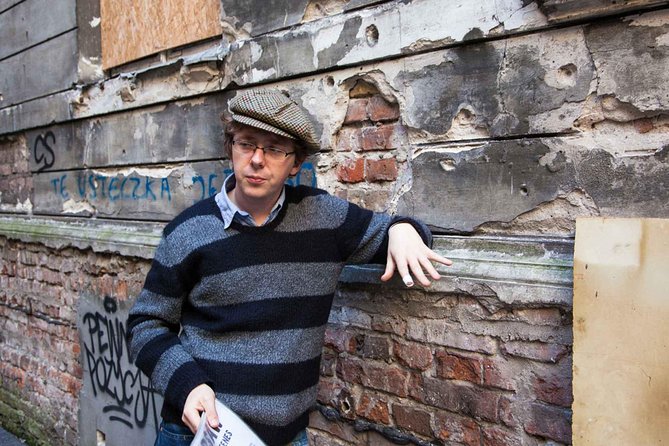
- A street-level WWII tour: You see surviving Ghetto Wall fragments, the Waliców ruins, Chłodna Street, and memorials in the places where the story unfolded.
- A private ride for up to eight people: Your group travels together, with five Żuk minibuses available across the operator’s fleet.
- A guide-led history lesson: English-speaking guides such as Marcin, Karol, Tom, Martin, and Konrad explain events and answer questions in a conversational way.
- Hotel pickup has a limit: Pickup and drop-off cover hotels, apartments, and Airbnb addresses within 3 kilometers of central Warsaw.
- Walking still matters: The minibus connects the stops, but you leave it at each site. Comfortable shoes are important.
- Expect a real vintage vehicle: Some vehicles lack air conditioning and seat belts, as allowed for historic vehicles. Heating is provided in winter.
Why Warsaw’s WWII story works best from the street
Warsaw was almost destroyed during World War II, yet the city’s modern blocks, memorials, empty spaces, and surviving fragments still reveal what happened. A driving tour gives you the scale of that destruction faster than a walking tour can.
The story begins with the political crisis of the late 1930s, Germany’s invasion in 1939, and the Soviet attack from the east two weeks later. That opening matters because Warsaw’s wartime experience was shaped by two occupying powers, not one. Your guide connects those events to daily life, forced labor, terror, deportation, and the growth of the Polish resistance.
I especially value the way this route joins separate parts of the story. The Jewish Ghetto, the Soviet occupation, and the 1944 uprising are often presented as different subjects. Here, you see how they fit into Poland’s long struggle against both Nazi Germany and Soviet domination.
A good guide also keeps the history from becoming a string of dates. The strongest guides named for this experience, including Marcin, Karol, Tom, Martin, Konrad, Lukas, and Marek, are described as warm, flexible, and comfortable answering questions. That is useful when the subject turns painful or politically complex.
A few more Warsaw trips to weigh up
- Private Tour: Warsaw City Sightseeing by Retro Fiat
★ 5.0 · 562 reviews - Warsaw: Warsaw Ghetto Private Walking Tour with Hotel Pickup
★ 4.9 · 369 reviews - Private Tour: Warsaw’s Jewish Heritage by Retro Fiat
★ 5.0 · 208 reviews
The Żuk minibus makes the transfer part of the tour
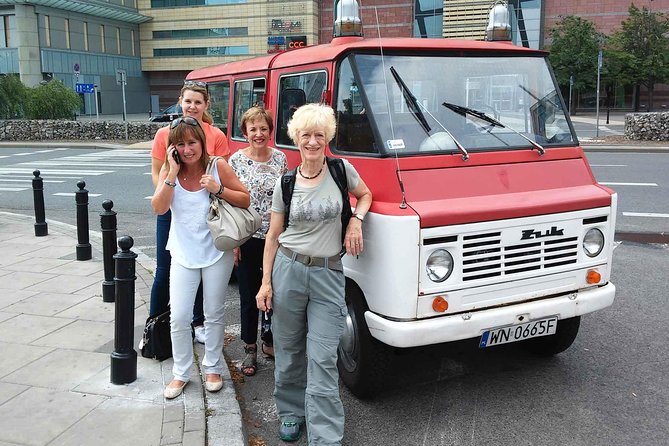
The restored Żuk is an old Polish communist-era minibus, not a polished modern touring coach. That is part of its charm. You travel between stops in a vehicle connected to Poland’s more recent past, and the ride adds an authentic, slightly comic touch to a serious history tour.
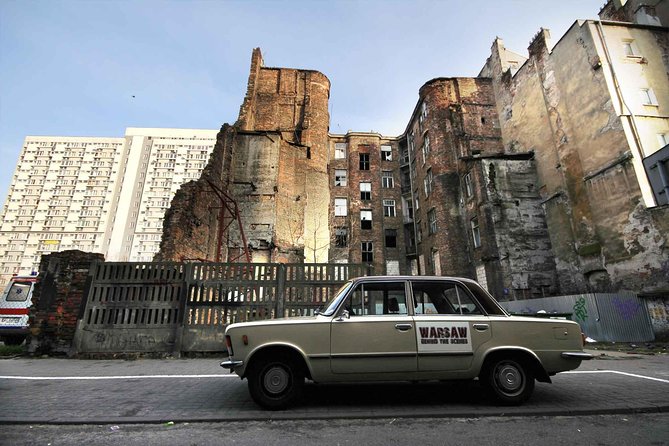
The tradeoff is comfort. Some passengers found the seats hard and the entry difficult, especially an older passenger of smaller build. The vehicle used may also be a minibus rather than the smaller vintage car shown in promotional material, so ask in advance if the exact vehicle matters to you.
The minibuses hold up to eight people, and this is a private activity, so only your group participates. That gives you room to pause for questions instead of following a fixed lecture. It also makes the tour a good fit for families or friends who want one shared history lesson without joining a large bus.
The vehicles are mainly used to move between locations. You will walk at each stop, sometimes on ordinary city streets rather than a smooth museum path. Wear shoes with good support, and dress for the weather. Classic vehicles do not have air conditioning, and some do not have seat belts, though they do have winter heating.
The opening explains Poland between Germany and the Soviet Union
The first part of the tour sets up the political story before reaching the Ghetto sites. You learn about the German invasion in September 1939 and the Soviet occupation of eastern Poland soon after.
This is more than background. It explains why Polish memory of the war includes Nazi camps, mass murder, the destruction of Jewish life, Soviet deportations, the Katyń massacres, and decades of communist rule after 1945. If you know only the western European outline of World War II, this section gives you essential Polish context.
The guide also introduces the resistance movement that developed under occupation. Warsaw became a center of underground activity, but resistance existed alongside fear, hunger, forced displacement, and brutal punishment. The tour works best when you treat this opening as the frame for everything that follows.
Waliców reveals the lost Jewish quarter
At Waliców, you see one of the remaining fragments of the former Warsaw Ghetto Wall. It is easy to miss if you are moving through the city on your own. The fragment survives between newer buildings and along old property lines, a small piece of masonry carrying the weight of a much larger boundary.
Before the war, Poland was home to about three million Jews, including roughly 300,000 in Warsaw. In 1940, Nazi Germany sealed nearly half a million people into the Warsaw Ghetto.
Your guide explains how the wall divided streets, homes, families, and working lives. The physical fragment is modest, but that is precisely why it can be so affecting. There is no grand ruin here to announce its importance. You have to look closely and picture the system of confinement that once surrounded it.
Waliców also includes a ruined tenement house, described as one of the last ghostly remnants of the Ghetto. A surviving wall fragment is nearby. These remains help you imagine the prewar city beneath today’s Warsaw, though the stop can feel brief if you want time for quiet reflection or photographs.
Same country, a completely different kind of day:
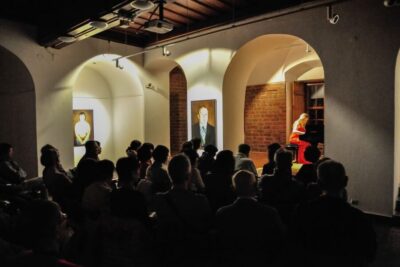
- Warsaw: Chopin Concert in the Old Town
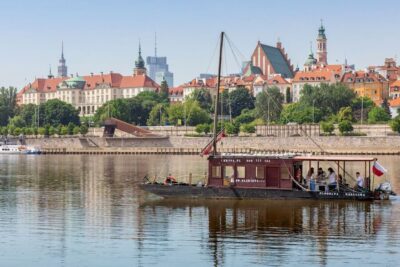
★ 4.8 · 2,287 reviews - Warsaw: Traditional Galar Cruise on The Vistula River
★ 4.6 · 1,640 reviews - Warsaw: Old Town Highlights Walking Tour in English
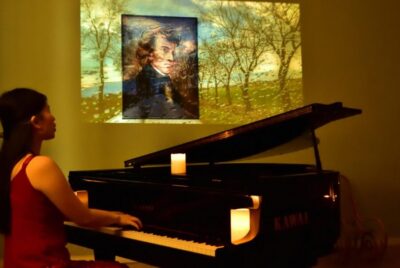
★ 4.7 · 1,516 reviews - Warsaw Concert: Chopin – Painted by Candlelights with Wine
★ 4.8 · 1,442 reviews
Chłodna Street shows how the Ghetto was divided
The Ghetto was split into two sections by Chłodna Street in 1941. The road carried east-west traffic, and the separation made daily movement even more difficult for the people trapped inside.
A wooden footbridge once crossed above the street near the junction of Chłodna and Żelazna. It linked the two Ghetto sections while trams, German military traffic, and cars moved below. The bridge reached the third floor of nearby buildings, making it an extraordinary image of occupation-era urban planning.
The bridge is gone, but the location helps you read old photographs against the present-day street. This is one of the tour’s strongest moments because it connects a familiar city function, a road carrying traffic, with the forced separation imposed above and around it.
The stop is short, so do not expect a long walking exploration of the neighborhood. Its value comes from the guide’s explanation and from seeing the exact setting rather than only a photograph in a museum.
Muranów sits above the buried Ghetto
Muranów may first appear to be a plain district of square apartment blocks. That ordinary look is part of the lesson. Much of modern Warsaw was built after the war over the ruins of the former Ghetto.
With a guide, the neighborhood becomes easier to read. The blocks, open areas, memorials, and rebuilt streets sit above a destroyed Jewish quarter. You are not looking at a preserved medieval district. You are looking at a new city built over the remains of one that Nazi Germany tried to erase.
This stop is especially useful for visitors who have already seen Warsaw’s major museums and want help understanding the spaces between them. It also adds scale. Memorials can mark a single event, but Muranów helps you grasp the size of the community and the extent of the destruction.
The Ghetto Heroes Monument and POLIN area
The Monument to the Ghetto Heroes is near the site of the first armed clashes of the 1943 Warsaw Ghetto Uprising. Its broad setting gives the memorial room to speak without much visual clutter.
Nearby, the POLIN Museum of the History of Polish Jews provides a larger setting for Jewish life in Poland. The tour does not include museum admission, so you should plan a separate visit if you want the full indoor exhibition. The outdoor stop still gives you the essential location and helps explain why this area matters.
The 1943 uprising was a desperate armed revolt by people facing deportation and death. Your guide places it within the larger history of the Ghetto, rather than treating it as an isolated battle. The area also carries a later message of dialogue and remembrance involving Polish, Jewish, and German communities.
For many people, this is the emotional center of the tour. It can also be the point where three hours begins to feel too short. If your main interest is Jewish Warsaw, tell your guide at the start and ask how much time can be given to Muranów, the monument, and nearby sites such as Mila 18.
The eastern memorial brings Soviet crimes into view
The Monument to the Fallen and Murdered in the East shifts the focus from Nazi occupation to Soviet repression. It honors Poles deported to Siberian Gulags, those killed in executions, and victims of the Katyń massacres.
The monument is a useful corrective to a simplified WWII story. Poland was attacked and occupied by Germany and the Soviet Union, and the Soviet presence did not end with the war. In January 1945, the Red Army entered the ruins of Warsaw, followed by a new period of communist rule.
This stop may be less familiar to visitors from western Europe or North America. Give it your full attention. It helps explain why Polish memories of 1939, 1944, and 1945 can differ from the standard Allied narrative.
The Warsaw Uprising Monument closes the story
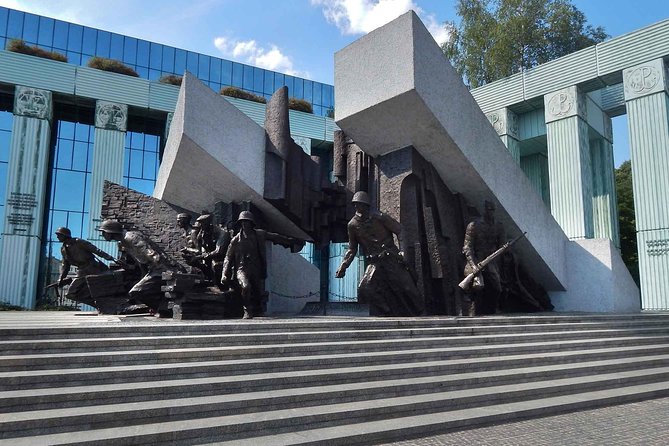
The last major stop is the Warsaw Uprising Monument, connected to the 1944 attempt by the Polish underground to regain control of the capital before Soviet forces arrived.
The uprising lasted long enough to bring catastrophic consequences. After its defeat, Nazi forces systematically destroyed much of what remained of Warsaw. The Soviet army later entered a city of ruins, and Poland began its postwar communist era.
The monument provides a strong ending because it brings together the themes introduced at the beginning: occupation, resistance, independence, and the political cost of waiting for outside help. You leave with a clearer sense of why Warsaw’s rebuilt city is not simply a reconstruction project. It is also a statement about survival and national identity.
What the three-hour format really gives you
Three hours is enough to cover a wide area and establish the main story. It is not enough for lengthy museum visits, extended time at every memorial, or a detailed study of every wartime event.
I see the format as a smart orientation tour. Take it early in your stay, then use the guide’s suggestions to plan further visits. Several guides also recommend museums and restaurants, and the historical context can make the rest of your time in Warsaw more meaningful.
The private setup helps. You can ask for more time on the 1943 Ghetto Uprising, the 1944 Warsaw Uprising, the Soviet period, or lesser-known locations away from the usual tourist route. If you have already visited the main sights, say so. The guide may adjust the route rather than repeat what you know.
Hotel pickup is available within 3 kilometers of the city center. If your accommodation lies farther out, or the vehicle cannot reach it, you will be offered a nearby meeting point. Remember that pickup and drop-off count within the roughly three-hour duration. Meeting in central Warsaw may give you more history time.
Is the price fair at $169.38 per person?
At $169.38 per person, this is not a cheap sightseeing ride. The value depends heavily on your group size and interest level.
For a private group of two, the per-person price is a serious expense. For a larger group sharing the vehicle and guide, the cost becomes easier to justify, especially since the tour covers many scattered sites without requiring you to plan public transport between them.
You are paying for a private English-speaking guide, transport, hotel pickup within the stated radius, and a route that would be difficult to reproduce efficiently on your own. There are no admission tickets included because the key stops are outdoor sites. If you want to enter POLIN or another museum, budget separately.
I would book it for a history-focused visit, a short stay, or a first day in Warsaw. If you prefer to explore quietly at your own pace, or want several hours inside museums, spend the money elsewhere and visit the sites independently.
Who should book this Warsaw history tour?
This tour suits you if you:
- Want WWII explained through actual streets and memorials.
- Have only a few hours in Warsaw.
- Prefer a private guide to a large group.
- Enjoy asking questions and changing the focus as you go.
- Want to understand both Nazi and Soviet occupation.
- Are traveling with family members who may not manage a long walking tour.
- Like unusual local transport and do not require modern vehicle comfort.
It may not suit you if you need air conditioning, seat belts, easy step-free access, or a quiet museum-style experience. The subject is also intense. You will hear about ghetto confinement, deportation, executions, mass murder, destruction, and political repression. Go in prepared for serious material.
Should you book it?
Book this tour if you want a compact, personal introduction to Warsaw’s wartime story, especially if you can share the cost with friends or family. The Żuk adds character, but the guide is the real reason to choose this experience. Ask for a guide who can tailor the route, and tell the operator your main interests before pickup.
I would also confirm the vehicle type if you are expecting a small vintage car rather than a minibus. For most visitors, the combination of local guiding, scattered memorials, and a private route makes this a strong use of three hours. Just keep your expectations clear: it is a moving outdoor history lesson, not a full museum tour.
FAQ
How long does the Warsaw WWII tour last?
The tour lasts approximately three hours. Hotel pickup and drop-off are included in that total time.
Is this a private tour?
Yes. Only your group participates in the activity.
How many people can travel in one minibus?
Each minibus accommodates up to eight passengers. The operator has a fleet of five minibuses.
Is the tour offered in English?
Yes. A professional English-speaking local guide leads the tour.
Where can hotel pickup take place?
Pickup and drop-off are available from hotels, apartments, and Airbnb accommodations within 3 kilometers of Warsaw’s city center.
What if my accommodation is farther than 3 kilometers away?
If your accommodation is too far away or cannot be reached by car, the operator will suggest a nearby meeting point.
Does hotel transfer time reduce the sightseeing time?
Yes. Transfer from and back to your hotel counts toward the total tour duration. Meeting in central Warsaw may leave more time for the historical stops.
Are museum admissions included?
No. The listed stops are free outdoor locations, and museum admission is not included.
Can children join the tour?
Adults and children over 150 centimeters can book online. Children under 150 centimeters require advance contact with the operator to check booster-seat availability. Polish law requires booster seats in those cases.
Are the vintage minibuses air-conditioned?
No. The classic minibuses are not equipped with air conditioning. Some also do not have seat belts, as permitted for historic vehicles, but all have heating for winter use.
Just added around Warsaw
- Taste of Poland, food tour and guided walk with 12 tasting★ 5.0 · 3 reviews
- Skip-the-Line Warsaw Royal Castle Private Guided Tour★ 5.0 · 4 reviews
- Secrets of Warsaw 4-hour Bike Tour★ 5.0 · 25 reviews
- Warsaw: Live Show at Sabat Theatre★ 4.5 · 11 reviews
- Private Warsaw City Tour★ 4.9 · 4 reviews
- Warsaw: WWII Private Tour by Retro Minibus with Hotel Pickup★ 5.0 · 7 reviews
- Private Tour From Warsaw: Łowicz Mazovian Countryside★ 5.0 · 10 reviews
- Packrafting kayaking guided tour Vistula river Warsaw Poland★ 4.5 · 14 reviews
Warsaw Tours, compared.
Traditional Galar Cruise on The Vistula River
Read our review →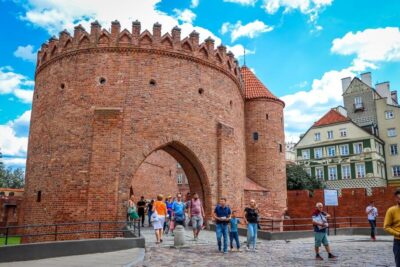
Warsaw Concert: Chopin – Painted by Candlelights with Wine
Read our review →
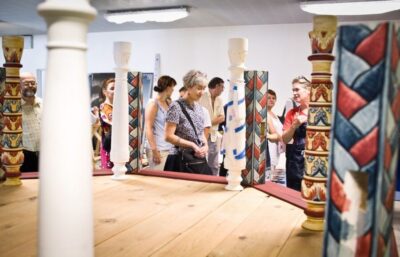
POLIN Museum of the History of Polish Jews Ticket
Read our review →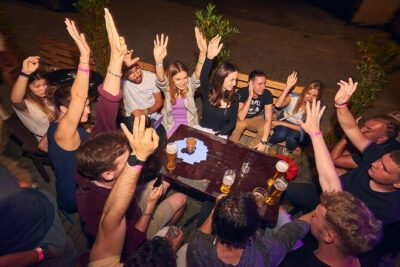
#1 Pub Crawl Warsaw with Optional Premium 1 Hour Open Bar
Read our review →
Browse the lists this tour appears in