
Reviewed · WALKING TOURS
Warsaw Private Walking Tour
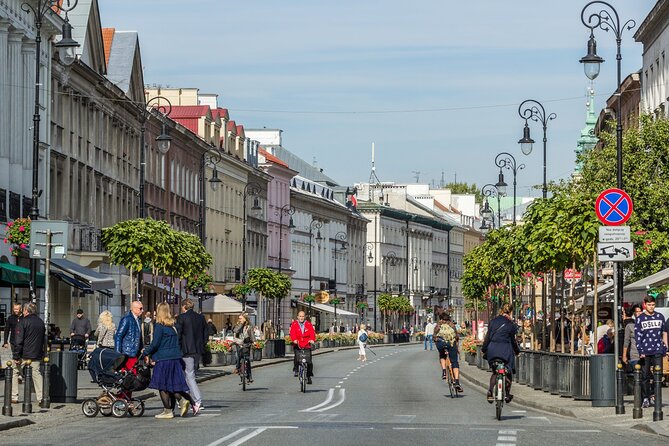
Warsaw’s story comes into focus on foot, from Sigismund’s Column in Castle Square to the rebuilt streets of the Old Town, the Jewish Ghetto memorial area, and royal Łazienki Park. This private tour gives you a useful first look at a city that was nearly destroyed in World War II and then reshaped under communism.
I like the flexible length, since a three-hour introduction may be enough for a short stay, while five hours adds the Jewish Ghetto and seven hours reaches Łazienki. I also like the private format, which lets you ask questions and set a pace that suits your group.
The main caution is that the seven-hour version may feel long if your guide does not keep the route tight. Public transport can be needed between sections, and the cost of buses or trams is not included.
Key points to know before booking
- Castle Square is the natural starting point: You begin beside the Royal Castle and its 22-meter Sigismund’s Column, right at the Old Town’s main gateway.
- The five-hour route adds serious wartime context: It reaches Grzybowski Square and the former Jewish Ghetto, then continues to the Palace of Culture and Science viewing terrace.
- The seven-hour option is more varied than simply longer: Its final two hours shift from urban history to royal gardens, Chopin’s monument, and the Palace on the Isle.
- Private means up to 10 people in your own group: You can ask for stops, questions, and explanations suited to your interests.
- Transport money is extra: The longer routes may use a bus or tram, so carry a little Polish currency or arrange a ticket in advance.
- Several guides have drawn special praise: Kasia, Kate, and Margret are named as especially strong choices when available.
Start with Warsaw’s royal front door
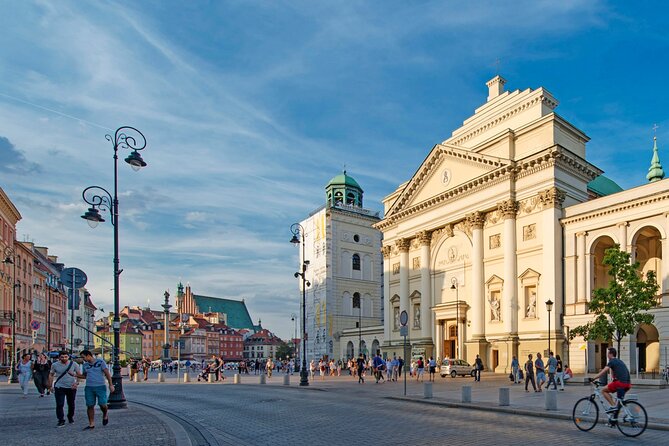
Meet your guide at Castle Square, known locally as Plac Zamkowy. It is a smart place to begin. You are not dropped into an anonymous street. You start in the ceremonial heart of Warsaw, with the Royal Castle’s red façade on one side and the Old Town rising ahead.
The first landmark is Sigismund’s Column, a tall monument dedicated to King Sigismund III Vasa. At 22 meters, it gives the square a strong vertical marker and makes an easy meeting point. Your guide uses this area to introduce Warsaw’s royal past and explain how the city’s center was rebuilt after wartime destruction.
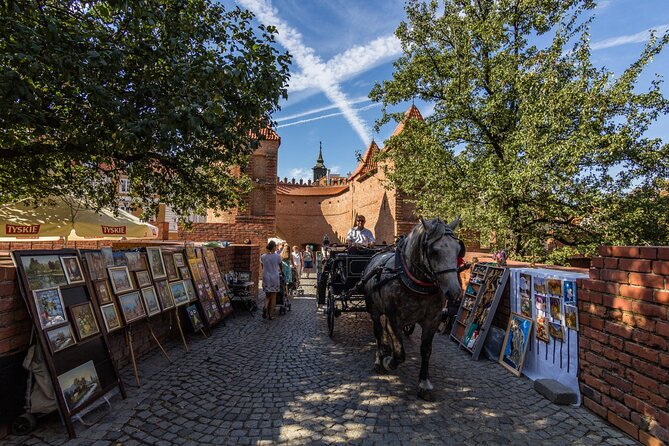
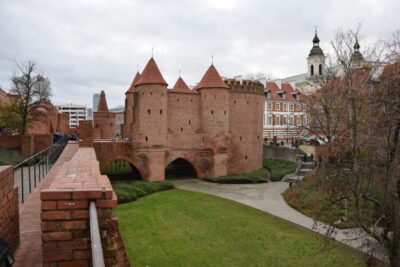
From there, the route threads through the Old Town. You may see the Cathedral of St. John, the Warsaw Barbican, and the narrow streets around the old defensive walls. The Barbican is a photogenic reminder of the medieval city, though you should keep your expectations in check. This is an outdoor walking tour, not a detailed tour of every interior.
The lively Market Square is one of the stops that makes the route feel less like a history lecture. The Mermaid Monument in the center gives you a classic Warsaw photo, while the surrounding façades show the visual charm of the Old Town. Your guide can help you see the difference between the picturesque surface and the difficult story underneath it.
A few more Warsaw trips to weigh up
- Warsaw: Old Town Highlights Walking Tour in English
★ 4.7 · 1,516 reviews - Warsaw: Old Town Guided Walking Tour
★ 4.9 · 599 reviews - Half-Day Polish Food Walking Tour with Guide and Dinner
★ 4.5 · 381 reviews
Why the rebuilt Old Town matters
The Old Town is UNESCO listed, but its importance is not only about attractive buildings. Warsaw’s historic center was destroyed during World War II and later rebuilt. That fact changes how you look at the colorful façades, church towers, and market streets.
A good guide can connect what you see now with what was lost and reconstructed. This is where the private setup helps. If you want more detail on the rebuilding process, Polish identity, or the effect of the war on ordinary residents, you can ask without slowing down a large group.
The first section takes about three hours when you choose the shortest option. That makes it a good introduction for a first morning in Warsaw. You get the main Old Town sights, several central monuments, and a route that helps you understand the city before tackling museums on your own.
The three-hour version is also the simplest logistically. You meet at Castle Square, walk through the historic center, and can finish in the Old Town. If you have only a brief stop in Warsaw, this option gives you a solid base without taking over the day.
From Krakowskie Przedmieście to the city’s public memory
The route then reaches Krakowskie Przedmieście, one of Warsaw’s best-known streets. This broad historic avenue links the Old Town with the newer central districts and brings together churches, university buildings, palaces, and monuments.
Holy Cross Church is listed as one of the stops. The church is especially associated with Frederic Chopin, whose heart is kept there, though the supplied tour details do not promise a formal interior visit. Treat it as an important exterior and cultural stop unless your guide says otherwise.
You also see the Presidential Palace and the University of Warsaw area. These locations help explain how Warsaw functions as both a historic capital and a living city. The walk is not confined to old stones and war memorials. It moves through a street still used for public life, government, study, and ceremonies.
Pilsudski Square adds another layer. The Tomb of the Unknown Soldiers honors Poland’s fallen, while nearby spaces recall the country’s political and military struggles. Krasińskich Square, linked with the Warsaw Uprising, gives the tour a more direct connection to the city’s wartime resistance.
These stops are valuable because Warsaw’s past is not neatly arranged in separate districts. Royal power, occupation, Jewish life, resistance, postwar reconstruction, and communist rule overlap. A guide who explains those links can make the city much easier to read.
The five-hour route and the former Jewish Ghetto
Choose five hours if you want more than the postcard Old Town. After the first section, you head toward Grzybowski Square, in the area of the former Jewish Ghetto. A short bus or tram ride may be part of this transfer, and transport costs are not included.
This part of the tour brings Warsaw’s Jewish heritage and Nazi-era persecution into the same city center you have already been exploring. The former Ghetto was once the largest Jewish Ghetto in Europe under Nazi occupation. The physical setting matters because the district was not some distant site outside Warsaw. Jewish life, wartime terror, and the rebuilt city occupy overlapping ground.
Expect a more serious tone here. The purpose is not simply to collect another landmark. It is to understand what happened to Warsaw’s Jewish population during World War II and how the city remembers that loss.
The five-hour route can be the best balance for many people. It gives you the royal Old Town, major civic monuments, and the Jewish Ghetto area without committing to a full day of walking. One especially useful feature is the way the route can connect the Old Town and Ghetto sections rather than treating them as unrelated excursions.
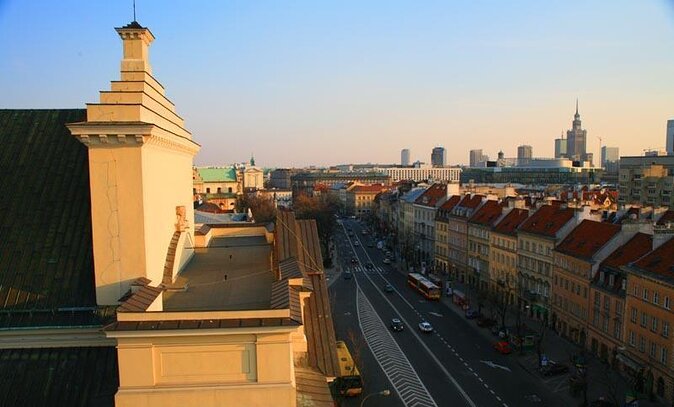
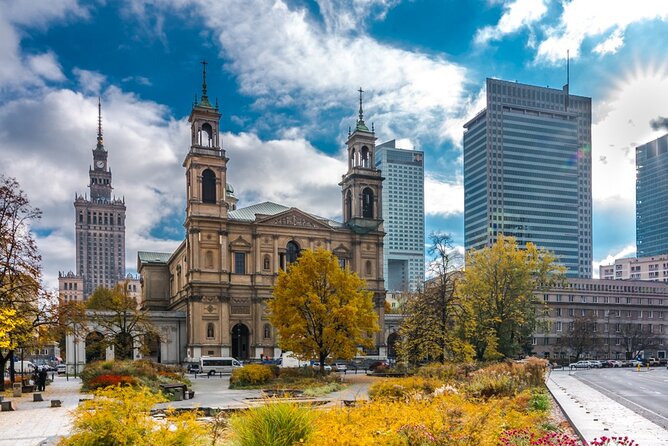
The final stop on this option is the Palace of Culture and Science, Poland’s tallest building. The viewing terrace provides a broad look over Warsaw. It is a fitting change of angle after so much street-level history, though the tour details do not specify how long you spend at the terrace.
Same country, a completely different kind of day:
- Warsaw: Chopin Concert in the Old Town
★ 4.8 · 2,287 reviews - Warsaw: Traditional Galar Cruise on The Vistula River
★ 4.6 · 1,640 reviews - Warsaw Concert: Chopin – Painted by Candlelights with Wine
★ 4.8 · 1,442 reviews - Warsaw: City Sightseeing Hop-On Hop-Off Bus Tour
★ 3.6 · 1,415 reviews
What the Palace of Culture adds
The Palace of Culture and Science is one of Warsaw’s defining communist-era buildings. Its scale and style are hard to miss, and its presence gives you a clear introduction to the period after World War II, when Poland was under communist rule.
Seeing the city from above helps you understand its patchwork of old, reconstructed, and modern districts. You can compare the low Old Town with the larger central city and see why Warsaw feels different from many other European capitals.
I would choose the five-hour option if your main goal is context. It includes enough walking to orient you, enough time for the major sights, and a serious look at the wartime district. It also leaves you part of the day for a museum or an independent visit.
One practical tip comes from the experience of a past participant who received help buying a weekend public transport pass. A 48-hour weekend pass was reported at 24 Polish zloty, a little over $6 at the time. Prices can change, but asking your guide about ticket options could save time later.
The seven-hour route reaches Łazienki Park
The seven-hour version adds about two hours in Łazienki Royal Park. This is the prettiest and most restful part of the route, but it also makes the day substantially longer.
Łazienki is a royal park with gardens, historic buildings, and broad paths. You visit the monument to Frederic Chopin, the Palace on the Isle, the Old Orangery, and the Amphitheatre. These stops shift the mood from war and occupation to royal taste, music, architecture, and outdoor space.
The Palace on the Isle is the park’s signature building. The Old Orangery and Amphitheatre add variety, so the park section is not just a walk among trees. You see several historic structures while your guide explains the royal setting and the people connected with it.
I like this addition for visitors who want a fuller picture of Warsaw. The city is not only its wartime memorials and reconstructed Old Town. Łazienki shows a more refined side of the capital and gives your feet a different kind of work after several hours on city streets.
Still, seven hours is a lot. One three-star assessment found that the day felt stretched and that much of the same information could have fit into five hours. That is a fair warning. The seven-hour option works best when you want a full orientation in one day, have limited time in Warsaw, or strongly prefer a private guide over independent exploring.
Private guiding, group size, and the human factor
The tour is private for your group, with a maximum of 10 people. That is a major difference from a large scheduled walk. You can ask about Polish history, local food, museums, or practical transport without waiting for a crowd to move along.
The named guides praised most warmly are Kasia, Kate, and Margret. Kasia was singled out for linking the city and former Ghetto in a way that made the geography easier to understand. Kate was praised for taking a small group to important and interesting places at a comfortable pace.
Margret was also credited with useful suggestions for local events, sights, and restaurants. If the booking system allows a guide request, asking for one of these names is sensible, but availability is not guaranteed.
The official language is English. Other languages may be possible if requested ahead of time and available. Since the walking pace and amount of explanation can shape the day, it is worth stating your interests when arranging the tour.
Most people can take part, but remember that the experience covers several hours on foot. The route can change based on your preferred starting and ending points. You may begin at Sigismund’s Column or arrange another city meeting point, and the finish can also be adjusted.
Is $338.47 good value for your group?
The listed price is $338.47 per group of up to 10 people, not per person. For a full group, that works out to about $34 per person. For two people, it is roughly $169 each, so the value changes sharply with group size.
For a family or group of friends, the private format can be good value. You are paying for a dedicated guide, flexible questions, and a route that covers major sights without the limits of a large public group. The five-hour option offers the strongest balance between coverage and cost.
For a solo visitor or couple, the price is harder to justify unless you place a high value on private attention. The three-hour version reduces the time commitment, but it does not change the basic group price.
The price does not include public transportation. Ask about the expected bus or tram transfer before setting out and have a ticket plan ready. A surprise request to pay for an underground or subway ticket was a frustration on one seven-hour outing, so this is worth clarifying at the start.
The tour has a 4.9 rating from 22 ratings, with 95 percent recommending it. That points to a strong record, but the small number means you should still match the option to your own pace and interests.
How to choose three, five, or seven hours
Choose three hours if you are in Warsaw for a short stay, want the Old Town explained properly, or plan to spend the afternoon in museums. You will see Castle Square, the Market Square, key churches and monuments, Krakowskie Przedmieście, and the central historic streets.
Choose five hours if you want the most useful first-day overview. The former Jewish Ghetto adds essential wartime context, while the Palace of Culture and Science gives you a look at communist Warsaw and a city view. This is my pick for most first-time visitors.
Choose seven hours if Łazienki Park matters to you or you want one guide-led day covering royal, wartime, communist, and modern Warsaw. Be ready for a long day and make sure the itinerary is clearly planned, especially if transport is needed between sections.
Should you book the Warsaw private walking tour?
Book it if you are new to Warsaw and want the city’s major stories explained in one private outing. The five-hour choice is the safest recommendation: it covers the Old Town, Jewish Ghetto area, communist-era Palace of Culture, and the main central avenues without making the day feel endless.
Pick three hours for a compact introduction. Pick seven only if you have the stamina and genuinely want Łazienki Park included. The strongest reasons to book are the private guide, small maximum group, flexible route, and the chance to connect Warsaw’s rebuilt streets with its wartime and communist past.
If you prefer to set your own pace, dislike walking for hours, or want every transport cost settled in advance, you may be happier exploring independently. The tour is best used as a first-day framework, then you can return to the museums, memorials, and neighborhoods that catch your interest.
FAQ
How long is the Warsaw private walking tour?
You can choose a three-hour, five-hour, or seven-hour version. The three-hour option focuses on the Old Town and central sights, while the longer choices add the former Jewish Ghetto, Palace of Culture and Science, and Łazienki Royal Park.
Where does the tour begin?
The usual meeting point is Castle Square, at Plac Zamkowy in Warsaw. The starting point may also be changed to another place in the city by arrangement.
What is included in the price?
The price includes a private guide and the walking tour in the selected three-, five-, or seven-hour format. Public transportation is not included.
Is the tour private?
Yes. The activity is for your own group, with a maximum of 10 people.
Is the tour offered in English?
Yes. English is the listed language. Other languages may be possible with advance notice and subject to availability.
Can I cancel the tour for a full refund?
You can cancel for a full refund if you do so at least 24 hours before the experience start time. Cancellations or changes made less than 24 hours before the start time are not accepted for a refund.
Just added around Warsaw
- World War II Warsaw Old Town, Military Cemetery Walking Tour★ 4.7 · 3 reviews
- Warsaw: Wolf’s Lair & Swieta Lipka Small-Group Tour + Lunch★ 5.0 · 3 reviews
- Wilanów Palace: 2-Hour Guided Tour with Entrance Tickets★ 4.8 · 8 reviews
- Warsaw Zoo Skip-the-Line Entry Ticket with Private Transport★ 4.8 · 3 reviews
- Warsaw Wolf’s Lair with St. Lipka and Mamerki Private Guided★ 4.2 · 3 reviews
- Warsaw: Vistula River Cruise with Your Music & City Views★ 4.6 · 78 reviews
- Warsaw: Private Vodka Tasting Night with Snacks and Pickup★ 5.0 · 7 reviews
- Warsaw Private Wilanow Palace & Garden Tour★ 4.6 · 30 reviews
Walking Tours, compared.
Gdańsk City Sights & History Guided Walking Tour in English
Read our review →
Browse the lists this tour appears in