
Reviewed · OLD TOWN WALKING TOURS
Gdańsk Old Town Private Walking Tour with Legends and Facts
Gdańsk’s story comes in layers: medieval trade, grand rebuilt streets, wartime destruction, and the Solidarity movement that helped change Poland. This private walk links those chapters in one day, beginning at the Upland Gate and ending with the city’s most important modern history.
I like the one-to-one format, since you can stop to ask about Hanseatic trade, Polish politics, architecture, or local legends without waiting for a large group. I also like the flexible pace. Guides such as Marek, Thomas, Marta, Kaja, and Elwira have adjusted routes, added local tips, and helped groups fit in special sights such as St. Mary’s clock show.
The main consideration is that the tour can mean very different things at two hours and at six. The shorter walk stays close to the Old Town highlights, while the longest version adds St. Bridget’s Church, the shipyard memorial, the European Solidarity Centre, and the river islands. Confirm your planned route before booking.
Key points to know before you book
- Start at the Upland Gate: Meet at Wały Jagiellońskie 2A, the historic entrance to the medieval city.
- Choose your depth: Routes last about two to six hours, with longer options covering Solidarity sites and the Motława islands.
- Expect a private guide: Only your group takes part, so questions, photo stops, and pace changes are easier to manage.
- See Gdańsk’s best-known sights: The Town Hall, Artus Court, Neptune’s Fountain, St. Mary’s Basilica, the Green Gate, and the Great Armoury all fit into the central route.
- Add modern Polish history: St. Bridget’s Church and the European Solidarity Centre give the tour more weight than a standard architectural walk.
- Watch the meeting details: Pickup is available only within 1.5 kilometers of the meeting point in Gdańsk Old Town.
Starting at the Upland Gate
The tour begins at Brama Wyżynna, or the Upland Gate, at Wały Jagiellońskie 2A. This is a useful place to begin because it marks the entrance to the historic city and gives your guide a natural starting point for explaining Gdańsk’s walls, power, and trade.
You spend about 10 minutes here. There is no admission charge, and the stop is mostly about orientation rather than an extended visit. If you arrive early, use the time to check your meeting point carefully. The pickup offer applies only to accommodations within 1.5 kilometers of this location, and the route may change if your lodging falls outside that area.
A private start also helps if your group has special interests. You can tell the guide at the outset if you care most about medieval merchants, the Teutonic Knights, the Hanseatic League, architecture, Solidarity, or local food advice. Joanna, for example, has shaped a walk around Hanseatic and Teutonic themes, while other guides have added restaurant, bar, amber, and beer-tasting suggestions.
More Old Town Walking Tours in Gdansk
- Gdańsk: Sightseeing EcoCruise around the Old Town of Gdansk
★ 4.6 · 719 reviews - Gdańsk: Old Town Private Walking Tour with Legends and Facts
★ 4.9 · 245 reviews - Gdansk Old Town 2-Hour Walking Tour
★ 4.5 · 94 reviews
Dluga Street and the Long Market
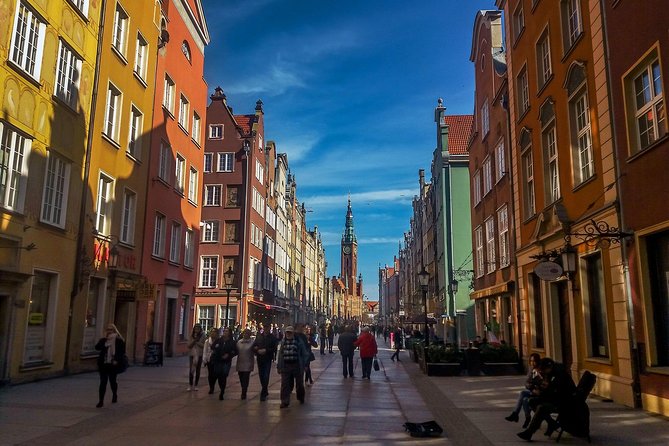
From the Upland Gate, the walk continues through the Golden Gate and along Dluga Street toward the Long Market. This is the visual heart of Gdańsk, lined with narrow facades, decorative details, and landmarks that make the city so easy to recognize.
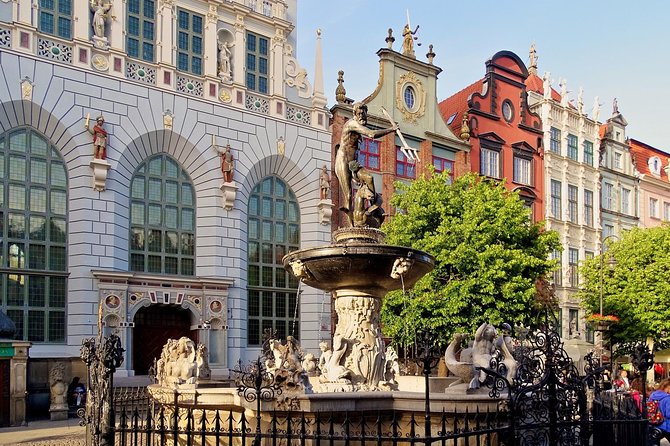
Allow about an hour here. You will see the Gdańsk Town Hall, the Golden House, and Neptune’s Fountain, a 17th-century landmark with a strong place in the city’s identity. This is the section where a guide adds real value. A quick walk can leave you admiring the fronts without understanding who built them, why the street mattered, or how the city’s merchant wealth shaped its appearance.
The central route is also a good fit for first-time visitors who want an easy introduction without spending a full day on museums. You get a clear sense of the old city’s layout, then can return later to explore the Town Hall or nearby streets at your own pace.
The drawback is simple: this area is the most popular part of Gdańsk, so the walk can feel more polished and tourist-focused than the shipyard and residential districts. Ask your guide to point out the less obvious details rather than rushing from one famous facade to the next.
Artus Court and the merchant city
Artus Court, or Dwór Artusa, was once a meeting place for Gdańsk’s merchants. Today it forms part of the Gdańsk History Museum and presents local art and historical collections.
The planned stop lasts about 20 minutes. Admission is listed as included, but the time is short, so you should ask whether your version includes a full interior visit or mainly an explanation from the outside. This is one place where the length you choose matters. A two or three-hour walk may give you a useful introduction, while a longer route may allow more time inside.
I especially like this stop for readers who want the city explained through trade rather than kings and battles. Gdańsk grew through its links to the Baltic and wider European commerce, and Artus Court gives that merchant world a physical setting.
The guides are also praised for connecting facts with stories. Thomas has mixed political history, architecture, and lighter details, while Michal has used old photographs to show how places looked before the city was rebuilt. That kind of visual comparison can make the past easier to grasp than a list of dates.
The Green Gate and Motława waterfront
The route then moves toward the Green Gate and the Motława River embankment, known as Długie Pobrzeże. This takes about 10 minutes, with the admission charge not included.
It is a short stop, but the river view helps explain Gdańsk as a port city. Look across the water and you will see the relationship between the historic center, waterfront trade, and the redeveloped areas on the opposite side. Your guide can also point out where the longer route continues toward the river islands.
This is a good place for photographs and a brief pause. It is not a substitute for a full waterfront walk, so if river scenery is a major reason for booking, choose an extended version. The route description includes the view, not a separate boat trip or a long riverside excursion.
Same country, a completely different kind of day:
- Gdansk: City Cruise on Historical Polish Boat
★ 4.8 · 2,913 reviews - Gdańsk: Sunset Cruise on a Historic Polish Boat
★ 4.9 · 977 reviews - Gdańsk City Sights & History Guided Walking Tour in English
★ 4.8 · 876 reviews - Gdansk: Firearm Shooting Experience with Instructor
★ 4.8 · 866 reviews
St. Mary’s Basilica and the Great Armoury
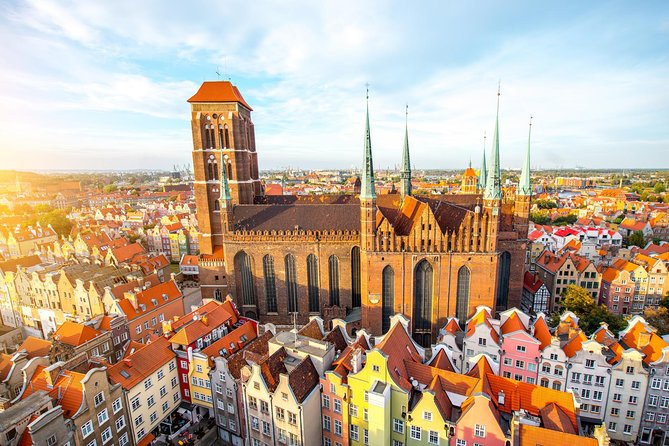
St. Mary’s Basilica is one of the largest brick churches in the world. Inside, the grand hall includes an ornate altar, an organ set, and a royal chapel. The planned visit lasts about 20 minutes, with free admission listed for the stop.
The church gives the tour a welcome change of pace. After the decorated merchant streets and waterfront, you enter a vast interior where scale matters more than facade detail. You may want to check with your guide about the timing of any special feature you hope to see. Margaret, one of the guides, has arranged the route so a group reached St. Mary’s in time for the clock show.
The central walk ends at the Great Armoury, a 17th-century Renaissance building and one of Gdańsk’s finest architectural examples. This ending works well for a shorter tour because it leaves you near several other sights and shopping streets.
Keep in mind that a 20-minute church stop is an introduction, not a long visit. If you want quiet time for the altar, organ, or chapel, tell your guide early. A private tour makes that request more practical than it would be in a fixed group.
Wyspa Spichrzów and the river islands
The longer route crosses into Wyspa Spichrzów, an island on the Motława that has been redeveloped while retaining old brick structures and warehouse ruins. The visit lasts about an hour and admission is included.
This is one of the more useful additions to the basic Old Town walk. The old warehouses connect directly to Gdańsk’s trading past, while the newer development shows how the waterfront has changed. You get a better feel for the city as a working port, not only as a row of handsome facades.
The extended route also reaches Ołowianka, where you can see the red-brick Baltic Symphony Hall. This section adds distance and variety, but it also makes the day more demanding. If you choose the full route, wear shoes suited to several hours on foot and allow enough time for questions, photographs, and short stops.
The island section is not essential if your time in Gdańsk is limited to one afternoon. It is worth adding if you have already seen the Long Market or if you want a broader look at the city beyond its best-known monuments.
St. Bridget’s Church and its Solidarity story
St. Bridget’s Church is a particularly strong stop for anyone interested in Poland’s modern political past. It served as a place of protection for Solidarity leaders during martial law, and one of its large doors shows scenes from the August 1980 strikes through the imposition of martial law in December 1981.
The visit is listed at two hours, which makes it one of the biggest additions to the extended route. The church also contains religious objects and a remarkable amber altar, made from the region’s most recognizable natural material.
This is where the tour’s title, legends and facts, earns its keep. You are not only looking at an old church. You are hearing how a religious space became tied to opposition, fear, courage, and the Solidarity movement. The amber altar adds a local art angle, while the door offers a direct visual link to recent history.
The stop may be too long for a group that wants only a quick introduction to Gdańsk’s architecture. For anyone drawn to 20th-century Poland, it is one of the most meaningful parts of the full route.
The shipyard memorial and European Solidarity Centre
The route can continue from the Old Town toward the Monument to the Fallen Shipyard Workers of 1970. The monument honors workers killed during anti-communist riots and provides a serious transition from old city streets to the modern history of Gdańsk.
The European Solidarity Centre follows, with about 30 minutes listed for the visit and admission included. Its modern museum explains the Solidarity strikes, the trade union movement, and the process that helped bring an end to communist government in Poland.
I would not treat this as a minor add-on. The museum is the best reason to choose the full route if you want to understand why Gdańsk matters beyond its architecture. The city’s past is not only medieval and Hanseatic. Its shipyards became a center of opposition, and the Solidarity movement reached far beyond Poland.
Thirty minutes gives you an introduction, but not enough time for every display. If the museum is your main goal, ask how much time the guide plans to allow. A private walk can explain the setting and key events, but you may want a separate return visit for a slower museum experience.
How the private format changes the walk
The private arrangement is the tour’s central advantage. Your group is the only group taking part, so you can ask direct questions, slow down for photographs, or move more quickly through a stop that matters less to you.
The guides have different strengths and personalities. Kaja has been praised for humor and careful preparation. Elwira and Elvyra have brought strong local history and personal insight. Marek has adjusted times, added unusual details, and recommended places to eat and drink. Marta has kept the main sights moving at a good pace, while Karina has focused on clear explanations and an entertaining approach.
Those names are useful examples, but you should not assume you can select a particular guide unless the booking process confirms it. The experience is offered in English, and there are also accounts of German, Italian, Danish, Norwegian, and French-language guiding, but confirm your needed language before paying.
Flexibility can also rescue a difficult day. One group arrived late after struggling with parking in rainy weather and still received a full walk because the guide waited. That should not be treated as a promise that any delay will be accepted, but it shows why direct communication matters.
Time, price, and practical value
The listed price is $107.89 per person. That is not the cheapest way to see Gdańsk’s center, but the value depends heavily on the length and size of your group.
For a couple booking a two-hour introduction, the cost pays for privacy, questions, and a focused route. For a family or staff group sharing one guide over four to six hours, the price may compare well with several separate tickets and a standard group excursion. Group discounts are available, so check the final rate for your party rather than judging the per-person figure alone.
The shorter route is best for first-time orientation. The longer route is better if you want the Old Town, river islands, St. Bridget’s Church, the shipyard memorial, and the European Solidarity Centre in one connected experience. Since the listed stops add up to several hours, ask for a clear time plan if you are booking a shorter version.
Pickup is offered only when your accommodation is within 1.5 kilometers of the meeting point in Gdańsk Old Town. Otherwise, meet at the Upland Gate. The activity ends back at the meeting point, and it is near public transportation.
Free cancellation is available until 24 hours before the start time. Changes made inside that window are not accepted, so check your schedule and meeting details the day before. Most people can take part, but remember that this is a walking tour lasting up to six hours on the extended route.
Who should book this Gdańsk walk?
I would choose this tour for a first visit when I wanted a guide to organize the city’s main stories quickly. It suits couples, families, school or work groups, and anyone who prefers asking questions instead of listening to a fixed speech.
It is especially good for people who want more than pretty buildings. The route can connect the Hanseatic trading city, Catholic landmarks, amber craft, the port, the shipyards, and Solidarity. That range gives you a stronger sense of Gdańsk as a living city.
I would be more cautious if you want a slow museum day or a very precise schedule. The full version covers a lot of ground, and a short version cannot give every major stop equal time. One poor experience also involved a late start, a meeting mix-up, weak English, and an unscheduled shop visit. That appears to be an exception among the supplied feedback, but it is a reminder to confirm pickup, language, and route details before the day begins.
Should you book it?
Book this private Gdańsk Old Town walk if you want a well-organized introduction with room for questions and the option to add Solidarity history. The strongest version is likely a three to four-hour route, long enough for the major center sights and at least one deeper historical stop without turning the day into a march.
Choose the extended option if the European Solidarity Centre, St. Bridget’s Church, and the shipyard memorial matter to you. Choose the shorter route if you mainly want the Town Hall, Artus Court, Neptune’s Fountain, St. Mary’s Basilica, and the riverfront.
Before booking, confirm the guide’s language, pickup location, exact duration, and which museums or interiors are included. Do that, and this becomes a practical way to get your bearings fast while hearing the stories that make Gdańsk more than a beautiful postcard city.
FAQ
Where does the Gdańsk Old Town tour begin?
The tour begins at the Upland Gate, also called Brama Wyżynna, at Wały Jagiellońskie 2A, 80-887 Gdańsk, Poland.
Where does the tour end?
The activity ends back at the meeting point.
How long does the walking tour last?
The tour lasts approximately two to six hours, depending on the route selected.
Is this a private tour?
Yes. Only your group participates in the private activity.
Is the tour offered in English?
Yes. English is listed as the language offered for this experience.
Is hotel pickup available?
Pickup is available only from accommodations in Gdańsk Old Town within 1.5 kilometers of the meeting point.
What happens if my accommodation is farther away?
If your accommodation does not meet the pickup distance, the tour itinerary may be changed. Otherwise, you meet the guide at the Upland Gate.
Are admission tickets included?
Admission is listed as free at the Upland Gate, Golden Gate and Long Market, Artus Court, St. Mary’s Basilica, and the shipyard workers monument. The extended route lists admission as included for Wyspa Spichrzów, St. Bridget’s Church, and the European Solidarity Centre. Admission at the Motława embankment is not included.
Can I ask the guide to adjust the pace or route?
The private format allows you to ask questions and discuss your interests with the guide. The supplied tour information also describes flexible routes and the ability to adapt the experience to the group.
What is the cancellation policy?
You can cancel up to 24 hours before the start time for a full refund. Cancellations or changes made less than 24 hours before the start time are not accepted for a refund.
More Walking Tours in Gdansk
- Main Town Gdańsk Walking Tour
★ 5.0 · 644 reviews - Discover Gdansk Walking Tour
★ 5.0 · 495 reviews - Gdansk Old Town Half-Day Private Walking Tour
★ 4.9 · 62 reviews - Nature Walk and Wildlife Tour in Sobieszewo Island
★ 5.0 · 13 reviews
Just added around Gdansk
- Private 2-Hour Tour with City Game in Gdańsk★ 5.0 · 15 reviews
- Malbork Castle regular tour★ 4.5 · 23 reviews
- Malbork Castle Tour from Gdansk★ 4.5 · 52 reviews
- Malbork Castle and Westerplatte Tour with Lunch★ 5.0 · 27 reviews
- Malbork Castle Regular Audioguided Tour★ 4.5 · 15 reviews
- Limo Party & Club Package in Gdansk★ 5.0 · 9 reviews
- Malbork Castle Private Tour from Gdansk★ 5.0 · 25 reviews
- Hevelius Treasure | Scavenger Hunt★ 5.0 · 76 reviews
Old Town Walking Tours, compared.

Bike Tour of Old Town, Jewish Quarter and the Ghetto
Read our review →


Sightseeing EcoCruise around the Old Town of Gdansk
Read our review →
Browse the lists this tour appears in