
Reviewed · OLD TOWN WALKING TOURS
Private Walking Tour of Gdansk Old Town
Gdansk reveals itself best on foot, where grand gates, brick churches, merchant houses, and the old harbor sit close together. This private walk follows the city’s ceremonial Royal Way and ends beside the Motlawa River, giving you a clear first look at Gdansk’s architecture and maritime past.
I like the private format, since your group can ask questions and set a comfortable pace. I also like the route itself: the Golden Gate, St. Mary’s Basilica, Neptune’s Fountain, and the Crane give you the city’s big sights without wasting time on transport.
The main consideration is the short length. Two hours is enough for an excellent introduction, but not enough for every museum or interior visit, and the advertised price is paid per group rather than per person.
Key points to know before you book
- A private group of up to 15: You do not share the guide with strangers, and your group can ask questions along the way.
- A carefully packed two-hour route: The walk links eight central sights, with no bus or car rides between them.
- The Royal Way is the backbone: You follow the route once used by Polish kings during visits to Gdansk.
- Brick architecture takes center stage: St. Mary’s Basilica and the Great Armoury show two very different sides of the city.
- The harbor finish adds variety: The Crane and Motlawa embankment shift the focus from city pageantry to trade and seafaring.
- English guiding and flexible cancellation: The tour is offered in English, with free cancellation up to 24 hours before the start.
Why a private walk works well in Gdansk

Gdansk’s central streets are made for walking. The major sights sit close enough that a vehicle would add hassle rather than save time, and several of the most useful viewpoints and street details are best understood at ground level.
A private guide also changes the feel of the visit. With a group limit of 15, you can stop to ask why a building looks Dutch, what a symbol means, or how Gdansk’s port shaped the city. The guide can explain the setting as you stand in it, rather than leaving you to read a plaque after the moment has passed.
The tour is offered in English. Names connected with guiding this route include Martin, Olga Libura, Michael Maj, Agnieszka Syroka, and Basia Lasota. Your assigned guide may differ, so do not book on the assumption that one particular person will lead your walk. Still, the guiding style described for this experience points toward history explained in a clear, friendly way rather than a string of dates.
A useful detail comes from the way the walk has been handled for some groups: the pace can be relaxed, and one group even added a coffee break and extended its time because the conversation was so engaging. That should not be treated as a guaranteed extra, but it tells you what to ask for if your schedule allows.
More Old Town Walking Tours in Gdansk
- Gdańsk: Sightseeing EcoCruise around the Old Town of Gdansk
★ 4.6 · 719 reviews - Gdańsk: Old Town Private Walking Tour with Legends and Facts
★ 4.9 · 245 reviews - Gdansk Old Town 2-Hour Walking Tour
★ 4.5 · 94 reviews
Starting at the Golden Gate
The meeting point is the Highland Gate, at Wały Jagiellońskie 2A. From there, the route reaches the Golden Gate, also called Langgasser Tor or Goldenes Tor, one of the city’s most important architectural entrances.
The gate is more than a photo stop. Designed by Abraham van den Block and built by Hans Strakowski, it carries inscriptions and allegorical sculptures that express the ideals once associated with the city and its citizens. A guide gives these figures a purpose, helping you see the gate as a civic statement rather than a decorated arch.
You have about 10 minutes here. That is enough for an explanation and photographs, though not a long architectural study. If you want a picture without feeling rushed, take it early, then listen. The guide’s context is the useful part.
Dutch Renaissance at the Great Armoury
The Great Armoury brings a different architectural mood. It is one of the most striking examples of Dutch Renaissance design in Poland, with a grand exterior that helps define the view along Piwna Street and toward the Coal Market area.
The stop lasts about 10 minutes and admission is free. You will mainly appreciate the building from outside, so this part works well for a quick orientation to Gdansk’s merchant wealth and international connections.
I find this stop valuable because it prevents the walk from becoming a parade of only famous names. The Great Armoury may not be the first building you know, but its form and scale show how much civic pride went into the central streets.
Walking the Royal Way
The Royal Way receives about 20 minutes, making it one of the longer stops. This was the route used by Polish kings during periodic visits to Gdansk, and it ties several major sights into one ceremonial sequence.
Walking here helps you understand the city’s old power structure. Streets were not just routes from one address to another. They were stages for royal arrivals, civic display, trade, and public identity.
This is also where a guide’s storytelling matters most. You can easily walk the route alone and notice the attractive façades, but a good explanation shows why the route was chosen and how the city presented itself to visiting rulers.
The term Old Town can be a little loose in tour descriptions, since this route includes sights associated with Gdansk’s Main Town. That is not a practical problem for your visit. The important point is that the walk covers the historic core and its best-known public spaces.
Same country, a completely different kind of day:
- Gdansk: City Cruise on Historical Polish Boat
★ 4.8 · 2,913 reviews - Gdańsk: Sunset Cruise on a Historic Polish Boat
★ 4.9 · 977 reviews - Gdańsk City Sights & History Guided Walking Tour in English
★ 4.8 · 876 reviews - Gdansk: Firearm Shooting Experience with Instructor
★ 4.8 · 866 reviews
Inside the scale of St. Mary’s Basilica
St. Mary’s Basilica gets about 15 minutes. The church is widely described as the largest brick church in the world, and its size is difficult to grasp from photographs alone.
Inside, the vault is supported by 37 windows, and the building contains more than 300 tombstones and 31 chapels. It can hold up to 25,000 people. Those numbers are useful, but the real effect comes from standing in a space built on such a huge scale.
The basilica also carries a modern political connection. During martial law in Poland from 1981 to 1983, members of the Solidarity movement sought refuge there. That link gives the building a role beyond medieval or religious history.
The scheduled time is enough for orientation and a look inside, but it is not a long church visit. If you want quiet time for every chapel or tombstone, you will need to return on your own. The tour’s value here is the explanation and the sense of scale.
Neptune’s Fountain and the Long Market
Neptune’s Fountain is allotted 15 minutes and sits on the Long Market, one of Gdansk’s most representative public spaces. The fountain stands in front of Artus Manor, making this a strong place to pause and take in the surrounding civic architecture.
Its creation was initiated by Mayor Bartłomiej Schachmann and the city council in 1633. Neptune is an apt figure for a port city whose wealth and identity were tied to waterborne trade.
This stop is likely to be one of the most memorable visually. The fountain gives you a clear symbol to photograph, while the guide can connect it to the buildings around the square. Look beyond Neptune himself. The surrounding façades and the relationship between fountain, street, and Artus Manor are part of the scene.
Because the area is one of Gdansk’s most representative spaces, it can feel like a busy part of the route. The private format helps somewhat, since you can stay with your own group instead of trying to keep track of a large crowd.
The Main Town Hall and its northern connections
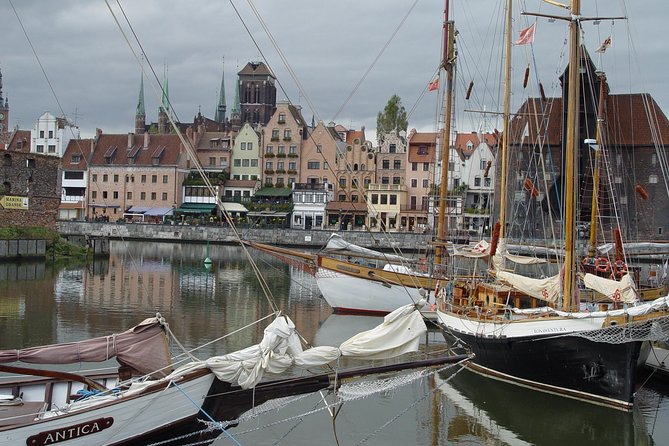
The Main City Hall receives about 15 minutes. This spectacular building once served as the seat of city authorities and contains architectural references to Gdansk’s multicultural past.
Its form and main decorative features resemble the Hanseatic House, or Osterlinghaus, in Bruges. That comparison gives you a useful reminder that Gdansk was connected to a wider northern European trading world. The city did not develop in isolation.
This is a good place to ask questions about who governed Gdansk and how local power worked. The building is not simply a pretty stop between the fountain and the river. It represents administration, civic ambition, and international ties.
Admission is listed as free for the stop, but the tour schedule does not promise a museum visit or extended interior access. Treat the stop as a guided look at the building and its setting unless your guide tells you otherwise.
The medieval Crane and Gdansk’s working harbor
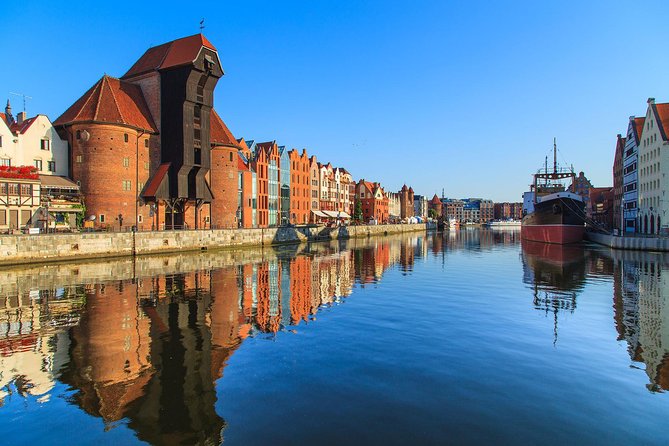
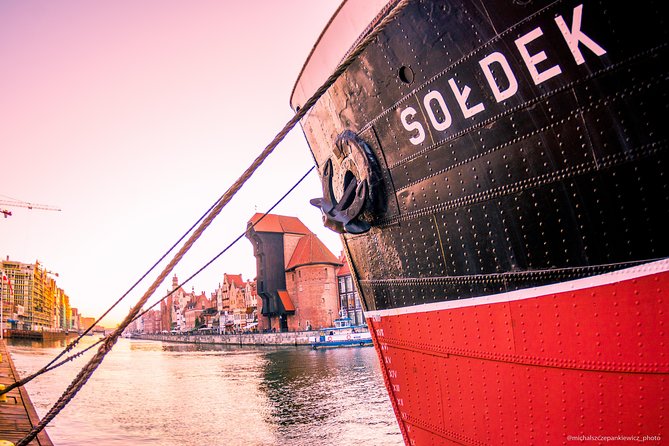
The Crane gets about 15 minutes. It is one of Gdansk’s best-known symbols, especially when the city’s seafaring past is the subject.
The structure was a former port crane, so it makes the old harbor easier to picture. Instead of seeing only elegant streets and ceremonial squares, you get a reminder that Gdansk was also a working commercial port where cargo had to be lifted, moved, and stored.
The Crane is a particularly good transition point. The tour shifts from royal processions and civic buildings toward the river and the practical business of trade. If you are interested in engineering, shipping, or the everyday labor behind a wealthy port, pay close attention here.
The stop is short, so ask your questions promptly. The private arrangement is useful because you can focus on the details that interest your group, rather than waiting through a general talk aimed at many different people.
Finishing beside the Motlawa River
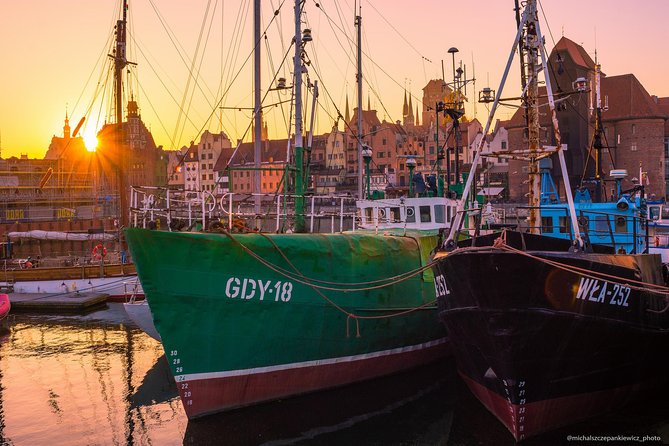
The final 20 minutes take you along the Motlawa River embankment, known as Dlugie Pobrzeze. This was Gdansk’s historic harbor, and it provides the tour’s broadest sense of place.
The embankment is where the city’s architecture and maritime story come together. You can connect the Crane with the river, then picture the port as a place of constant movement. The historical account associated with this site describes as many as 300 ships mooring here each day in the seventh century.
The waterfront is a fitting end because it lets you step back from individual buildings. After the Golden Gate, basilica, fountain, and town hall, you see why the port mattered so much to Gdansk’s growth.
The tour returns to the meeting point at the end. The route is outdoors, so wear shoes suited to a moderate amount of walking and check the weather before you set out. Children must be accompanied by an adult, and the stated requirement is a moderate level of physical fitness.
What the $159.70 group price really means
The price is $159.70 per group of up to 15 people. For one or two people, that is a fairly costly two-hour walk. For a larger family or group of friends, the arithmetic becomes much better, since the cost is divided among the group rather than charged separately to each person.
The private format is the main reason to consider the price. You are paying for a guide focused only on your party, a central route with eight major stops, and the chance to ask questions without competing with a large group.
For a cruise passenger with one day in Gdansk, the price can make sense if you want an efficient introduction and do not want to organize the route yourself. For a solo visitor on a tight budget, a shared walk or self-guided visit may offer better value.
The two-hour schedule also matters. You are not paying for a full-day program, museum admissions, or transport. You are paying for a compact orientation. If you understand that before booking, the price is easier to judge fairly.
Who will get the most from this walk
I would choose this tour for a family, small group, or cruise party that wants a private introduction to Gdansk without spending half a day inside museums. It also suits anyone who learns better through conversation than through guidebooks.
It is a strong first activity because the route covers the city’s key symbols in a logical order. Afterward, you will know where the Royal Way runs, where the main civic buildings are, and how to return to the riverfront or basilica on your own.
History fans should benefit from the range of subjects: royal visits, Renaissance architecture, church life, martial law, city government, and port trade. The guiding can also reach smaller details. One experienced guide was praised for explaining brick-making, a detail that later helped make sense of other buildings across Eastern Europe.
The walk is less suitable if you want long interior visits, extensive museum time, or a relaxed afternoon with many café stops. Two hours passes quickly across eight stops. You will see a lot, but you will not study every building in depth.
Practical details that affect your day
Your mobile ticket and booking confirmation make the meeting arrangement simple. Start at Highland Gate, Wały Jagiellońskie 2A, and remember that the activity ends back at the same meeting point.
The tour is offered in English. Since the activity is private, only your group participates. That makes it easier to keep children involved, ask for a slower pace, or spend a little longer on a subject that catches your attention, although the total time remains about two hours unless another arrangement is made.
The route is primarily outdoors and requires moderate physical fitness. Children need an accompanying adult. The tour information does not promise special accessibility arrangements, so contact the operator before booking if anyone in your party has mobility needs.
Free cancellation is available if you cancel at least 24 hours before the start time. Changes or cancellations made less than 24 hours before the local start time are not accepted for a refund.
Should you book this private Gdansk walk?
Book it if you want a focused first look at Gdansk, value a private guide, and have a group large enough to share the $159.70 cost. The route gives you the city’s major visual landmarks, but it also connects them to royal ceremony, civic power, religious life, and the working harbor.
I would be more cautious if you are traveling alone, watching every dollar, or hoping for a full museum tour. In that case, use the route as a map for a self-guided walk and spend your money on the interiors that matter most to you.
For most families, cruise passengers, and small groups, this is a sensible way to get oriented quickly. Just keep your expectations clear: it is a lively two-hour introduction, not a complete study of Gdansk.
FAQ
Where does the tour start?
The tour starts at Highland Gate, Wały Jagiellońskie 2A, 80-887 Gdańsk, Poland.
Where does the tour end?
The activity ends back at the meeting point.
How long does the walking tour last?
The tour lasts approximately two hours.
How many people can join the private tour?
The price covers one private group of up to 15 people.
Is the tour offered in English?
Yes. The experience is offered in English.
What sights are included?
The route includes the Golden Gate, Great Armoury, Royal Way, St. Mary’s Basilica, Neptune’s Fountain, Main Town Hall, the Crane, and the Motlawa River embankment.
Do I need to be physically fit?
A moderate level of physical fitness is recommended because this is a walking tour.
Can I cancel for a full refund?
Yes, if you cancel at least 24 hours before the experience start time. Cancellations or changes made less than 24 hours before the local start time are not accepted for a refund.
More Walking Tours in Gdansk
- Main Town Gdańsk Walking Tour
★ 5.0 · 644 reviews - Discover Gdansk Walking Tour
★ 5.0 · 495 reviews - Gdańsk Old Town Private Walking Tour with Legends and Facts
★ 5.0 · 65 reviews - Gdansk Old Town Half-Day Private Walking Tour
★ 4.9 · 62 reviews
Just added around Gdansk
- Gdansk, Gdynia, and Sopot: 8-Hour Private Sightseeing Tour★ 4.9 · 13 reviews
- Westerplatte private tour led by Expert-Guide (door to door)★ 5.0 · 5 reviews
- Whisky Tasting in Gdańsk★ 5.0 · 3 reviews
- Gdansk EVERYDAY Vodka Tasting Tour★ 5.0 · 6 reviews
- Westerplatte – 2h private trip by luxury car|★ 5.0 · 4 reviews
- Private WW2 Tour of Westerplatte,Gdansk and Stutthof Including Lunch★ 5.0 · 12 reviews
- Torun – City of Copernicus Private Tour★ 4.5 · 5 reviews
- Undercover City Games: Gdynia★ 5.0 · 34 reviews
Old Town Walking Tours, compared.


Bike Tour of Old Town, Jewish Quarter and the Ghetto
Read our review →


Sightseeing EcoCruise around the Old Town of Gdansk
Read our review →
Browse the lists this tour appears in