
Reviewed · HISTORICAL TOURS
Wroclaw: Third Reich and World War Two Historical Tour
Wroclaw’s wartime story is unusual because the city was German until 1945, then became part of Poland after the war. This two-hour historical walk connects that political change with the damage caused during the long siege from February to May 1945, when much of the city was destroyed.
I like the route for two clear reasons: it links major sights to real events, and it gives proper attention to the city’s Jewish heritage and Holocaust history. Guides such as Michal, also referred to as Mihael, are praised for detailed explanations and thoughtful answers. The main caution is simple: this is a walking tour, and there are few wartime buildings left to see because so much of Wroclaw was destroyed.
Key points to know before booking
- German Breslau becomes Polish Wroclaw: The tour explains the city’s change in identity at the end of World War Two.
- A serious two-hour walk: You begin outside Hotel Monopol and finish on Cathedral Island, with several central stops along the way.
- The former Gestapo building adds a direct connection: This is one of the clearest physical reminders of Nazi rule in the city.
- Jewish history is part of the main story: The White Stork Synagogue and Holocaust discussion give the tour a human focus.
- The guide is the heart of the experience: Michal and Mihael are noted for strong historical detail, clear communication, and useful book suggestions.
- The price is modest for a private-feeling history lesson: At $31 per person, the value depends largely on your interest in wartime history and your comfort with walking.
Why Wroclaw’s wartime story is different
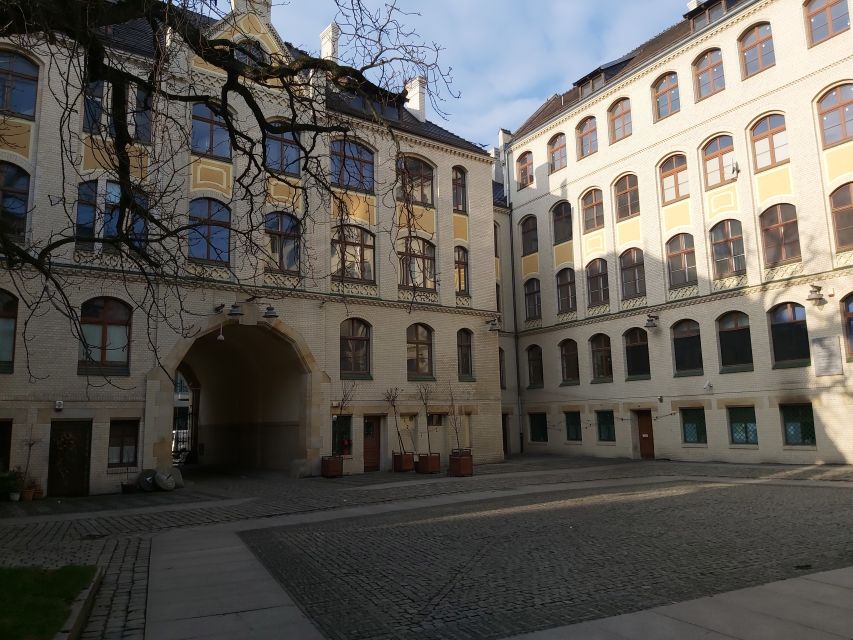
Before 1945, Wroclaw was known as Breslau and belonged to Germany. That fact can be easy to miss when you stroll through today’s Polish city, where the signs, language, and public life feel firmly tied to modern Poland.
This tour puts that change at the center. You learn how German rule shaped the city, how Nazi power affected local life, and how the end of the war brought a complete political and population shift. The result is not a simple story of one country replacing another. It is a lesson in how borders, governments, and ordinary lives can all be changed at once.
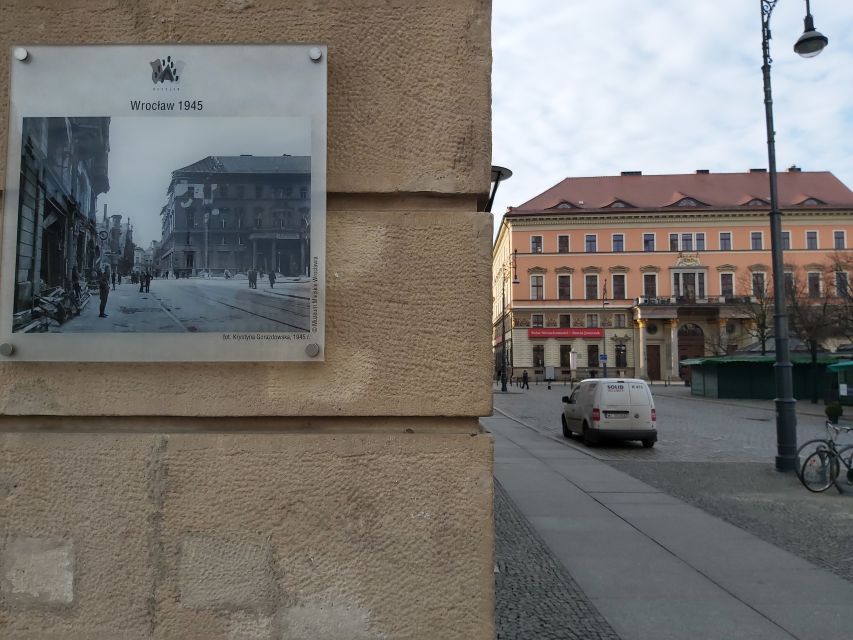
The siege from February through May 1945 is another key part of the walk. Wroclaw suffered heavy damage during the fighting, and many buildings were destroyed. That explains an important feature of the experience: you will often be standing in a rebuilt city rather than looking at untouched wartime streets.
I find that absence useful, though it can also be frustrating. You will not see a preserved war zone at every turn. Instead, the guide helps you read the modern city as a place rebuilt after ruin. The tour works best when you are willing to imagine what stood in these spaces before 1945.
A few more Wroclaw trips to weigh up
- Best of Wroclaw 3-Hour History and Culture Walking Tour
★ 4.9 · 49 reviews - Wroclaw: Private Tour by smal Historic Tram (1,5h, 16 seats)
★ 4.8 · 24 reviews - UNESCO World Heritage-listed Church of Peace Day Tour from Wroclaw
★ 4.5 · 14 reviews
Starting at Hotel Monopol and entering the Old Town
The meeting point is outside the main entrance of Hotel Monopol. Your guide carries a sign marked World War Two Tour, so finding the group should be straightforward.
From there, the walk moves into Wroclaw’s Old Town. This is a practical starting place because it quickly introduces the city’s older civic and religious center before the tour turns toward wartime events. You get the broad story first, then the individual locations begin to make sense.
The guide sets out how Wroclaw’s past under German rule fits into the wider events of World War Two. That opening matters. Without it, the former Gestapo building, synagogue, memorials, and churches could feel like disconnected points on a map.
The route is guided in English. You should expect a spoken history lesson while walking through public streets, not a museum tour with long indoor visits. Monument opening times can change, and the supplied details do not promise entry into every building. The value is mainly in the guide’s explanation of what you are seeing.
The former Gestapo building and the weight of Nazi rule
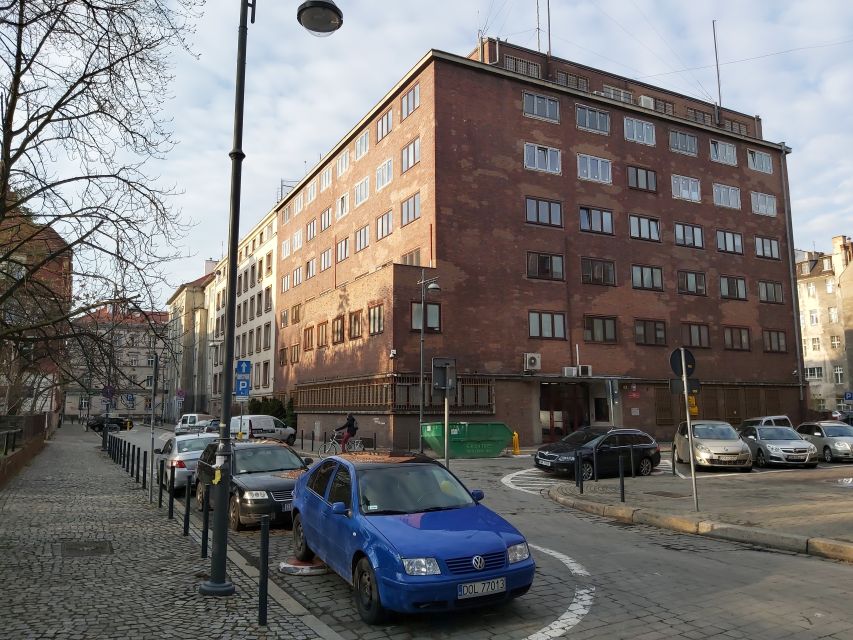
The former Gestapo building is one of the most direct stops on the route. It gives the discussion of German wartime control a fixed location rather than leaving it as a broad political subject.
A stop here can help you understand how Nazi authority operated locally. The point is not just that the building existed, but that it connects the city’s streets with surveillance, repression, and the machinery of occupation. Your guide supplies the context, since the exterior alone cannot explain everything that happened there.
This is also where a good guide makes a real difference. A strong explanation can help you see why an ordinary-looking building matters. Michal and Mihael are praised for giving detailed information, answering questions, and using clear examples. One guide also offered suggestions for books and further reading, which is useful if you want to continue studying Wroclaw after the walk.
Do not expect a dramatic ruin or a large museum display at this stop. The building is valuable because of its association and location. If you want a tour filled with preserved interiors, this may feel limited. If you want the historical meaning of the site explained carefully, it is one of the route’s most important moments.
Wolności Square and the city’s wartime scars
Wolności Square adds a wider view of Wroclaw’s destruction and rebuilding. Open urban spaces can be especially effective on a history walk because the guide can explain how the area changed without forcing you through a narrow museum sequence.
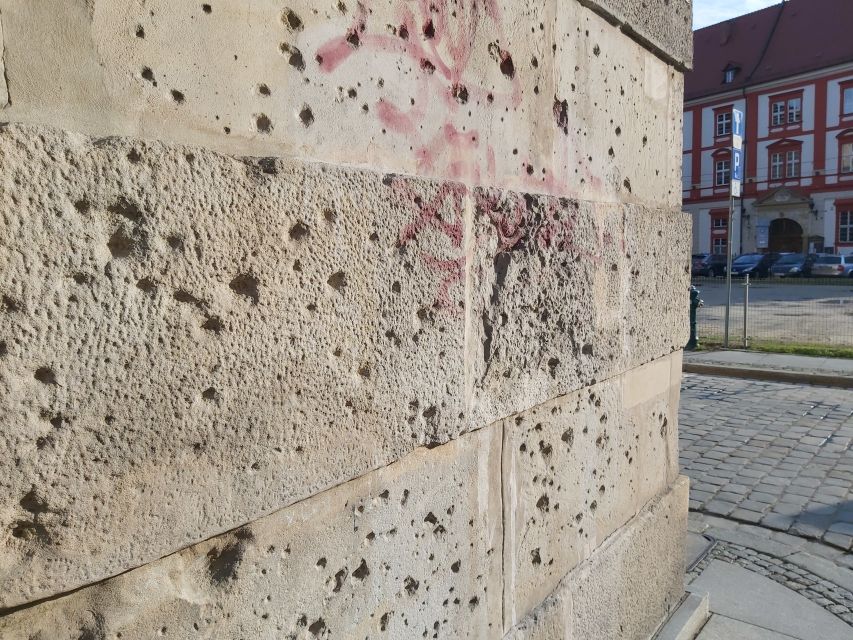
The siege lasted from February to May 1945, and the city suffered severe damage. Much of what you see today was rebuilt or repaired after the fighting. The square therefore becomes part of a larger lesson: modern Wroclaw is not simply an old German city preserved under a Polish name. It is a postwar city shaped by destruction, reconstruction, and a new national identity.
You may find that this part of the route requires more imagination than sightseeing. The tour does not promise a large collection of intact wartime structures. One practical way to get more from it is to listen for the guide’s descriptions of what disappeared, not only what remains.
The walk is described as rain or shine. In good weather, an open square gives you room to pause and listen. In snow or heavy rain, it can be harder to stay comfortable and absorb a long explanation. A January participant specifically found snowy conditions made the route less enjoyable, so check the forecast and dress for outdoor walking.
Same country, a completely different kind of day:
- Wroclaw: E-Car Tour and Audio Guide
★ 4.6 · 1,738 reviews - Wroclaw: 2-Hour Private Guided Tour by Electric Car
★ 4.8 · 805 reviews - Wrocław: Old Town and Ostrów Tumski Walking Tour in English
★ 4.8 · 311 reviews - Wroclaw: Private Old Town Guided Walking Tour (2 hours)
★ 4.8 · 275 reviews
White Stork Synagogue and Jewish Wroclaw
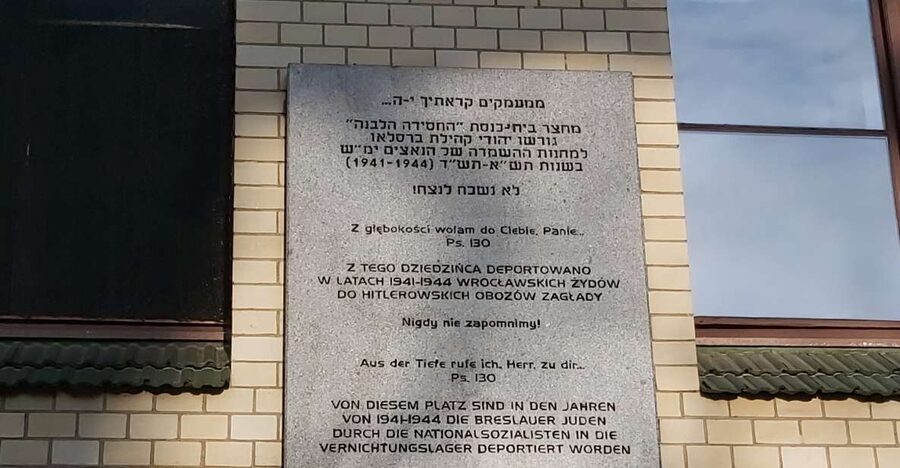
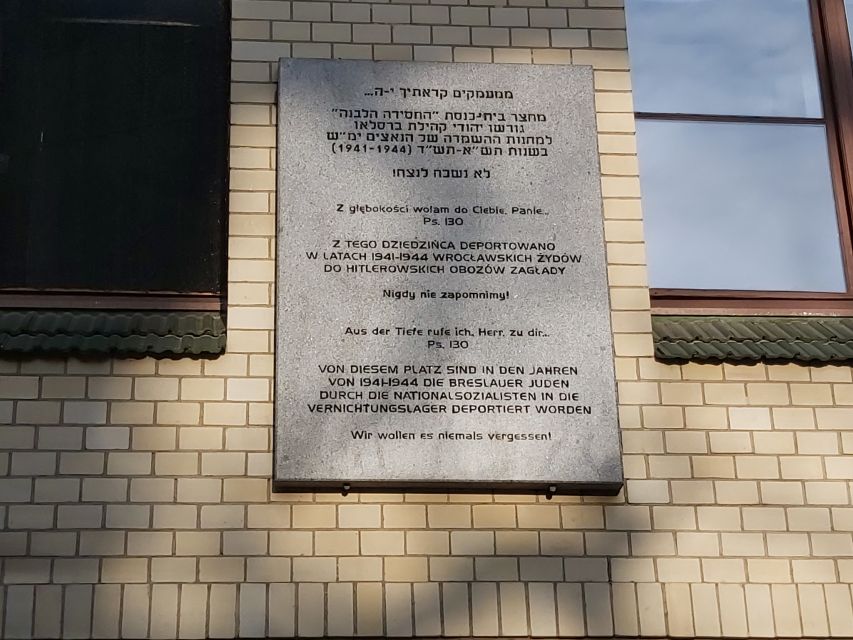
The White Stork Synagogue brings the city’s Jewish history into sharp focus. It is an important stop because the tour does not treat the Holocaust as a distant event that happened elsewhere. The guide connects Jewish life in Wroclaw with the broader story of Nazi rule and the destruction of Jewish communities during the war.
This part should appeal to you if you want more than military dates and battlefield movements. The synagogue gives the human side of the history a clear place in the city. You hear about a community that existed before the war, the persecution that followed, and the changes brought by the Holocaust and the postwar period.
The available details do not guarantee a visit inside the synagogue, and monument hours can change. Plan to treat it as a significant route stop rather than assuming an indoor tour. Even from outside, the location helps anchor the guide’s explanation.
I especially like this balance in the route. The former Gestapo building represents the state machinery of repression. The White Stork Synagogue points toward the people and community affected by it. Together, the two stops make the history less abstract.
The Dietrich Bonhoeffer Memorial and moral choices
The Dietrich Bonhoeffer Memorial adds another human and ethical angle. Bonhoeffer was a German theologian associated with resistance to Hitler, and the memorial gives the guide a way to discuss individual choices under dictatorship.
The stop is not presented as a complete lesson on Bonhoeffer’s life, so you should not book the tour expecting a specialist biography. Instead, it forms part of the wider question running through the walk: how did people respond when government power became violent and destructive?
That question can make the tour feel more personal. Dates and political changes matter, but a memorial invites you to think about courage, compromise, fear, and responsibility. The guide’s ability to answer questions is useful here, especially if you want to connect the site to wider German and Polish history.
University Church and the city’s layered identity
The University Church shows how Wroclaw’s religious and academic buildings fit into the city’s changing story. Religious sites often carry several identities at once, and this stop gives your guide another setting for discussing the city before, during, and after the war.
As with the other monuments, opening hours can change. The tour information does not promise a full interior visit, so you should be prepared to hear the explanation from the street or nearby public space.
That is not necessarily a weakness. A two-hour route has to keep moving, and the outdoor format lets you cover more ground. You get several pieces of the city rather than spending the entire time inside one building. The tradeoff is that the experience depends heavily on the guide’s storytelling.
Ossolineum Garden, Sand Island, and the walk east
The Ossolineum Garden offers a quieter setting after the heavier wartime stops. It helps show that Wroclaw’s history is not confined to official government buildings and memorials. Gardens, churches, riverside areas, and university spaces all form part of the city you are trying to understand.
The walk then continues toward Sand Island and Cathedral Island. These stops broaden the tour beyond the central Old Town and bring you toward one of Wroclaw’s best-known historic areas.
The route’s movement matters. You are not simply returning to the starting point after a short loop. You finish at Cathedral Island, which gives the tour a clear endpoint and takes you through several parts of central Wroclaw. You should allow for a steady amount of walking, even though the total duration is only two hours.
One participant described the route as involving a fair bit of walking, while also noting that the guide allowed time for explanations. That is a good picture of the pace. You will not be sprinting from one marker to the next, but you should wear comfortable shoes and be ready to remain outdoors.
Cathedral Island as the final stop
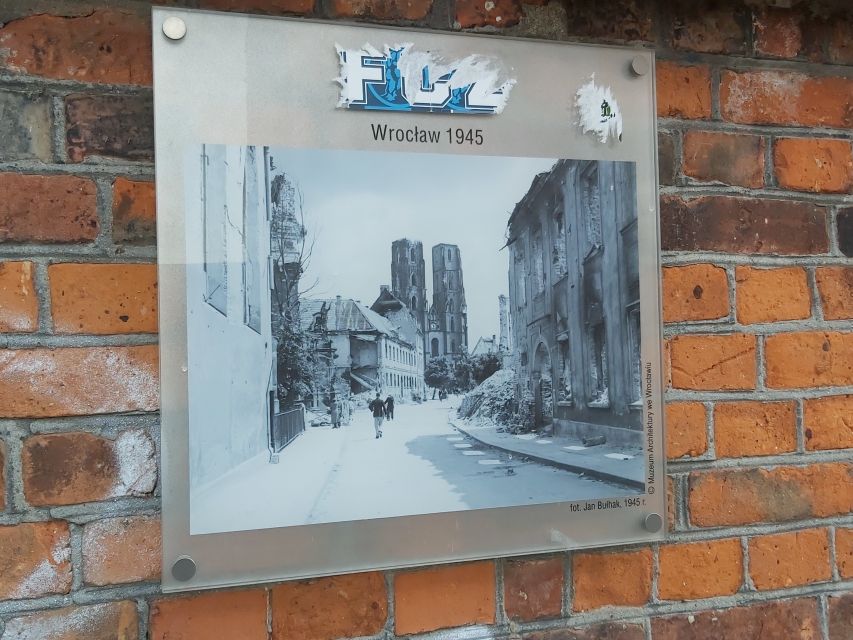
Cathedral Island, or Ostrów Tumski, is the finishing point. The island is one of the city’s major historic areas, so ending here gives the walk a strong sense of place rather than dropping you back at the hotel.
By this point, the guide has moved from German rule and Nazi repression to Jewish history, wartime destruction, and postwar change. Cathedral Island helps close that arc by placing you in a part of Wroclaw that carries a much longer story than the years of World War Two alone.
The endpoint is also practical. You can continue exploring from here, but the tour does not include hotel drop-off. Food and drinks are not included either, so plan your next stop independently.
How strong is the guiding?
The guide is the main reason to choose this activity. Several names connected with the tour are Michal and Mihael, and the strongest praise focuses on preparation, communication, detail, and the ability to answer questions.
That matters because wartime Wroclaw is complicated. The city was German, suffered under Nazi rule, endured a destructive siege, and then became Polish. A rushed or shallow explanation could easily leave you with a jumble of dates. A careful guide can show how each event led to the next.
The guide also appears to adjust the amount of explanation to the group. One person felt the guide gave plenty of time, though the experience could feel different with a larger group. The minimum operating requirement is four participants, but the maximum group size is not provided, so you should not assume a small private tour.
The tour is currently offered in English. One German-speaking participant said a German version would be welcome, but German is not listed as an available language. If English is not comfortable for you, the historical detail may be harder to follow.
Is $31 a fair price for two hours?
At $31 per person, this is a reasonable price if you value a focused history lesson and a licensed guide. You are paying for two hours of local interpretation, not for transport, meals, or admission to a museum.
The value is strongest for people who would otherwise walk through Wroclaw without knowing why the city looks the way it does. The route connects several central locations, and the guide gives them a shared meaning. You can continue exploring on your own afterward with a better sense of what was lost and rebuilt.
The value is weaker if you want a large number of preserved wartime buildings or indoor exhibits. Much of Wroclaw was destroyed during the 1945 siege, so the physical evidence is uneven. You are paying for explanation and context as much as for the sights themselves.
The tour has a 4.9 rating from 43 reviews, with repeated praise for the guide’s historical detail and engaging manner. The practical caution is that weather, group size, and your own interest in serious history will affect how much you get from the price.
Who should book this Wroclaw history walk?
I would recommend it to you if you want to understand the city’s German past, the Holocaust, and the postwar transformation in one compact outing. It is also a good choice if you prefer a guide who can answer questions rather than a recorded audio tour.
It suits visitors with a family connection to the former German territories, people studying World War Two, and anyone curious about how borders changed after 1945. The subject is serious, so it is not a light sightseeing stroll.
You should think twice if you have difficulty walking for two hours, though the activity is listed as wheelchair accessible. You should also be cautious if you dislike outdoor tours in poor weather. The route runs rain or shine, and snowy conditions can make the experience less comfortable.
Free cancellation is available up to 24 hours before the start, and you can reserve while paying later. Those terms give you some flexibility, but they do not change the basic decision: book this for the guide’s interpretation, not for a long list of intact wartime monuments.
FAQ
Where does the tour begin?
Meet your guide outside the main entrance of Hotel Monopol in Wroclaw. The guide will hold a sign saying World War Two Tour.
Where does the tour finish?
The walk finishes at Cathedral Island, also known as Ostrów Tumski, in Wroclaw.
How long does the tour last?
The guided walk lasts two hours.
What language is the tour offered in?
The live tour guide speaks English. German is not listed as an available tour language.
Is the tour wheelchair accessible?
Yes. The activity is listed as wheelchair accessible.
Does the tour operate in bad weather?
Yes. The tour takes place rain or shine.
What happens if there are too few participants?
The tour requires at least four participants to operate. Monument opening hours can also change, so access to particular sites is not guaranteed.
Should you book it?
Book this tour if you want Wroclaw’s streets explained through the difficult years of German rule, Nazi persecution, the Holocaust, the 1945 siege, and postwar rebuilding. The strong guiding, central route, and $31 price make it a sensible choice for history-minded visitors.
Skip it if you mainly want preserved ruins, long indoor visits, or a relaxed sightseeing walk with little serious discussion. Wroclaw’s wartime evidence is often missing because the city was so badly damaged. Here, the guide fills in those gaps, and that is exactly what you are paying for.
Just added around Wroclaw
- Wrocław: World War II and the non-existent city of Breslau★ 3.6 · 3 reviews
- Wrocław to Rock City in Adrspach and Project Riese day trip★ 5.0 · 5 reviews
- Wroclaw: WW2 Tour to Project Riese & Gross-Rosen Museum★ 4.8 · 26 reviews
- Wroclaw: University Baroque Tour★ 5.0 · 19 reviews
- Wroclaw : Walking Custom Tour with a Local Guide★ 4.8 · 3 reviews
- Wrocław: Tour of the Old Town in an Imperial E-car★ 4.3 · 13 reviews
- Wroclaw to Rock City in Adrspach and Ksiaz Castle day trip★ 4.9 · 16 reviews
- Wroclaw: 3-Hour Bike Tour in English or Polish★ 4.8 · 66 reviews
Historical Tours, compared.
POLIN Museum of the History of Polish Jews Ticket
Read our review →
Gdańsk City Sights & History Guided Walking Tour in English
Read our review →

Small-Group Historical Guided Tour of Warsaw with pick up/drop off. Public Tour.
Read our review →Browse the lists this tour appears in